Sri Sri Mahalakshmi Mandir, Kolkata: Where Visitors Say Mota Ganeshji
A cyclist blurs past on Rabindra Sarani in a visitor's photograph from 2018. Behind him, a small shrine opens straight onto the pavement, its altars lit, two men seated on the floor in front. A yellow board above reads Shri Shri Mahalakshmi Mandir in Devanagari, the script used for Hindi.
This is the Sri Sri Mahalakshmi Mandir, near Natun Bazar in Kolkata, West Bengal, dedicated to the goddess Mahalakshmi. Some visitors remember it by the figure beside her: Ganeshji, whom they call Mota Ganeshji. Very little about the shrine has been written down, so this article reads what there is to read: a road, a few photographs and what visitors say.
A shrine that faces the road
The front is open. From the pavement in that 2018 photograph you can see two lit altar bays, and a few people sit on the steps beside the entrance. Rails run through the asphalt, and one visitor places the shrine near the Ganesh Talkies tram line. Ganesh Talkies was a cinema on Rabindra Sarani, now demolished, says the Bengal Film Archive.
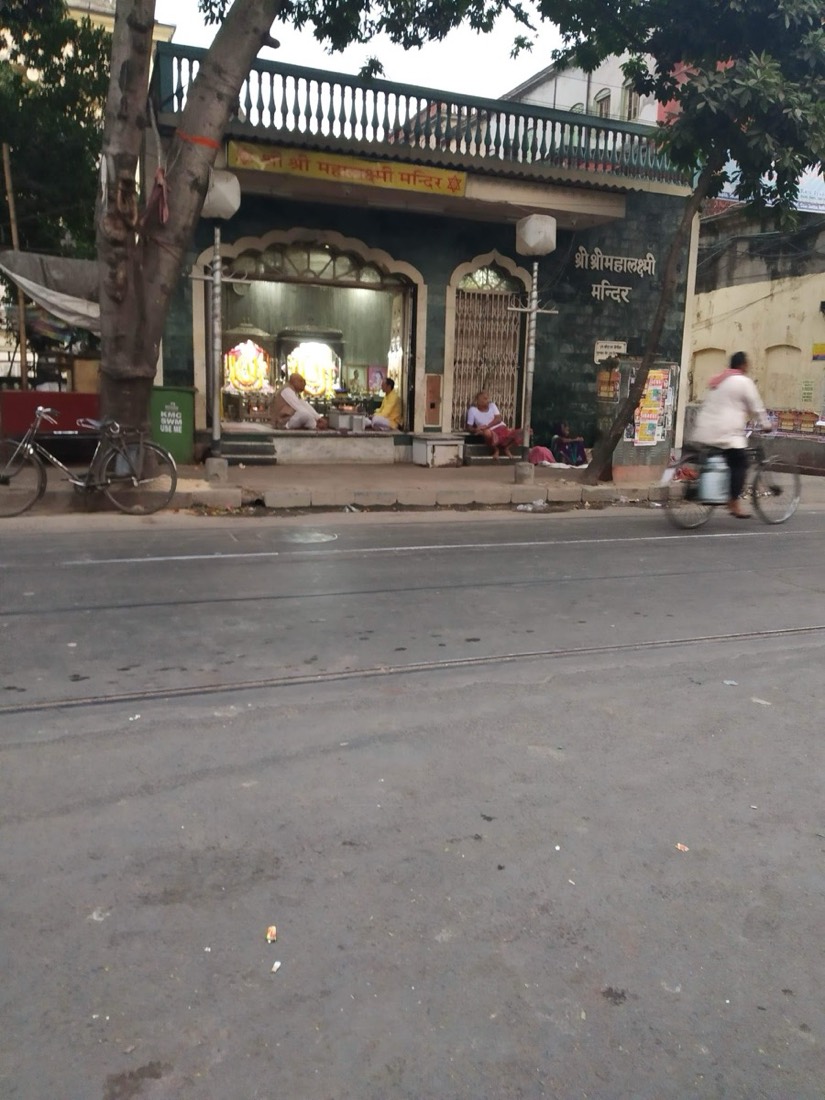
Rabindra Sarani has older names. Histories of the road call it Chitpur Road, and Wikipedia's account says East India Company maps marked it as a pilgrim path, the way devotees reached Kalighat. Nothing ties this shrine to that old traffic. The road is context, not evidence of the shrine's age.
Three bays and a wall of goddesses
A July 2021 photograph shows the inside. Three canopied bays stand side by side. Ganesha is in the middle one, red garlands looped across his image. A goddess image sits in the bay to his right, and visitors' comments say Mahalakshmi is seated beside him. At the left, a trident stands next to the third bay.
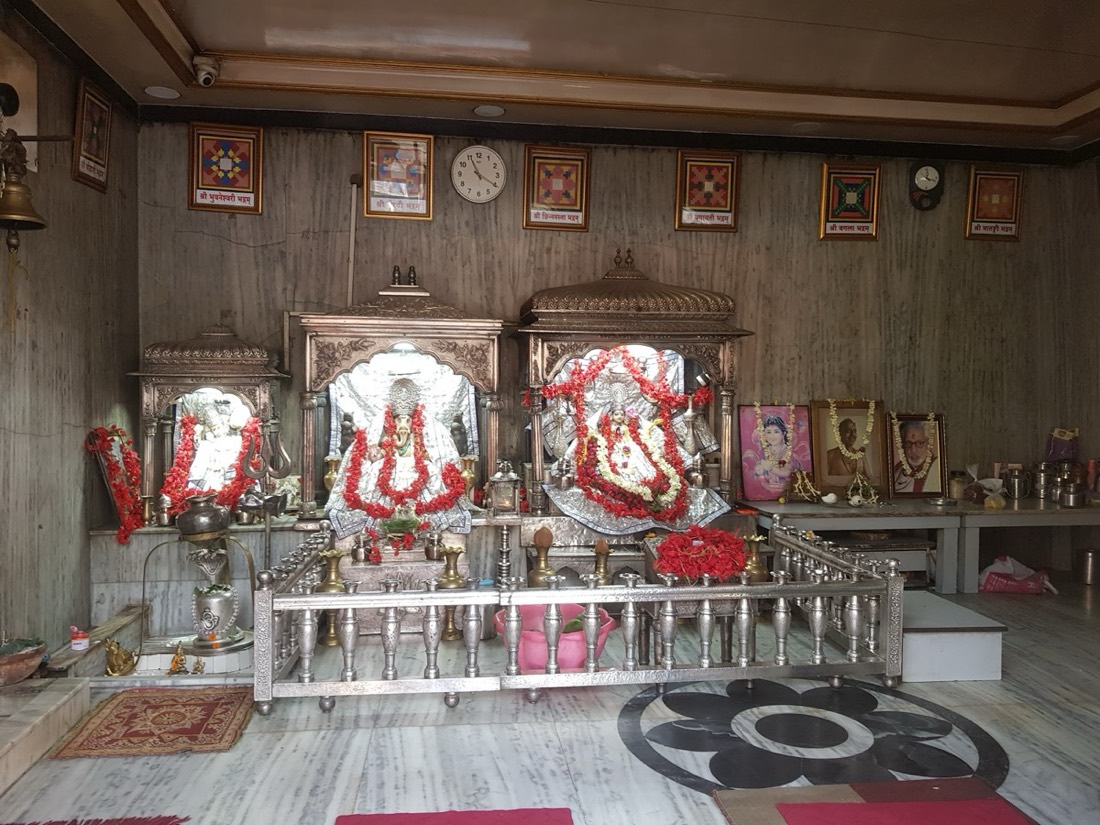
Along the wall above hang framed square panels, each labelled in Devanagari. As far as the photograph allows, four read Bhuvaneshvari, Chhinnamasta, Bagala and Matangi. All four are Mahavidyas, a group of ten Tantric goddesses whose tenth, Kamala, is sometimes described as a Tantric form of Lakshmi. No source read for this article says why the panels hang here or who placed them.
The goddess in her flowers
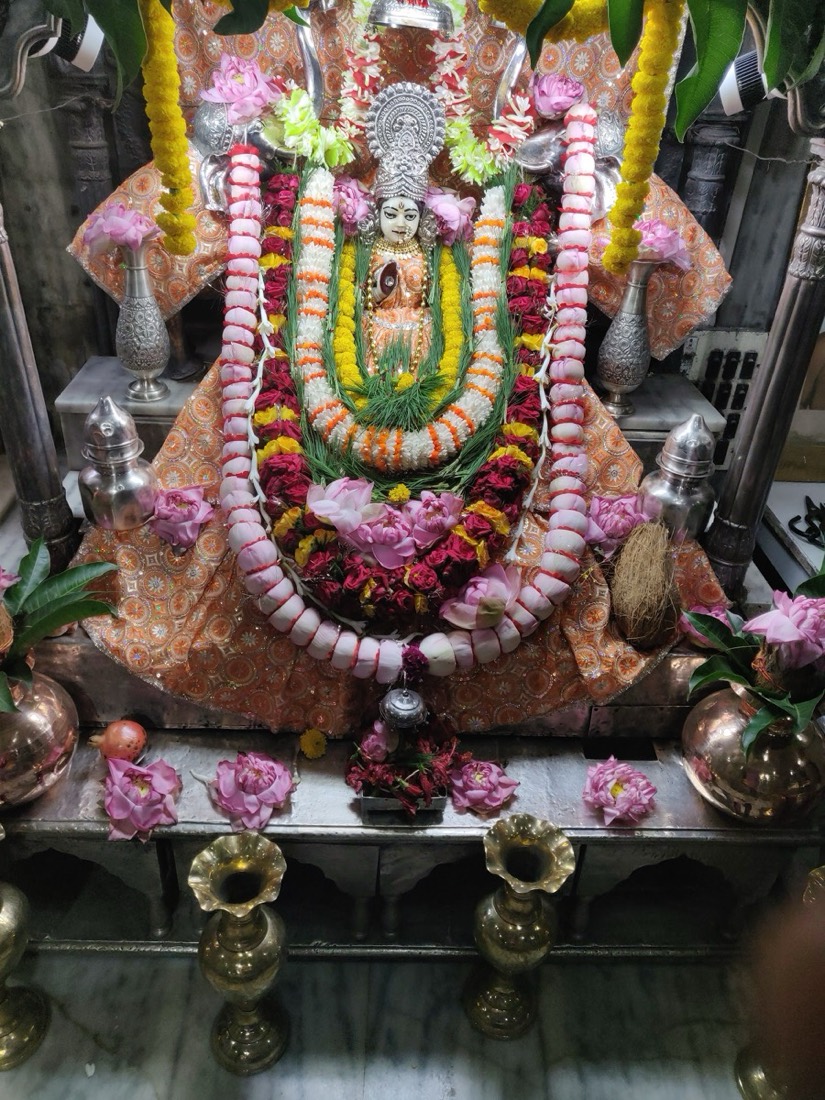
A September 2019 close-up shows a crowned goddess image in orange cloth, framed by white, red and marigold garlands, with pink lotus blooms at her base. No label names her, but the shrine's name and the comments about Mahalakshmi beside Ganeshji make her the likeliest reading. Visitors praise the shrine's decoration, and this is how one day's looked.
Why visitors say Mota Ganeshji
"Mota" is Hindi for big or plump, and "-ji" adds respect. At least two visitors use the name for the Ganesha here, and others simply call the place a Ganesh and Lakshmi temple. It is a nickname from comments, not a title on the signboard, and no temple record uses it.
The naming is split. The board gives the goddess, and visitors give her companion. The two are also paired in the festival most linked with Lakshmi: the Press Information Bureau calls the third day of Deepavali the Lakshmi-Ganesha Puja. That is a resemblance, not evidence that this shrine follows any particular Diwali ritual.
Devam, an app of temple and deity stories, is coming soon on the App Store and Google Play. If you enjoy finding the story behind a name, you can join the waitlist and hear when it opens.
A fortnight of Lakshmi nights
Kolkata keeps Lakshmi more than once in the season. In Bengali homes, Kojagari Lakshmi Puja falls on the full moon about a week after Durga Puja. Many households stay awake all night because, in the legend The Quint retells, Lakshmi goes around asking who is awake.
About a fortnight later comes the new moon of Diwali. The same report says North India's Lakshmi Puja falls on that night, while the PIB notes that in Bengal, Odisha and Assam Deepavali coincides with the worship of Kali.
Visitors' comments single out Diwali night at this shrine, with worshippers arriving from across Kolkata, and two name Marwari families among them. The comments are undated and unsigned, and no temple notice describes a Diwali programme. One way to read them: a Lakshmi and Ganesha shrine draws its crowd on the night when much of Bengal turns to Kali.
What nobody has written down
No founder, foundation year, origin story, managing body, daily timetable or Diwali schedule turned up. A few comments call the shrine old or famous; none gives a date. As of 4 November 2026 no official website, trust page or notice was found. Everything above rests on photographs from 2018 to 2021 and on undated comments, so it may not show the shrine as it is now.
Several comments place the shrine beside, or inside the premises of, the old Lohia Matri Seva Sadan building. A February 2026 Millennium Post report says that heritage building has been inaugurated as Charnock Lohia Hospital, and does not mention a shrine. How the two relate, and whether anything has changed, is unknown. The building's own history cannot stand in for the shrine's.
Finding the right Mahalakshmi in Kolkata
The listed address is Natun Bazar, Rabindra Sarani, Malapara, Ram Bagan, Kolkata 700006. A different Mahalakshmi temple stands at 70 Diamond Harbour Road in Kidderpore, and at least one comment on the listing site mixes the two up. For timings, dress or rules, ask at the shrine or look for a current notice; none turned up to quote here.
Questions people ask about Sri Sri Mahalakshmi Mandir
Is this the large Mahalakshmi Temple in Khidirpur (Kidderpore) on Diamond Harbour Road?
No. This shrine is on Rabindra Sarani near Natun Bazar, postcode 700006. The other is a separate temple at 70 Diamond Harbour Road in Kidderpore. At least one visitor comment on a listing site wrongly places this shrine on Diamond Harbour Road, so check the address before setting out.
When is Lakshmi Puja in Kolkata in 2026, and what time is the puja?
Lakshmi Puja on Diwali falls on Sunday, 8 November 2026. Drik Panchang, a panchang site, gives Kolkata's evening muhurat as 5:20 pm to 7:18 pm, inside a Pradosh Kaal of 4:56 to 7:29 pm. In Bengal the same night is also Kali Puja. Kojagari Lakshmi Puja, the worship in Bengali homes, comes earlier, on the full moon about a week after Durga Puja.
What are the shrine's timings, and when is it busiest?
No timetable has been published. As of 4 November 2026 no official website, trust page or notice was found. Visitors' comments single out Diwali night as the busiest time, with worshippers arriving from across Kolkata, but no temple notice gives a Diwali programme. Ask at the shrine or look for a notice there before you go.
Who is worshipped at the Sri Sri Mahalakshmi Mandir?
Mahalakshmi, named on the signboard, and Ganesha. Photographs show three bays, with Ganesha in the middle and a goddess image to his right, and visitors say Mahalakshmi sits beside Ganeshji. No deity list published by the temple was found, so this rests on photographs and visitor comments.
Who is Mota Ganeshji?
It is a nickname that at least two visitors use for the Ganesha at this shrine. "Mota" is Hindi for big or plump, and "-ji" adds respect. It is not on the signboard, and no temple record uses it.
Is Ganesha worshipped with Lakshmi on Diwali?
Yes. The Press Information Bureau calls the third day of Deepavali the Lakshmi-Ganesha Puja. Nothing published says whether this shrine follows a particular Diwali ritual.
How old is the shrine?
Nobody has published a date. No founder, foundation year, temple history or origin story has turned up. A few visitors call the shrine old, but none says how old. The documented history of the nearby hospital building belongs to that building, not to the shrine.
A board in Devanagari, a goddess in flowers
Rails in the asphalt, altars visible from the pavement, a goddess dressed in garlands and a plump Ganeshji beside her: the shrine keeps its small facts where passers-by can see them. If a founder's name or a foundation year exists, it has not reached any page that could be read. Until it does, this is a place to meet as its visitors do, by the sign and by the nickname.
If stories like this one appeal to you, Devam is gathering the stories of more than 1,000 Indian temples, with bhajans, mantras, aartis and quizzes beside them. It is coming soon on both the App Store and Google Play, and you can join the waitlist to hear when it opens.