Brihadeeswara Temple, Thanjavur: The People Named on Its Walls
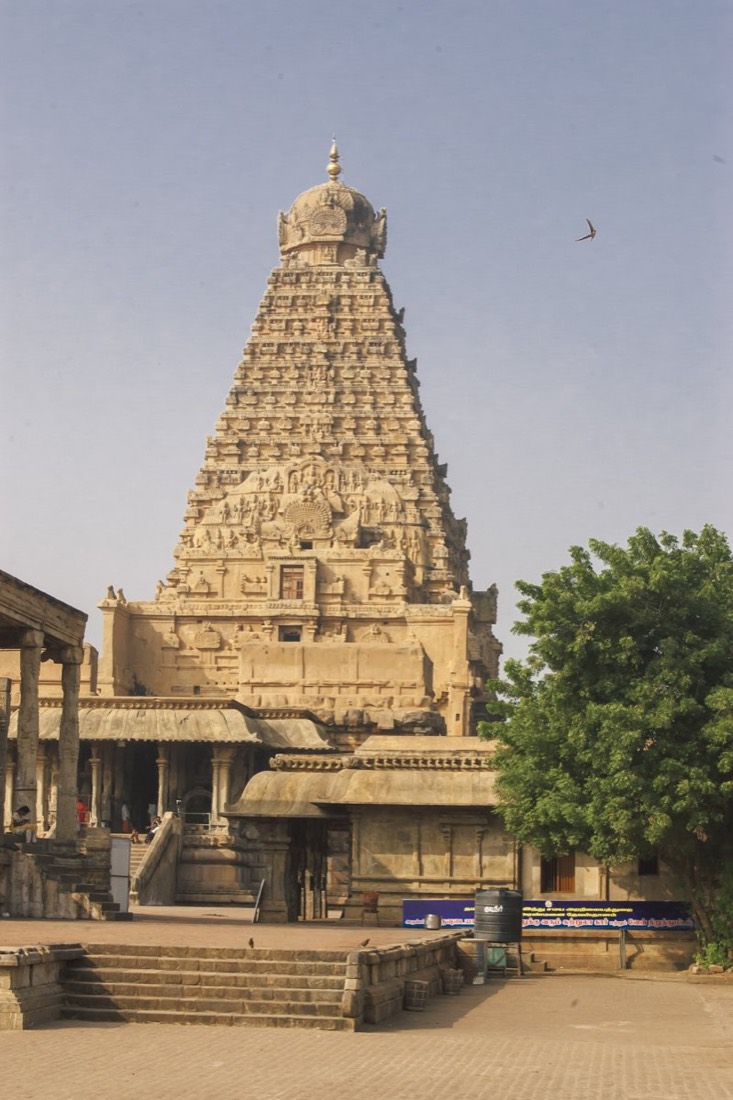
The Brihadeeswara Temple stands in Thanjavur, Tamil Nadu, and is dedicated to Shiva, who is worshipped there as a huge linga. Many call it the Big Temple. The stepped tower over the sanctum, the vimana, fills most photographs. The walls hold a quieter story. Orders cut into the stone name the women, reciters and drummers who served the temple, how they were supported and who would take over when they died or left. Inside, a dark passage holds paintings that were hidden under other paintings.
The state's tourism page credits the Chola king Rajaraja I with building it around 1010 CE. It calls the temple a UNESCO World Heritage Site and one of three Great Living Chola Temples. One of the other two, at Gangaikonda Cholapuram, is also called Brihadisvara but is a separate temple. The archaeologist P. S. Sriraman adds that the year work began is not recorded. The inscriptions call the temple Rajarajesvara, and the tourism page also gives its Tamil name, Peruvudaiyar Kovil.
A king speaks in the bathing hall
In the bathing hall of his Thanjavur palace, Rajaraja gives an order. It is the twentieth day of the twenty-sixth year of his reign. Every gift to the temple is to be engraved on the stone of the shrine: his own, his elder sister's, his wives' and other donors'. The edition of the inscriptions, by E. Hultzsch, identifies the sister as Kundavai.
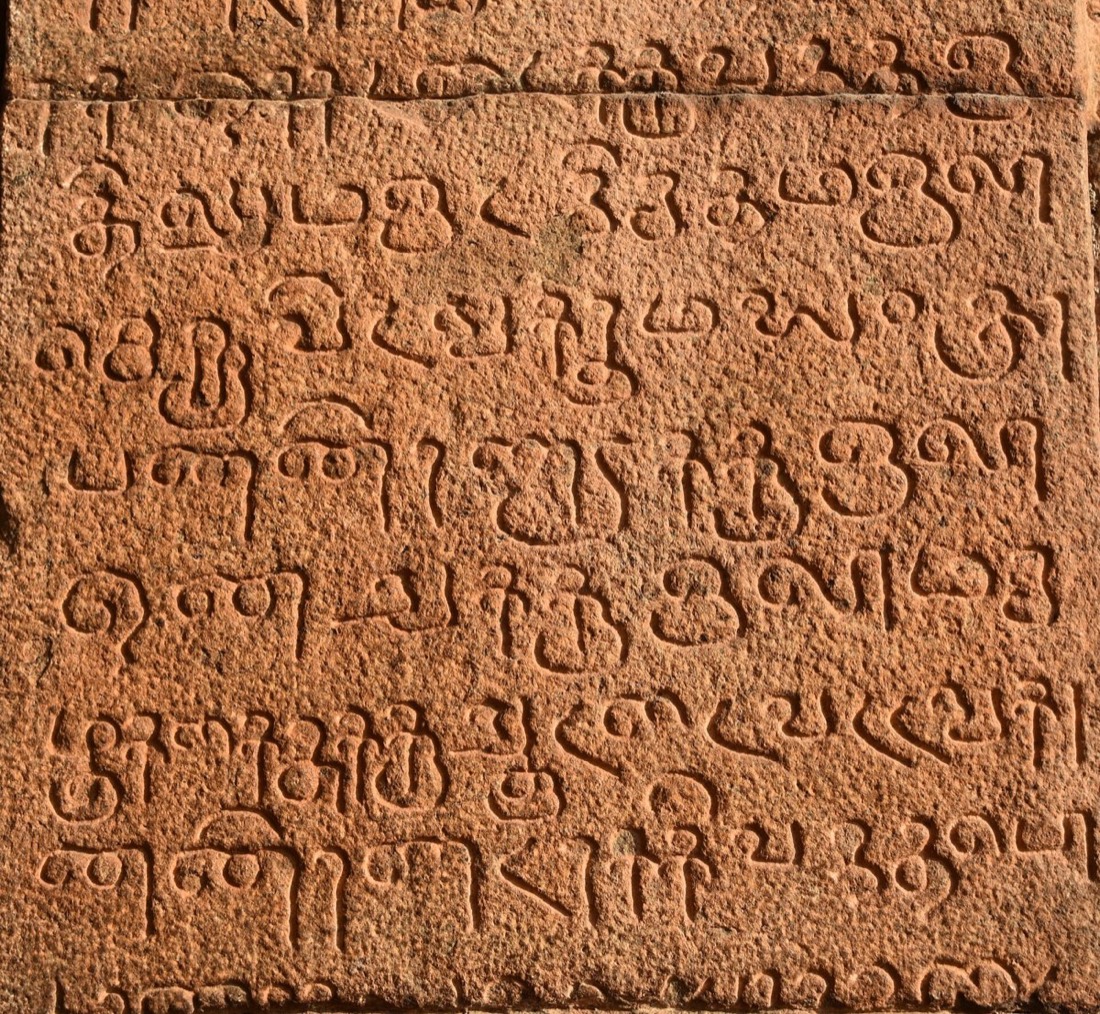
That order is a promise to keep records. Two later orders, both dated to the twenty-ninth year, show what the records kept. They list workers rather than donors.
Four hundred women, each with a house
The first of those orders moves women. According to the edition, 400 women are transferred to the temple from other temples across the Chola country. The editor took them to be dancers. Entries give a name, the temple the woman came from and a house on the temple street.
Udaram, from the Lokamahadevi-Isvara temple at Tiruvaiyaru, receives the third house. Rajakesari, from a temple at Nagapattinam, receives the eighth. The first house in the southern row goes to another woman from the Tiruvaiyaru temple, her name partly restored by the editor.
Entries generally carry one share each. A share is the produce of one veli of land, reckoned in paddy by a measure called Adavallan. The same edition gives that name to the temple's main image. A share is a claim on produce, not a record that the woman owned the land.
Read together, the entries look like a new temple recruiting people who already knew the work.
Forty-eight voices and two drums
The companion order covers sound. Forty-eight reciters are assigned the Tiruppadiyam, which the editor identifies with the Shaiva hymns of the Tevaram. Two drummers play the small drum and the large drum, the koṭṭi-mattaḷam. Each of the fifty receives a daily measure of paddy. The editor notes that many of the reciters' names come from the three Tevaram poets.
Both orders then ask what every institution eventually has to ask: who comes next? If a holder dies or emigrates, the nearest relatives receive the allowance and do the work. If those relatives are not qualified, they must choose qualified people instead. If there are no near relatives, the other holders of such posts choose a qualified person, who receives the allowance in turn.
Family could keep a place, but family could not supply skill. It reads like a rule written by people who expected the temple to outlast them.
These are the institution's records. They show posts, houses and allowances. They do not show what any of these people thought or chose, or how long the arrangements lasted.
Stories like this one, where a famous temple turns out to be full of named people, are what Devam is gathering for more than 1,000 Indian temples. The app is coming soon on the App Store and Google Play, and you can join the waitlist.
A glimpse by oil lamp
In 1930, S. K. Govindaswami of Annamalai University entered the dim passage around the sanctum with a small oil lamp. He saw patches of painting and little more. On 9 April 1931 he returned with a "baby petromax", a portable lamp. The paintings on view came from the time of the Nayaka rulers of Thanjavur, centuries after Rajaraja. Under them lay Chola work.
Sriraman records that Govindaswami reported the find in The Hindu. The Archaeological Survey of India, which took charge of the temple from its hereditary trustee, sent S. Paramasivan, a chemical curator at the Government Museum in Madras, to treat the paintings. The passage has fifteen chambers, and each chamber has two painted walls.
S. R. Balasubrahmanyam, writing in Middle Chola Temples in 1975, says the Nayaka layer once covered the whole wall and had flaked in places, so Chola paintings showed through. The Survey cleaned what showed and left the later layer standing where it was. In the 1950s the Lalit Kala Academy made copies, because Sriraman records that further deterioration was likely.
A wedding that stops, a journey to Kailasa
Chamber 7 holds a painted story of Sundarar, a Shaiva poet-saint whose hymns belong to the Tevaram. Balasubrahmanyam reads the wall in three bands, from the bottom up. The story is the devotional tradition's, not a record of events.
In the lowest band, a wedding is halted. Shiva, in the form of an old man, claims Sundarar as his slave and holds a palm-leaf document. In the wedding scene the painters also include a cooking oven, firewood and a cauldron.
Above it, Sundarar rides Airavata, the divine elephant, towards Kailasa. Cheraman, a Chera king, rides a horse. In the top band, a row of musicians and divine dancers welcome the saint and the king.
In Chamber 9, Sriraman identifies Rajaraja and his queens among the worshippers of Nataraja at Chidambaram. That identification is Sriraman's reading of the panel.
One wall has room for a saint's road to heaven and for a cooking fire. Two layers of paint also show a temple kept in use and painted again long after Rajaraja.
The later painters, in plain view
Not all of the temple's painting hides in the dark. The Nandi pavilion, where the large stone Nandi, Shiva's bull, sits, has a painted ceiling and carved pillars. Wikipedia, citing Michell and Balasubrahmanyam, places the Nandi shrine in the Nayaka era. A Wikimedia Commons description of the ceiling puts it in the Vijayanagara-Nayak period.
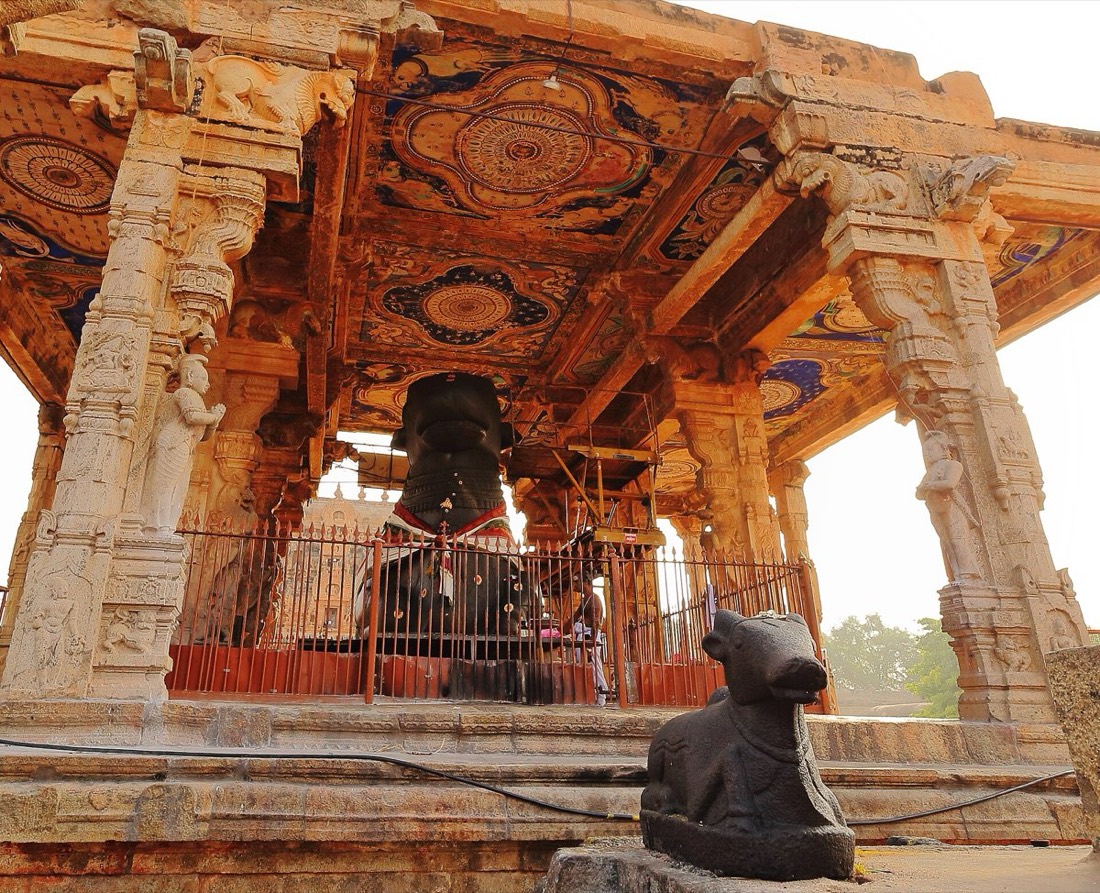
That makes the ceiling a later layer of the temple's story, not part of the Chola murals in the passage.
Reaching the temple
As of 11 November 2026, the Tamil Nadu Tourism page for the temple puts Thanjavur Junction railway station about 1.5 km away. It puts the airport at Tiruchirapalli about 61 km away. Timings, dress, photography and any queue or ticket arrangements can change, so the temple's own current notices are the place to check. This article does not give them.
Questions people ask about the Brihadeeswara Temple
Who built the Brihadeeswara Temple, and when?
The Chola king Rajaraja I built it. Tamil Nadu Tourism says around 1010 CE, and the archaeologist P. S. Sriraman notes that the year work began is not recorded. The inscriptions call the temple Rajarajesvara, and one of Rajaraja's orders is dated to the twenty-sixth year of his reign.
Is the Big Temple the same as Peruvudaiyar Kovil and the Gangaikonda Cholapuram temple?
It is the same as Peruvudaiyar Kovil, a Tamil name the state tourism page gives, and many call it the Big Temple. It is not the Brihadisvara temple at Gangaikonda Cholapuram. That is a separate temple in the same group of three Great Living Chola Temples.
Do the inscriptions tell us how the temple women lived?
Only in part. The orders record each woman's former temple, a house and a share of produce, and they provide for replacements. They do not record what the women thought or chose. Because the records are the institution's, any reading of their status goes beyond the evidence.
Are all the paintings Chola?
No. In the passage around the sanctum, Chola paintings lie under a later Nayaka layer and show where it has flaked. The Nandi pavilion's painted ceiling is Nayaka-period too. The scenes, such as Sundarar's, are devotional stories, not records of events.
What the tower does not show
The tower is what most photographs catch. It does not show Udaram's third house, the rule for replacing a reciter who has died, or a flaked patch of plaster that let a small lamp find older paintings. Rajaraja's temple was built to last, and its walls record who was expected to keep it going.
More temple stories like this are what Devam is gathering, along with gods and goddesses, bhajans, mantras, aartis and quizzes. The app is coming soon on Google Play and the App Store, and the waitlist is where to sign up.