Dwarkadhish Temple, Dwarka: the flag above, the shrines below
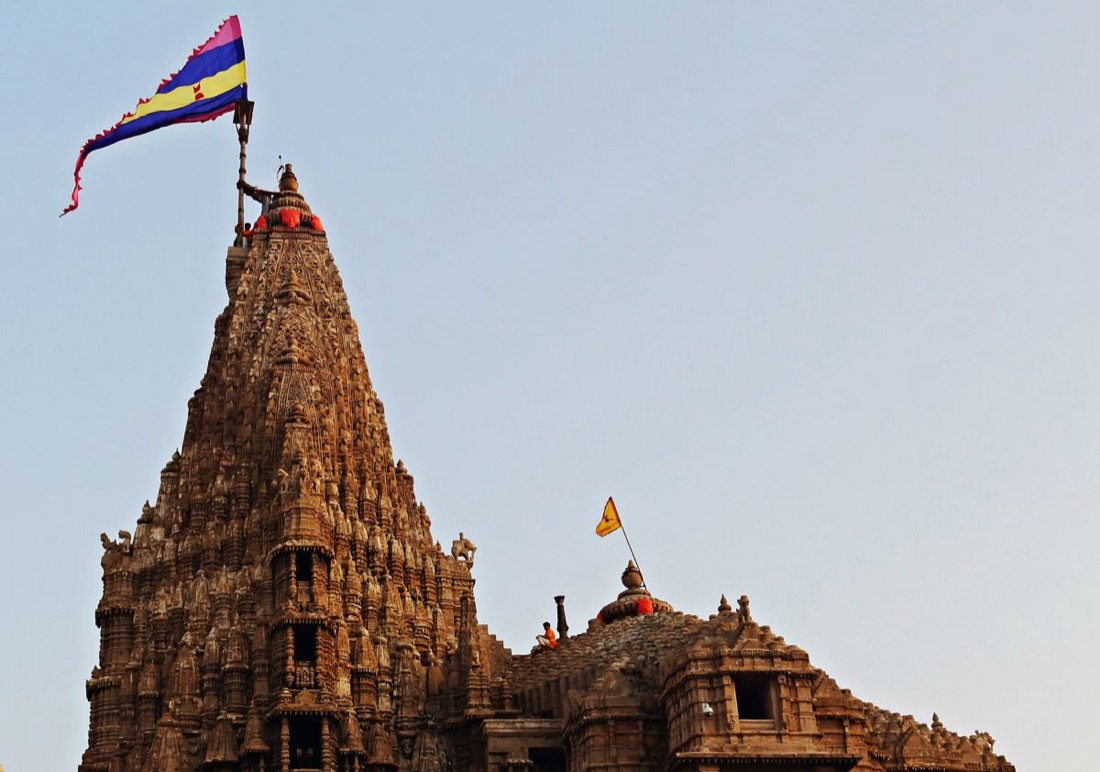
A flag has to be carried to the top of Dwarkadhish Temple, and it is carried by hand.
The temple, also called Jagat Mandir, stands in Dwarka on Gujarat's western coast, where the Gomti meets the Arabian Sea. Krishna is worshipped here as Dwarkadhish, Lord of Dwarka. This article follows two things: the flag that goes up the spire, and the older temples that archaeologists found buried in the forecourt.
Fifty-two yards of cloth
Gujarat Tourism describes the spire as topped with a flag made from 52 yards of cloth. The temple's own page on the flag adds a detail nobody sees from the street: fifty-two small flags are joined around the border. It says each yard stands for a gate of Dwarka in Krishna's time.
Other explanations of the number circulate. A 2021 Gujarati devotional report gives two. In the first, fifty-six Yadava groups once ruled Dwarka. Krishna, Balarama, Pradyumna and Aniruddha have flags of their own, and this flag stands for the other fifty-two. In the second, the number is a sum: twelve zodiac signs, twenty-seven lunar mansions, ten directions, the sun, the moon and Dwarkadhish. These are devotional readings, not rival measurements.
The flag also carries a sun and a moon. The same report says devotees take them as a sign that Dwarkadhish's name will last as long as the sun and moon do.
Why a flag at all? The Dvaraka Mahatmya, a section of the Skanda Purana, puts it in the pilgrim's first sight of the temple. In G. V. Tagare's English translation, a traveller who sees Krishna's shining temple with its flag and pitcher climbs down from the vehicle and rolls on the ground in reverence. The same chapter praises people who help pilgrims on the road: with a resting place, a midday meal, water pots, sandals, even care for tired feet.
In that passage, the flag is part of what the traveller sees first.
The family that climbs
The flag does not raise itself. A Gujarati news report of 8 April 2023 says members of the Trivedi family, Aboti Brahmins, climb through the temple to the spire to hoist the flags. It counts five flags a day, from morning to evening. The 2021 report counts three changes a day, rising to five on special occasions, and other published accounts give numbers between three and five.
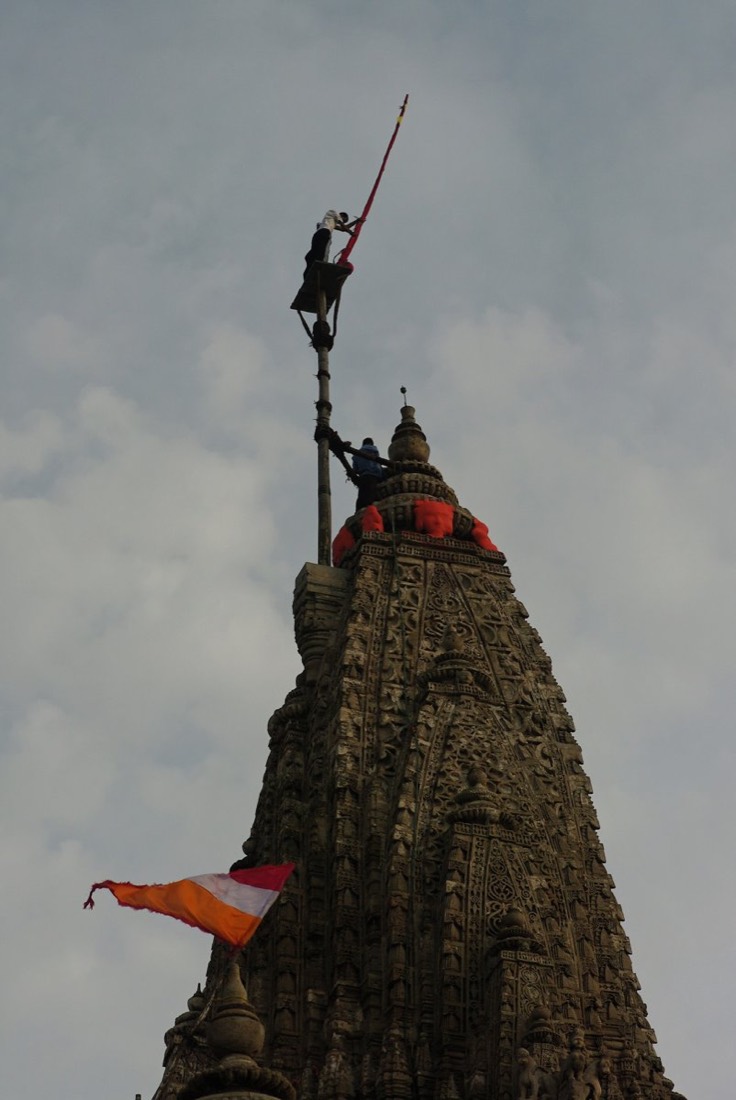
Devotees offer the flags. They register their names, the 2021 report says, and some wait up to two years for a turn. The same report says the Aboti Brahmins hold the right to hoist and take down the flag. The temple's flag page names a different community, the Shree Guggali Brahmin community, as the office that handles bookings. The sources give the two communities different roles, and they should not be mixed up.
In April 2023, the report continues, the district collector, who chairs the temple's Devasthan committee, raised the idea of an electric hoisting device to prevent accidents among those who climb. The report adds that such devices are already used at the Ambaji and Somnath temples in Gujarat. The Trivedi family objected. A machine, they said, would take away their traditional right to the service.
The report describes a discussion, not a decision, and no later report of an outcome turned up in the research for this article. How the flag is raised is for the temple to say.
Two concerns sit side by side: the safety of people climbing a spire, and the standing of a family that, the report says, has lived in Dwarka for generations and hoisted its flags. The report takes no side, and neither does this article.
If a flag raised by hand and a family's claim to a service make you curious about other temples, Devam is bringing together the stories of more than 1,000 Indian temples, along with gods and goddesses, bhajans, mantras, aartis and quizzes. It is coming soon on the App Store and Google Play, and you can join the waitlist to hear when it opens.
A painted plinth under the forecourt
The temple's second story runs downward. In 1979–80 the Archaeological Survey of India dug in the forecourt, in work led by S. R. Rao. The excavators uncovered a temple of Vishnu, which they assigned to about the ninth century. It is numbered Temple III.
Digging deeper, they traced two earlier temples. The temple's own history page says Temple II was built on the ruins of Temple I. Temple I, the lowest, still showed a lime-plastered stone plinth with a few lines of red ochre paint. Plaster and paint on a plinth suggest it once stood open to view, above the ground level of its time.
That is the detail to hold on to. Before later building buried it, a visitor to that shrine would have seen a finished, painted surface.
The same page puts Temple I in the first century BC or AD. It adds that a storm wave perhaps blew the roof off Temple III in the twelfth century, leaving its walls and plinth, that a fourth temple followed soon after, and that the present temple is the fifth in the series. Its inner part is assigned to the thirteenth century, its hall and spire to the fifteenth. These are proposed dates.
Tradition tells a different beginning. Gujarat Tourism says the temple is believed to have been established more than 2,500 years ago by Krishna's great-grandson Vajranabh. Tradition and excavation are different kinds of evidence, and this article keeps them apart. Gujarat Tourism also records that the original structure was destroyed by Mahmud Begada in 1472 and rebuilt in the fifteenth and sixteenth centuries. It says renovations left their clearest imprints in the sixteenth and nineteenth.
The explorations off Dwarka's coast are a separate subject and are left aside here.
From the street to the gate
The temple is reached by a flight of steps: 56 by the temple's own page, "more than fifty" by Gujarat Tourism. Two gates, Swarg Dwar and Moksha Dwar, serve as entrance and exit, though the sources disagree about which is which, so the temple's signs are the guide.
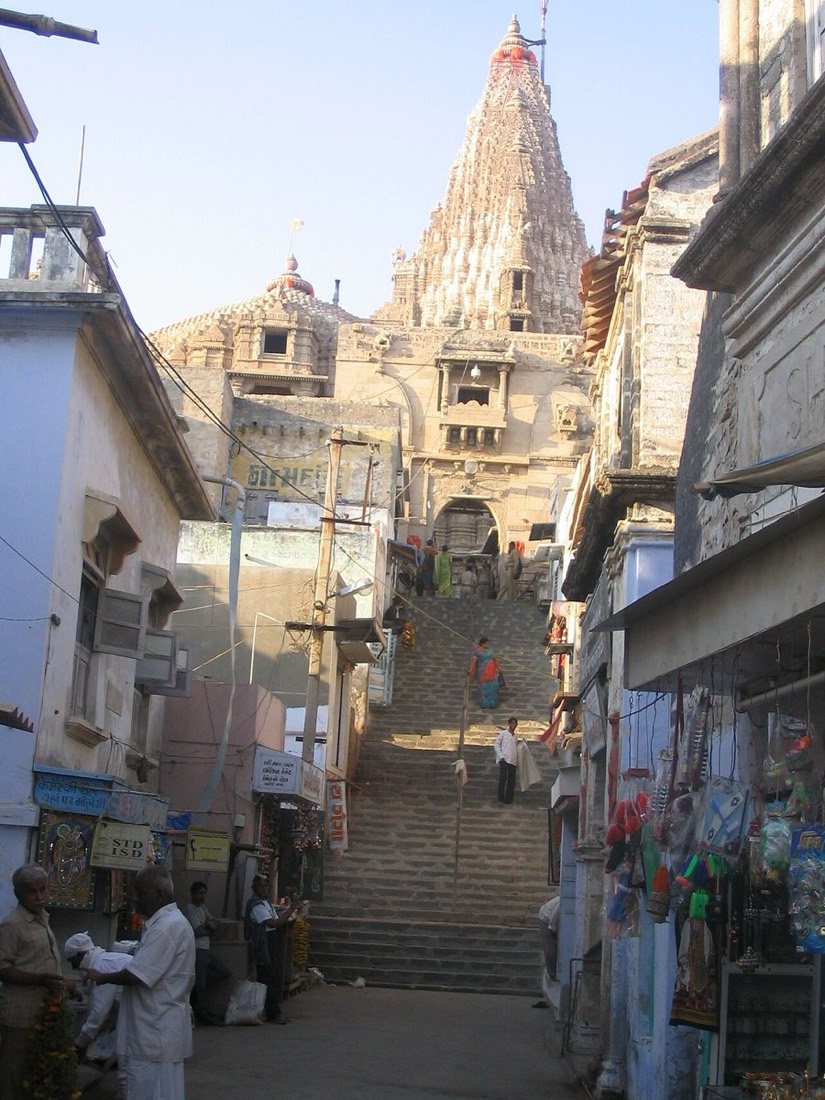
For timings, the temple's official site posts a timetable and says it may change on special days and festivals. Gujarat Tourism lists slightly different visiting hours, which is one more reason to trust the temple's notice. The temple's notices, not this article, are the place to check dress, rules and booking. Janmashtami, celebrated on a grand scale here according to Gujarat Tourism, follows the lunar calendar each year. Rukmini's temple, placed on the outskirts by Gujarat Tourism, is a separate shrine. As of 11 November 2026, this article draws on the temple's own pages, Gujarat Tourism and the reports linked above.
Questions people ask about Dwarkadhish Temple
How old is Dwarkadhish Temple?
Tradition credits Krishna's great-grandson Vajranabh with founding it, and Gujarat Tourism repeats that belief. The documented record is separate: archaeologists traced earlier temples under the forecourt, and the temple's own page counts the present one as the fifth, with its inner part assigned to the thirteenth century.
What is the 52-yard flag at Dwarkadhish Temple?
It is a flag made from 52 yards of cloth, with fifty-two small flags joined around its border, and it carries a sun and a moon. Explanations of the number differ: gates of Krishna-era Dwarka, Yadava groups, or a sum of zodiac signs, lunar mansions, directions, the sun, the moon and the deity.
Who climbs to hoist the flag?
A 2023 Gujarati report names the Trivedi family, Aboti Brahmins, as the people who climb through the temple to the spire. That April the district collector raised the idea of an electric hoist to prevent accidents, and the family objected. The report records no decision, and no later outcome was found.
How does a devotee arrange to offer a flag?
The temple's flag page says bookings go through the Shree Guggali Brahmin community's office and lists its contact details. A 2021 report says devotees register their names and some wait up to two years. Because arrangements change, the temple's own notices are the place to check.
Between the flag and the red paint
Dwarkadhish Temple keeps its history at both ends. At the summit, a flag goes up by hand, and the latest report found leaves open how it should be carried. Below the forecourt, archaeologists exposed a plinth that still showed traces of red paint. Between them stands a temple that, by its own account, is the fifth in its series.
Devam's app is coming soon on Google Play and the App Store. If the flag and the red paint have made you want more stories from India's temples, put your name on the waitlist.