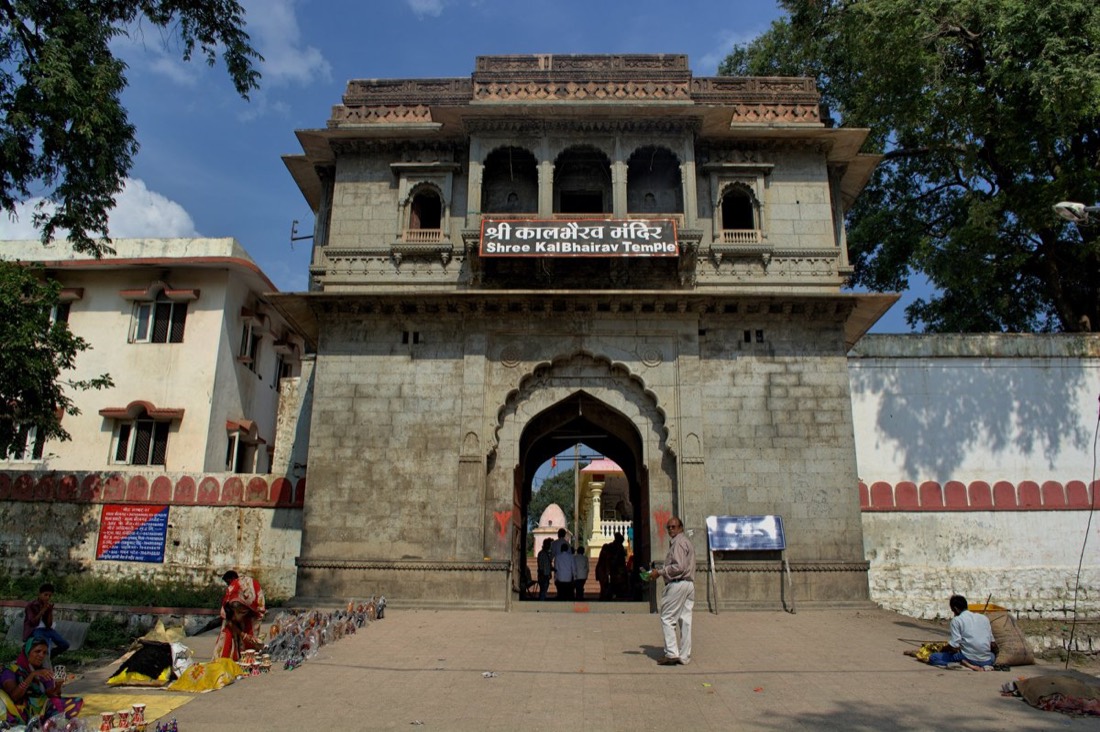
Kal Bhairav Temple, Ujjain: the guardian with a turban and a salute
On the evening of 22 September 2026, a palanquin stopped at the gate of Ujjain's Central Jail. Police gave it a guard of honour. The jail superintendent worshipped, and many prisoners had darshan, the Free Press Journal reported.
The palanquin had left the Kal Bhairav temple in Bhairavgarh, on the banks of the Shipra in Ujjain, Madhya Pradesh. Kal Bhairav, a fierce form of Shiva, is worshipped here as the city's guardian. This blog follows his office through a turban from Gwalior, an offering of liquor, and an April day in 2025. On that day, liquor sales near the temple stopped but the offering carried on.
The commander you meet before the king
Ujjain's great Shiva is Mahakal, and Kal Bhairav is his commander. The priest Pawan Chaturvedi explained it to the reporter Rajiv Malik, who visited in April 2004 and wrote it up in Hinduism Today. Bhairav heads Shiva's army, the priest said, and his permission is needed to meet the king. So, in that telling, devotees come to Bhairav first.
That was one priest's way of understanding the order of visits, not a rule every pilgrim follows.
The commander has a story too. In the Skanda Purana's chapter on the Kalabhairava pilgrimage place, in G. V. Tagare's English translation, the goddess Kali raises Bhairava like a son. He then faces nine Matrikas, a group of mother goddesses, among them Mahamari and Putana. They are described as harmful. Bhairava subdues them and makes them givers of boons.
The dangerous ones are not destroyed. They are turned around. The text places Bhairava on the north bank of the Shipra and lists how to honour him: leaves, flowers, scents, cooked food, betel leaves, incense, fire offerings and meals for Brahmins. Liquor is not on that list.
A turban sent from Gwalior
No founding year is established for the temple. The Ujjain district administration's page says it is believed to have been built by King Bhadresen, and notes that the Skanda Purana mentions a Kal Bhairava temple. The present structure shows Maratha influence, and a local tradition explains why.
After the Maratha defeat at the Third Battle of Panipat in 1761, the tradition says, the general Mahadji Shinde, also spelled Scindia, offered his turban to Bhairav. He prayed for success in rebuilding Maratha power in the north. When that power revived, he is said to have restored the temple. Wikipedia records this as local tradition. None of the sources read cites a record of the vow from Mahadji's own time.
The custom that follows is documented. A turban arrives on behalf of the Scindia family of Gwalior, and Kal Bhairav wears it for the procession. Reports from 2022 and 2026 both describe it.
Reports describe the procession on two occasions each year. One is the day after Bhairav Ashtami, the eighth day of the dark fortnight in Margashirsha, when the deity's birth anniversary is marked at midnight. The other is Dol Gyaras, the eleventh day of Bhadrapada's bright fortnight. Both dates follow the lunar calendar.
Then the palanquin moves. At the Central Jail it stops. The jail superintendent worships it, and prisoners have darshan. From there it goes on to Siddhavat for worship and aarti, and returns to the temple. Reports do not say why the jail is a stop. They only record that it was one in 2021, 2022 and 2026.
The picture is of an office as much as a deity: dressed by a royal house, saluted by police, welcomed by the head of a jail.
If you like finding the story behind a ritual, join the waitlist for Devam. It is coming soon on the App Store and Google Play, with stories of more than 1,000 Indian temples, along with bhajans, mantras, aartis and quizzes.
A face with no body
Liquor is the offering this temple is best known for. The district administration's page says it is offered as part of the ritual, and notes a belief that worship of Kal Bhairava was once part of the Kapalika and Aghora sects, prominent in Ujjain.
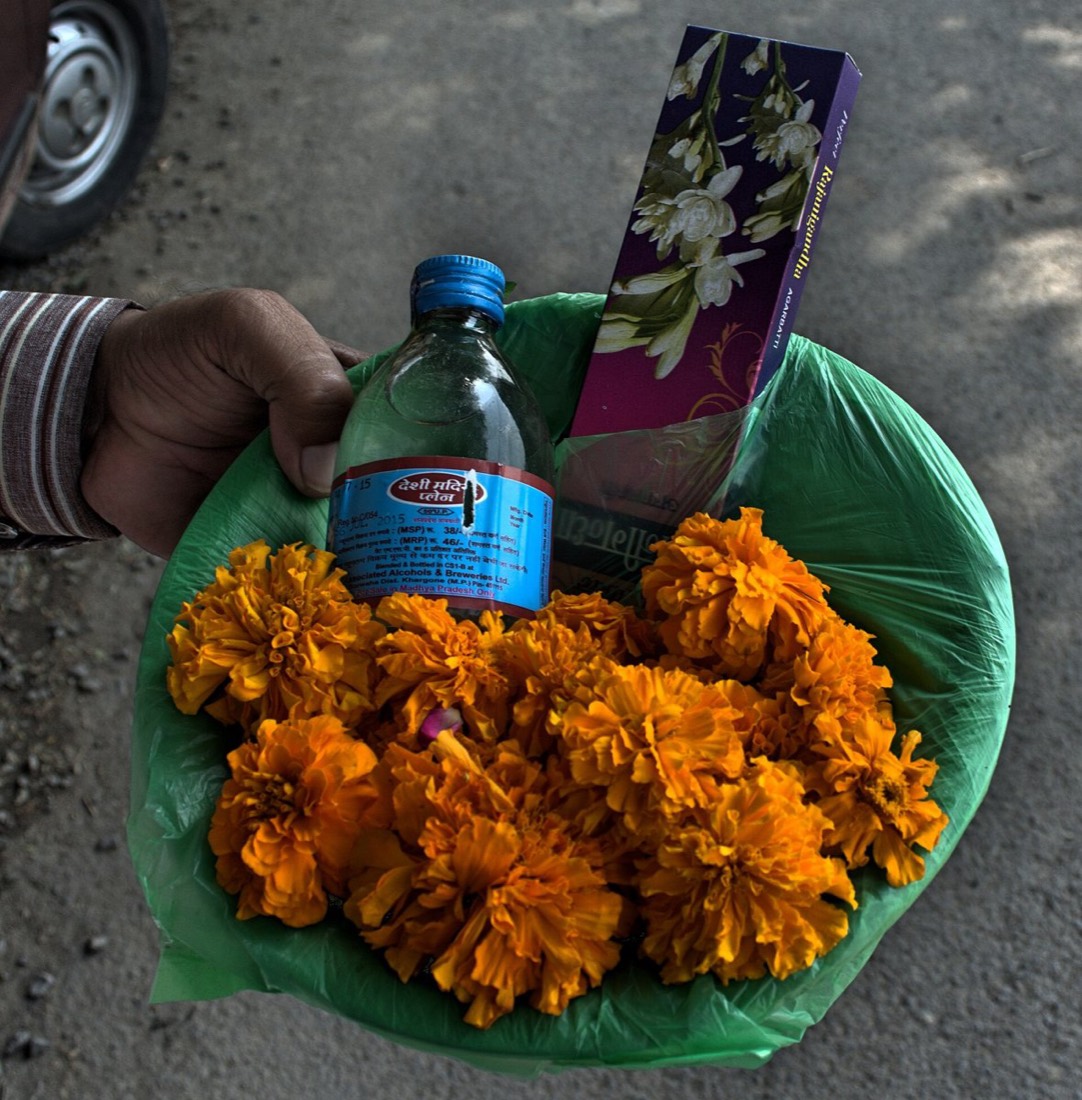
Inside the shrine, the art historian R. Nagaswamy describes the main deity as a big stone face of Bhairava, adorned with cloth and garlands, with no body or limbs. In front of it stands a silver face of the same Bhairava on a pedestal.
The priest also set the bottle among other kinds of gift. Kal Bhairav, the priest said, is worshipped in three ways. Sattvic worship, the pure kind, offers flowers and fruit. Rajasic worship, the passionate kind, offers gold ornaments. Tamasic worship, the dark or dense kind, offers liquor. Most days, the priest said, the worship is sattvic and rajasic.
The reporters were made to wait for a devotee with a bottle, so the offering could be photographed. The report says the liquid vanished quickly once placed near the lips of the image. The priest said no one knows where it goes. The sources read offer no test or measurement, so this blog can pass on only what was seen and said.
A priest also told Nagaswamy, in an undated interview, that a wider set of five Tantric offerings had been removed from the temple premises while liquor remained.
So the bottle is a living custom of this temple. It is not a line from the Purana.
The year the shops closed
From 1 April 2025, Madhya Pradesh banned liquor sales at 19 religious sites, Ujjain among them, Live Hindustan reported. Shops near the temple had to promise officials in writing that they would not sell. Devotees who arrived that Tuesday were surprised.
The daily offering needed somewhere to come from. The priest Omprakash Chaturvedi said the temple administration had been allowed two days' stock for daily worship. The temple committee, the priest said, had informed the administration before the ban and kept that stock. It was meant for the offering just after the temple opens, around the morning and evening aarti, and at closing time at night.
Aaj Tak reported the same day that the Ujjain district collector said the two liquor counters near the temple had closed, and that the temple committee would arrange the offering.
So the counters shut and the worship went on, through arrangement rather than a shop. These are reports from the first days of the change, not a guide to later arrangements.
At the Bhairavgarh gate
The temple is in Bhairavgarh, in Ujjain. In its courtyard rises a deepmalika, a tower of lamp holders. Ujjain has a railway station (code UJN) on Western Railway, and the district page lists Indore's airport, 53 km away, as the nearest.
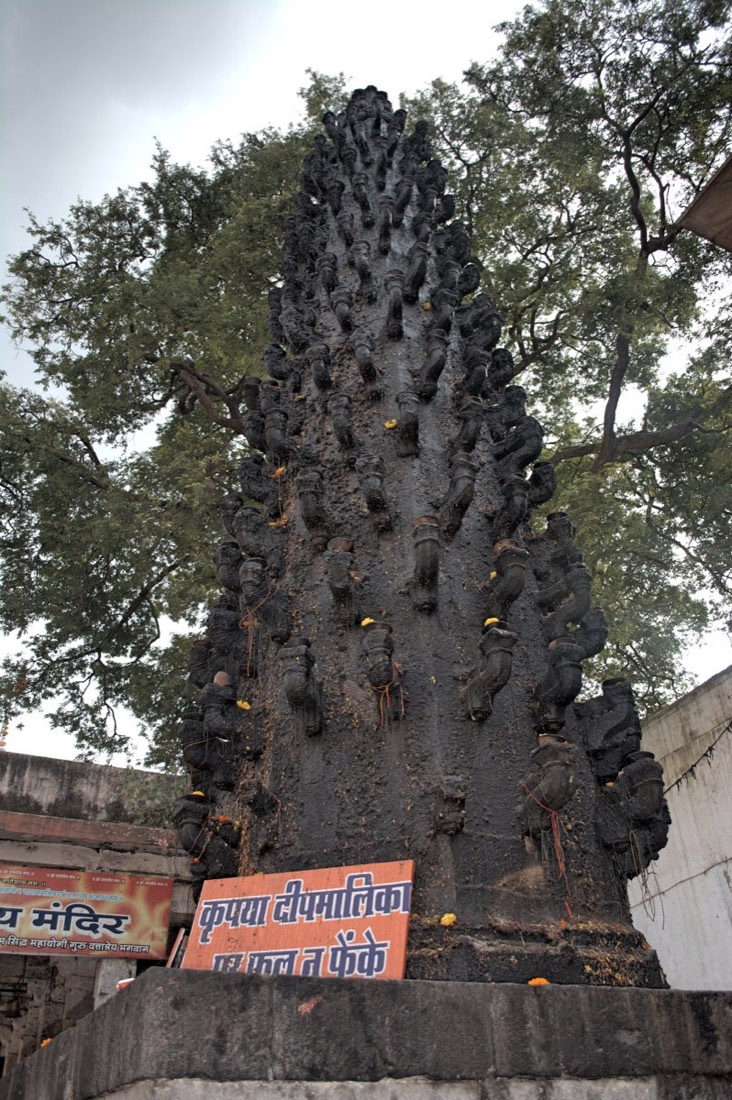
Timings, queues, dress rules and what may be offered change, and the temple's own notices are the authority. As of 10 November 2026, the district administration's page was the only official source found, and it gives no timings, so none appear here.
Questions people ask about Kal Bhairav Temple
Who is Kal Bhairav, and why do devotees visit him before Mahakal?
Kal Bhairav is a fierce form of Shiva, worshipped in Ujjain as the city's guardian. The priest Pawan Chaturvedi told a reporter in April 2004 that Bhairav commands Shiva's army and his permission is needed to meet the king, Mahakal. That is one priest's explanation, not a rule every pilgrim follows.
Is the liquor offering mentioned in the Skanda Purana?
No. The Skanda Purana's chapter on the Kalabhairava pilgrimage place lists leaves, flowers, scents, cooked food, betel leaves, incense, fire offerings and meals for Brahmins, and liquor is not among them. The liquor offering is a custom of the temple, which the district administration's page describes as part of the ritual.
How old is the Kal Bhairav temple?
No founding year is established. The district administration's page says King Bhadresen is believed to have built it, and the Skanda Purana mentions a Kal Bhairava temple. The present structure shows Maratha influence, so tradition's antiquity should not be read as the building's age.
Did the liquor offering continue after the 2025 sales ban?
Reports from April 2025 say it did. Live Hindustan quoted a priest saying the temple was allowed two days' stock for daily worship, and Aaj Tak quoted the district collector saying the temple committee would arrange the offering. These reports are dated, and the temple's notices are the guide to current arrangements.
The commander's place in the city
Ujjain keeps its commander close. A royal house sends his turban. Police salute his palanquin. A jail's superintendent welcomes it at the gate. When liquor sales closed near the temple in 2025, arrangements were reported to keep his daily offering going.
Devam is coming soon on Google Play and the App Store, gathering the stories of gods, goddesses and temples across India. To be on the list when it opens, put your email on the waitlist.