Salasar Balaji, Rajasthan: the story behind Hanuman's beard
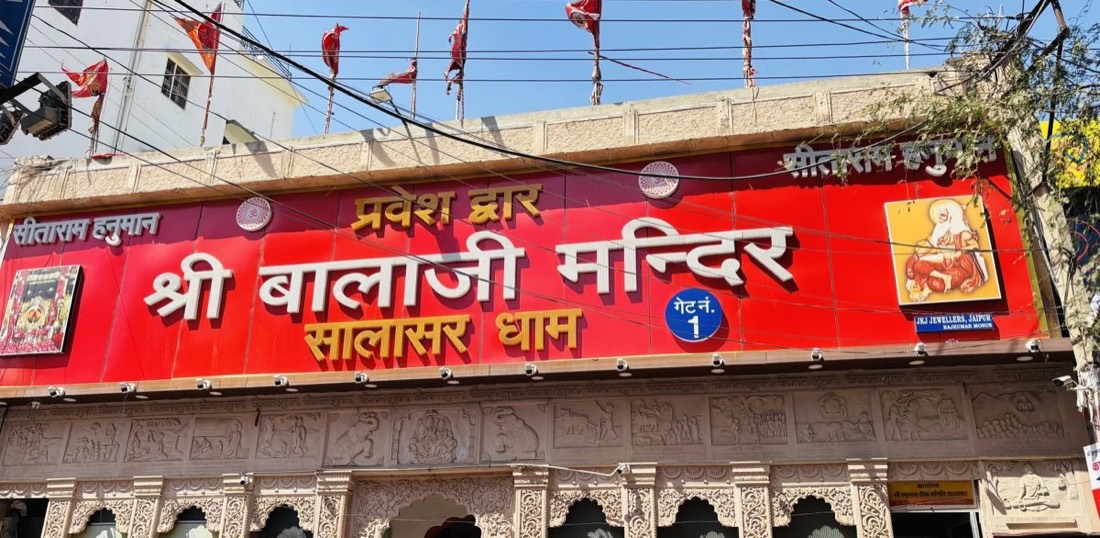
Salasar Balaji Mandir stands in Salasar, in Rajasthan's Churu district. Its Hanuman, addressed here as Balaji, is shown with an orange-red face, a moustache and a beard. The temple committee's history explains the beard through a stranger who calls at a door, vanishes, returns and agrees to stay. This blog tells that story to its end, follows a farmer's plough and a bullock cart to Salasar, and sets two tellings of the beard side by side.
The sadhu who vanished before the alms
In the committee's history, the story starts in a farming household. Kanhibai is widowed when her son Udayram is five. After some years at her parents' home in Rulyani, she returns to her house and fields in Salasar. Her father sends his youngest son, Mohan, who is unmarried, to live with her.
Mohan's days turn to prayer. In the field his axe keeps slipping from his hands, and he takes it as a sign to stop tying himself to worldly work. A marriage is arranged, and he refuses it. He becomes Mohandas. Udayram gives his uncle a corner of the farm and builds him a cottage for meditation.
One day, as Mohandas and Kanhibai eat, a call of "Alakh" rises from outside. Mohandas asks his sister to give alms to the sadhu. She steps out and finds no one. He searches the small village himself and finds no footprints. He says it was Hanuman, and that he has missed seeing him.
Two months later the same call comes at the same hour. Kanhibai tells her brother it is the same sadhu. The visitor has a beard and a moustache. When he sees Mohandas coming, he hurries away, and Mohandas runs after him into the forest. There the visitor tries to send him back and offers to grant a wish. Mohandas wants no wish. He clasps the visitor's legs and asks him to come home.
Hanuman agrees on two conditions: kheer, a rice pudding, and an unused bed to rest on. Mohandas is glad, the history says, because the guest has set terms that bring him closer. Hanuman comes home, eats, rests and disappears. The visits repeat. At last Mohandas asks him to stay for good, and Hanuman promises to remain in Salasar in the form of an image.
That promise needs an image to keep it.
A plough at Asota and a cart that stops
Mohandas waits. A landholder from Asota, a village in the Nagaur area, visits, and Mohandas asks whether a sculptor could make an image of his Lord. The landholder promises to arrange one.
Before any sculptor is found, a farmer ploughing at Asota feels his plough catch on something. He stops his bullocks and digs. The committee says he uncovers an image of Hanuman with Rama and Lakshmana seated on his shoulders. Rajasthan Tourism names him as a Ginthala Jat farmer. He cleans the image and shows his wife, who places it under a tree and makes an offering. Hindi accounts differ on that first offering: roti in a Dainik Tribune feature, bajra churma in a 2012 local report.
The landholder hears of it. That night, the committee says, a voice tells him that Hanuman has appeared for his devotee Mohandas and wants to reach Salasar. He remembers the request he was given and sends the image off in a bullock cart, villagers singing alongside. Mohandas has dreamed of his Lord's coming and goes out to meet the party. All agree that the image will be set down wherever the cart's bullocks stop.
They stop, and the image is installed there. The 2012 report puts the spot beside Mohandas's hermitage, where the temple stands. The committee says two sculptors, Noor Mohammad and Dau, were called to install it, and presents their part as an admirable example of secularism. Dainik Tribune says these Muslim craftsmen completed the temple's building.
Devotees date the installation to the ninth day of the bright half of Shravan, Vikram Samvat 1811. The committee's English page converts that to 1755, while Rajasthan Tourism and Dainik Tribune print 1754. No contemporary record turned up, so the lunar date is the safer anchor.
So the story has two places: Asota, where the image comes out of the ground, and Salasar, where it is installed.
Stories like this, where a household, a field and a bullock cart decide where a temple stands, are what Devam is bringing together for more than 1,000 Indian temples. The app is coming soon on the App Store and Google Play, and you can join the waitlist.
A robe, a bracelet and an incense box
Worship needs a keeper. Mohandas gives his robe to his nephew Udayram and ordains him for the Lord's worship. The committee says the service was assigned to Udayram and his descendants, and that the robe was kept in the temple. Dainik Tribune says the robe came to stand for the temple's gaddi, the seat of service. The 2012 report adds a bracelet and an incense box that it says are still in the temple, and calls Udayram the first priest.
It remains a household story: a widow's need brings her brother to Salasar, and her son inherits his seat.
The committee also says lamps lit in 1755 burn still, and Dainik Tribune writes of a flame burning without a break since Vikram Samvat 1811. The 2012 report calls it a dhuni, a sacred fire, lit by Mohandas himself. These are statements by the temple and local writers, and no independent check was found.
The committee marks two main observances: the day of installation, and a memorial day for Mohandas on Baisakh Shukla Trayodashi. Its daily aarti list has separate aartis for him.
Two tellings of the beard
In the temple's own photographs, the Balaji image has an orange-red face, a dark moustache and beard, a crown and garlands.
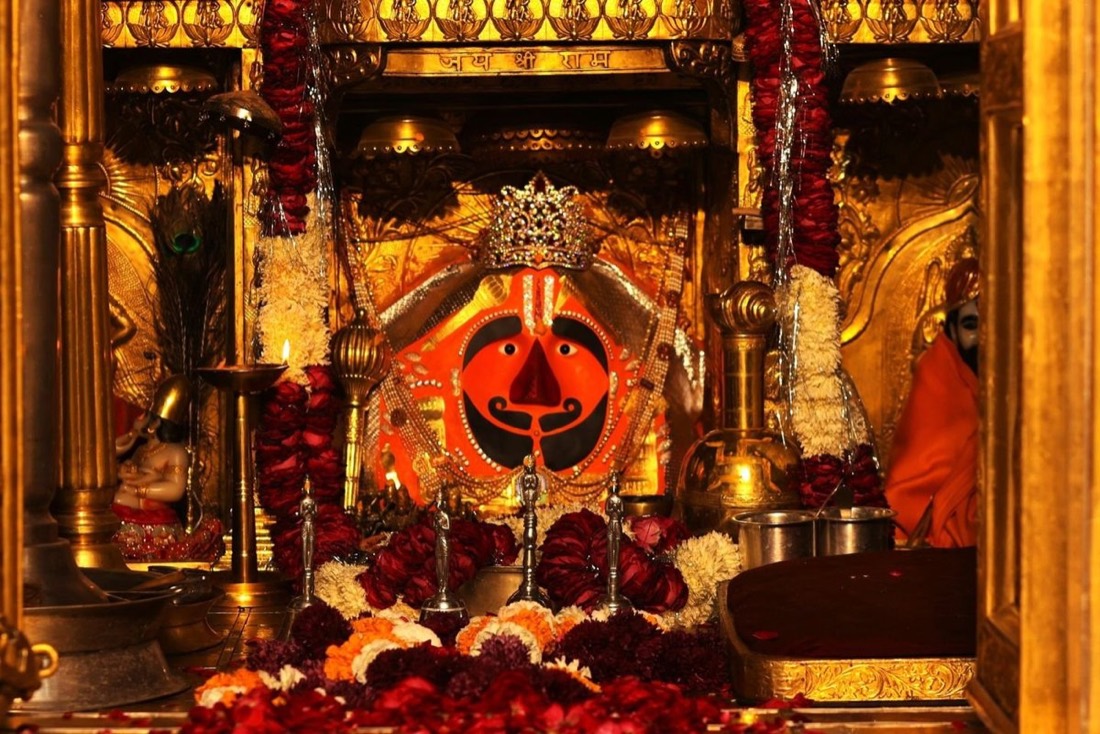
The committee's history says Mohandas altered the original image to add the beard and moustache, because that is how he first saw his Lord. It says that first sight was in a dream, though its own story has him meeting the sadhu at the door, and it does not settle which. The 2012 local report tells it differently: Mohandas asked Hanuman to be seated in the form in which he first appeared, and the face follows from that request.
Both Dainik Tribune and the 2012 report call this the only Balaji with a beard and moustache in India. No survey of other Hanuman images was found to test that. The two tellings agree on the main point: the face keeps the look of the visitor Mohandas first met.
What devotees bring to the altar
Offerings gather at the altar: garlands, flowers, lamps and, in the committee's photograph, a carpet of petals before the image.
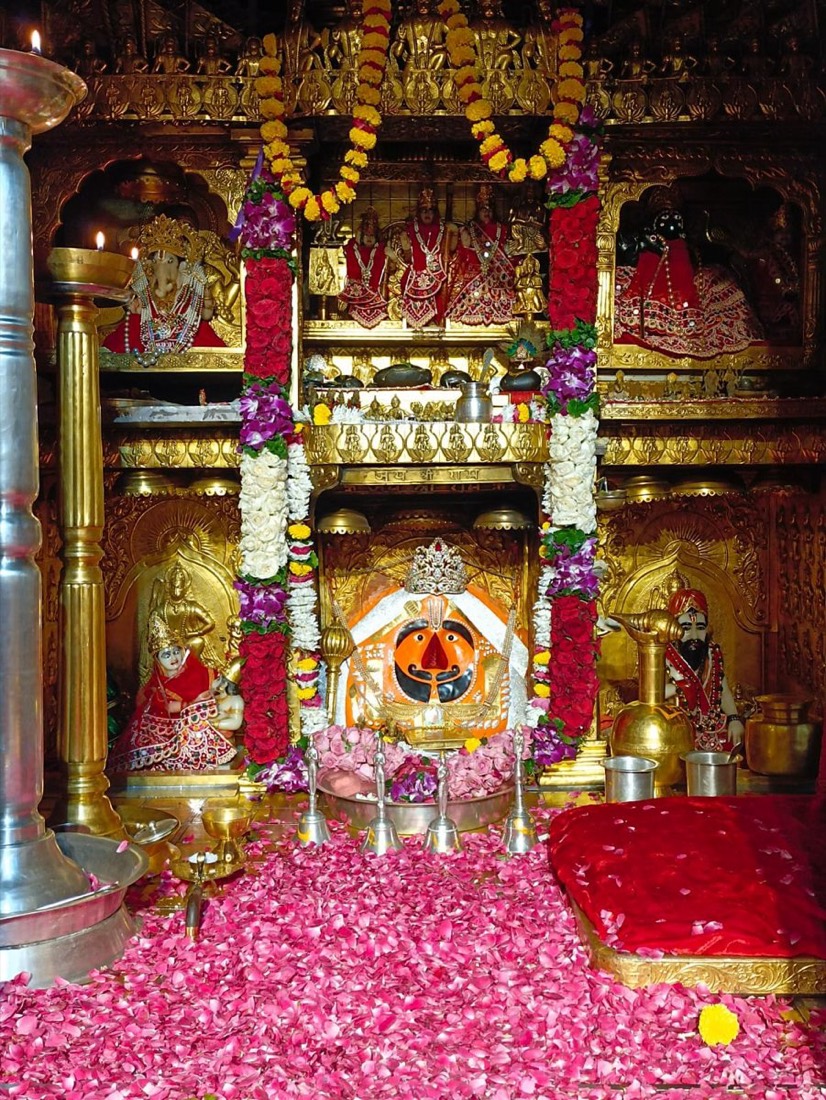
Many devotees tie a coconut within the temple as a vow, a manoti. The committee's history records the belief that Mohandas promised wishes would be fulfilled when coconuts are tied with devotion, and says these coconuts are put to no other use. It is a belief held by devotees, not an assurance.
Two fairs are held each year, according to the committee and Rajasthan Tourism: one around Chaitra Purnima, marked as Hanuman Jayanti, and one around Ashvin Purnima, also called Sharad Purnima. Both follow the lunar calendar, so their Gregorian dates move from year to year.
Planning a visit to Salasar
As of 10 November 2026, the committee's pages show the following, and visitor details change.
- Place: Salasar is in the Sujangarh tehsil of Churu district. Rajasthan Tourism says the temple stands in the middle of the town.
- Rhythm: the committee lists aartis from before dawn to night, with separate winter and summer schedules.
- Hours: its home-page notice and its timing page, both dated July 2025, give different closing times for darshan, so rely on the committee's own notices.
- Rules: dress, queues, booking and fair-day arrangements are the committee's to announce.
Questions people ask about Salasar Balaji
Why does Salasar's Hanuman have a beard and moustache?
Tradition says Mohandas first met Hanuman as a bearded sadhu. The committee's history says Mohandas altered the image to match. A 2012 local report says he asked Hanuman to be seated in that form. Both are devotional accounts, not documented history, and they differ on how the beard came about.
Was the image found at Salasar?
No. In the tradition, a farmer ploughing at Asota, a village in the Nagaur area, found it. A bullock cart carried it to Salasar, and it was installed where the bullocks stopped. Asota is the place of discovery; Salasar is the place of installation.
Is the founding date settled?
No. Devotees date the installation to the ninth day of Shravan's bright half in Vikram Samvat 1811. The committee converts that to 1755; Rajasthan Tourism and Dainik Tribune print 1754. No contemporary record turned up, so the date is tradition, not documented history.
When are the fairs held?
Twice a year: around Chaitra Purnima, marked as Hanuman Jayanti, and around Ashvin Purnima, also called Sharad Purnima. Both follow the lunar calendar, so their Gregorian dates change from one year to the next. Check the committee's notices for each year's dates before planning a journey.
Back at the doorway
Salasar's story starts with a call for alms at a widow's door and a visitor who is gone before the food is served. The plough, the cart and the robe all follow from that, and the beard on Balaji's face is how the temple remembers what he looked like when he first came.
If you like temple stories that begin in an ordinary household, Devam is bringing together stories of more than 1,000 Indian temples, with gods and goddesses, bhajans, mantras, aartis and quizzes. It is coming soon to Google Play as well as the App Store, and you can join the Devam waitlist.