Palani: The Fruit Murugan Lost and the Hill Where He Stays
Murugan loses a fruit to his brother. In the tradition kept at Palani, in Tamil Nadu's Dindigul district, that loss is why he ends up on a hill. There he is worshipped at the Dhandayudhapani temple as "the one with a staff in his hand". A second story gives the hill another beginning: a carrier who put down two hills and could not lift them again. This article tells both to the end. Then it turns to the written record, and to how the image is dressed from dawn to night.
A fruit, a peacock and a walk around two parents
One telling comes from a 1941 temple publication, Palni: The Sacred Hill of Muruga, by J. M. Somasundaram Pillai. It uses a pomegranate. Shiva holds it out and says it will go to whichever of his two sons first goes round the world.
Murugan mounts his peacock and sets off. Ganesha stays where he is and walks around their parents. They are the universe, he says, so he has already been round it. Shiva accepts the argument and gives him the fruit.
Murugan comes back to find the contest decided. He objects. Then he leaves Kailasa, Shiva's mountain, and goes south. Shiva and Parvati console him with two Tamil words, pazham nī, "you are the fruit". Devotees take this to mean that Murugan himself is the fruit that matters: wisdom. He settles on the hill as a recluse, and in this tradition Palani takes its name from that exchange.
The temple's portal describes the image as an andi, a renunciant who has given up possessions, holding a staff in a shrine that faces west. The tellings differ in small ways. Palani.org, a devotee-maintained site, gives a pomegranate or a mango and has Shiva console him alone. The Dindigul district administration's page has the sage Narada bring the fruit and sets the race at three times round the world.
The temple's own history page explains the name differently. As we read its Tamil, it gives Pothini, the town's name in the Sangam age, which wore down into Palani. The fruit story does not appear on the portal's history, about or home pages. So pazham nī is a devotional explanation of the name, and Pothini is the temple's own.
The two hills Idumban could not lift again
The second story is the Palani sthala purana, the temple's local sacred history, as the portal's history page summarises it. In this telling, the hill at Palani and the smaller Idumban Malai beside it began as two hills at Kailasa, Sivagiri and Sakthigiri. Shiva gives them to the sage Agastya, who wants them in the south, at Podigai. Agastya orders Idumban, an asura (a demon-like being) in his service, to carry them.
Palani.org pictures the load as a kavadi, the shoulder-borne burden that pilgrims carry as a vow, with one hill on each side of Idumban. He gets as far as Palani and sets it down to rest. When he tries to lift it again, the hills will not move. He climbs Sivagiri to find out why and meets a boy standing under a kura tree. The boy is Murugan. They fight, and Idumban dies. His wife, Idumbi, pleads for him, and his life is given back.
Then Idumban asks for two things. He wants to stand at the door of Murugan's shrine as its gatekeeper. And he wants anyone who brings a vow to Murugan in a kavadi, as he carried the hills, to receive Murugan's grace. The portal records both as granted: the Idumban shrine on the hill, and the kavadi that pilgrims carry to Palani.
So the carrier never reaches Podigai. He becomes the doorkeeper, and his burden becomes the shape of a pilgrim's offering. The district page tells it differently, with a demon named Ettumba and a second hill that travels on to Swamimalai. In the portal's account, both hills stay at Palani.
Devam gathers stories like these, from more than a thousand temples across India and their gods and goddesses, with bhajans, mantras, aartis and quizzes alongside. It is coming soon on the App Store and Google Play, and the waitlist is where to hear when it opens.
A poem that skips the hill and a deed that names a tank
A story can say why a hill matters. It cannot date a building, and the temple's own history is careful about that.
Nakkirar's Tirumurugarruppadai is a Tamil poem that guides a seeker to several of Murugan's places. Its third section is set at Avinankudi, which the portal identifies with today's Palani town. The portal says plainly that the poem makes no mention of a temple on the hill. In its account the hill temple came later, created by the siddha Bogar, a sage in Tamil tradition. The time when the image was made cannot be fixed. It also says the image is made of navapashanam, nine mineral substances, and not carved from stone. That is the temple's belief, with no date or analysis attached.
Inscriptions give firmer footing. The portal says the Archaeological Survey of India has published records from the hill temple and from a temple at its foot. They come from later Pandya, Kongu Chola and Vijayanagara times. One is no. 403 in K. G. Krishnan's South Indian Inscriptions, volume 17, a Tamil record of a Pandya king named Virapandya. The edition dates it to 1273 CE. Identifying the king is Krishnan's own call, made with caution (see the transcribed edition).
The record gives land, free of certain levies, in the southern part of a tract called Idumban-kulam, "Idumban's tank". The land is for the works, food offerings and other services of the god in the temple of Subramanya-pillaiyar on the Palani hill.
So by the later thirteenth century, on this edition's reading, worship on the hill was being paid for with land. That does not date the present building or the image. Nor does the deed say who Idumban was, so it cannot tell us whether the story or the name came first. The portal places this land below the hill, which means the name was already attached to a place there.
From ascetic at dawn to flowers at night
The portal lists six daily pujas, each giving the image a different adornment. The Vishvarupa darshan comes before them, at 6 a.m. The starts below are the ritual times it listed on 3 November 2026, and they can change.
At about 6.40 a.m. the Vila puja shows him as an ascetic. From 8.00, Sirukala sandhi makes him a hunter. Kalasandhi, from 9.00, shows the child Balasubrahmanya. At noon, Ucchikala brings a Vaidika, a Vedic scholar, wearing the sacred thread. From 5.30 p.m., Sayarakshai dresses him as a king. Rakkala, from 8.30 p.m., adorns him with flowers. Afterwards the image is taken to the bedchamber, where the temple's odhuvar, the hymn-singer, sings a cradle song before the sanctum is closed.
Set beside the fruit story, the day has a shape. The recluse who left Kailasa is attended in turn as hunter, child, scholar and king, and then sung to sleep.
These are ritual start times, not visiting hours. The portal lists general darshan separately, and its night puja falls after the evening darshan window closes.
Four ways up, and where to check them
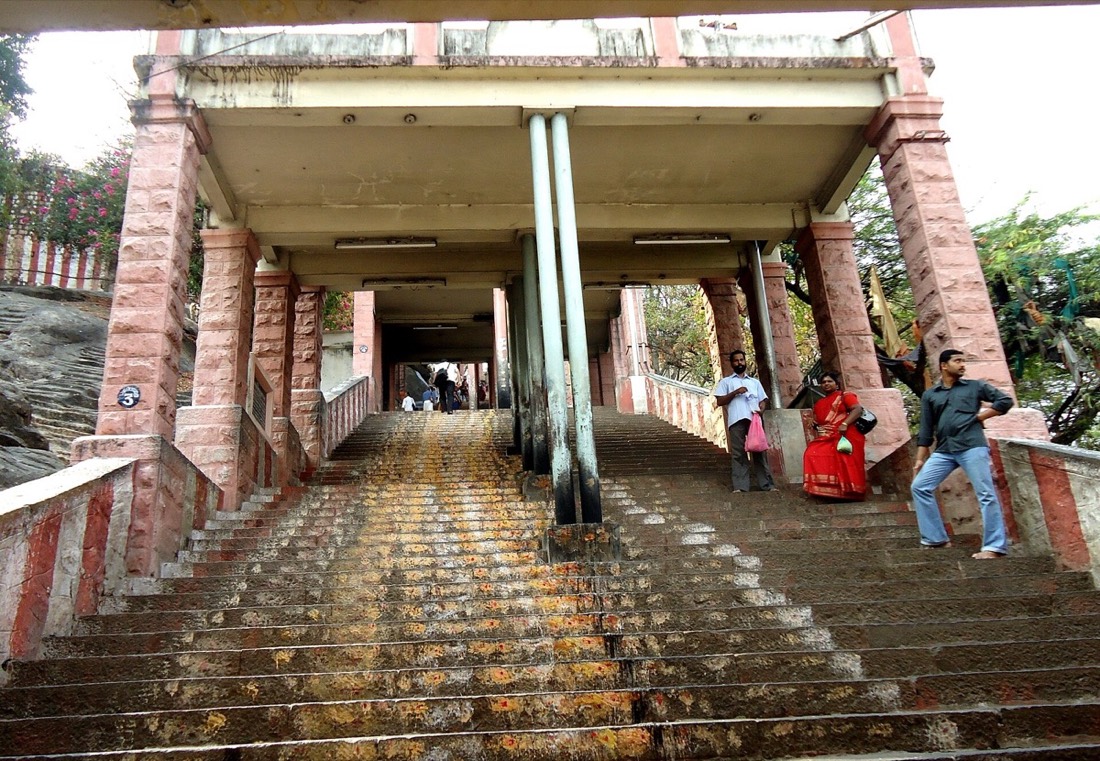
The portal describes four routes to the temple. There are the steps, 693 by its count, with shaded halls, drinking water and toilets along the way. There is a gentler elephant path, which it recommends for children and older pilgrims. Then come the winch, which it calls the electric traction rail, and a rope car that has run since 3 November 2004.
Timings, general darshan hours, online darshan-ticket booking, dress rules, charges and security rules are all on the official portal. The Tamil Nadu Hindu Religious and Charitable Endowments Department publishes it for Arulmigu Dhandayuthapani Swamy Temple. Entry conditions are set by the temple administration, so look there first. We read the portal on 3 November 2026.
Palani's panchamirtham is a prasada of banana, jaggery, cow ghee, honey and cardamom. A 2019 government announcement registered it as a geographical indication, the first for a temple prasadam in Tamil Nadu.
Questions people ask about Palani
Why is Murugan called Dhandayudhapani at Palani?
The name refers to the staff in his hand. The temple's portal describes the image as an andi, a renunciant who has given up possessions, holding a staff in a shrine that faces west. The fruit story is the tradition's devotional reason for why he lives on the hill as a recluse.
What is Palani's panchamirtham made of?
A 2019 government announcement that registered it as a geographical indication names banana, jaggery, cow ghee, honey and cardamom. It was the first geographical-indication registration for a temple prasadam in Tamil Nadu, and the prasada is also used in the abhisheka, the ritual bathing of the image.
Is the fruit story the origin of the name Palani?
It is a devotional explanation: pazham nī, "you are the fruit". The temple's own history page, as read from its Tamil, gives Pothini, the town's name in the Sangam age, which wore down into Palani. The fruit story does not appear on that page.
The younger one
One last detail comes from the portal's page on the inscriptions. It says the records call the deity Ilaiya Pillaiyar, which it glosses as "the one younger than Vinayaka". Vinayaka is Ganesha. The deed above reads Subramanya-pillaiyar, so this is the portal's summary, and no source ties either name to the fruit contest.
That connection is our observation, not the temple's claim. On the hill he holds a staff and has left the contest behind. In the records, he is still the younger brother of the one who won the fruit.
If more stories like Palani's are what you are after, Devam is coming soon on the App Store and Google Play. You can leave your email on the waitlist to hear when it opens.