Padmavathi Temple, Tiruchanur: The Gift That Walks Down the Hill
In Tiruchanur, near Tirupati in Andhra Pradesh, the Padmavathi Ammavari Temple holds an annual nine-day festival, the Karthika Brahmotsavam. On its last day, before dawn, a procession leaves the Venkateswara temple at Tirumala with a gift for the goddess here. She is worshipped as Padmavathi, as Alamelumanga and as Mahalakshmi, the consort of Venkateswara.
Why does the Lord of the hill send her a gift every year? A temple priest's account, published by the temple's administrators, answers with a pond, the Sun god and twelve years of waiting.
A procession leaves Tirumala at half past four
TTD, the Tirumala Tirupati Devasthanams, runs both temples. Its report of 6 December 2024 describes the morning.
At 2.30 am, inside the Tirumala temple, a mixture of aromatics is carried in procession: sandalwood powder, camphor, saffron and more. Then comes an Ekantha Tirumanjanam, a private ritual bath, for the Lakshmi who is worshipped on the chest of Srivaru. Srivaru is a respectful name for Venkateswara.
At 4.30 the gift itself sets out. It is called the sare, and it holds saffron, prasadam, tulsi garlands, silk clothes and ornaments. It goes round the four streets that circle the temple. Then, in TTD's Telugu version of the report, it is carried on foot down to Alipiri in Tirupati, below the hill.
A temple priest's description of the day, from 2019, fills in the rest. In Tirupati the sare is received with honours at the Kodandarama and Govindaraja Swamy temples. At Tiruchanur, temple officials meet it at a turmeric mandapam and lead it with music to the tank.
Twelve years on milk
The fullest account of why the gift travels is that priest's. Archakam Vakulabharanam Srinivasa Manikantha Bhattar gave it in a 2019 Telugu piece that TTD published, and he ties it to the Padma Purana. Here it is as he tells it.
In Vaikuntha, Srinivasa lies in yogic sleep when seven sages arrive, looking for the god who gives the fruit of sacrifice. He does not see the sage Bhrigu. Angry, Bhrigu kicks him on the chest. Padmavathi dwells there. She takes offence and goes away to Patala, the netherworld.
Srinivasa goes after her. With the help of Bhudevi, the earth goddess, he searches through fifty-six countries. At Kolhapur he worships the goddess whom the sage Agastya installed there. A voice from the sky then tells him to go to the bank of the Swarnamukhi river, bring golden flowers, and worship and do penance there. She will be pleased.
By the river he digs a pond with his weapon, the kuntalam. He calls Vayu, the wind god, and sends him to heaven for golden lotuses, with Indra's permission. So that the lotuses will bloom, Srinivasa installs the Sun god, Surya Narayana.
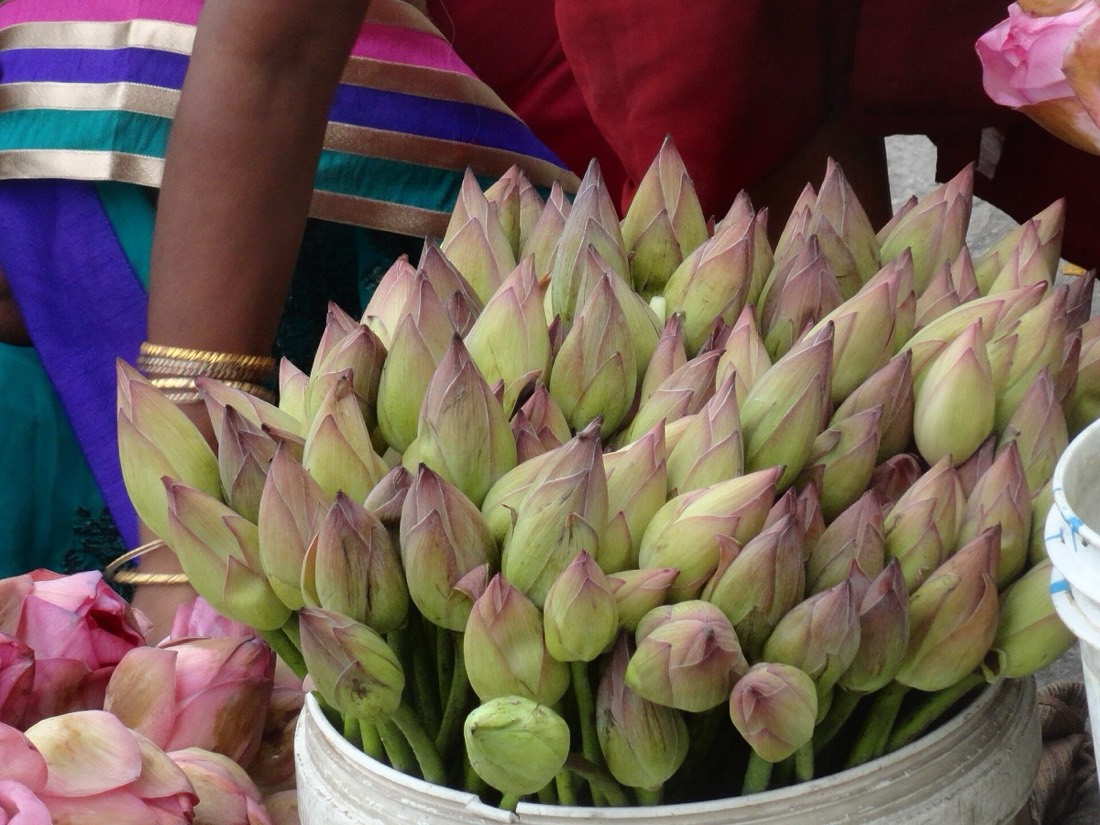
Then he waits. For twelve years he eats only milk and offers mantra, penance and worship. In the thirteenth year, on the fifth day of Karthika's bright fortnight, a Friday under the star Uttarashada, the air grows calm. Padmavathi rises from a thousand-petalled golden lotus.
Brahma, Shiva and Parvati, Indra and the seven sages arrive from the sky, and celestial musicians play. Padmavathi places a lotus garland around Srinivasa's neck. He adorns her with a lotus flower.
The priest adds what sets this telling apart. At the 108 divya desams, Vishnu's most celebrated shrines, he says the Bhavishyottara Purana has the goddess do penance for the Lord. At Tiruchanur the Padma Purana has the Lord do it for her. Here, it is Srinivasa who waits.
TTD's temple-legend page is less tidy. In one telling there, Mahalakshmi herself does the twelve years of penance before emerging from the lotus. In another, a king called Akasharaja finds a girl in a thousand-petalled lotus while ploughing for a sacrifice. These are separate accounts, and they are kept apart here.
A TTD note from 2017 supplies a sequel. After she appeared, it says, Venkateswara kept her on his chest as Vyuha Lakshmi and returned to Tirumala. The note counts one goddess at several addresses: Mahalakshmi at Kolhapur, Alamelumanga at Tiruchanur, Vyuha Lakshmi at Tirumala. Read that way, the gift travels from one home of the goddess to another.
Devam is bringing together stories like this one, for more than 1,000 Indian temples and for the gods and goddesses themselves. The app is coming soon on the App Store and Google Play, and you can join the waitlist to hear when it launches.
Where the sun meets the water
Opposite the temple tank, Padma Sarovaram, stands a small temple to Surya Narayana. TTD's page on the sub-temples says the image is believed to have been installed by Venkateswara himself, as a token of his worship of the Sun god. It also names the Venkatachala Mahatyam, a text about the Tirumala hill, as saying that Surya was instrumental in the golden lotus blossoming in full splendour.
So the water holds the flower, and the sun opens it. That is the temple's way of reading its own landscape, not a measured alignment.
The town's old name keeps the lotus too. TTD reads Alarmelmangapuram as the town of the goddess upon the lotus.
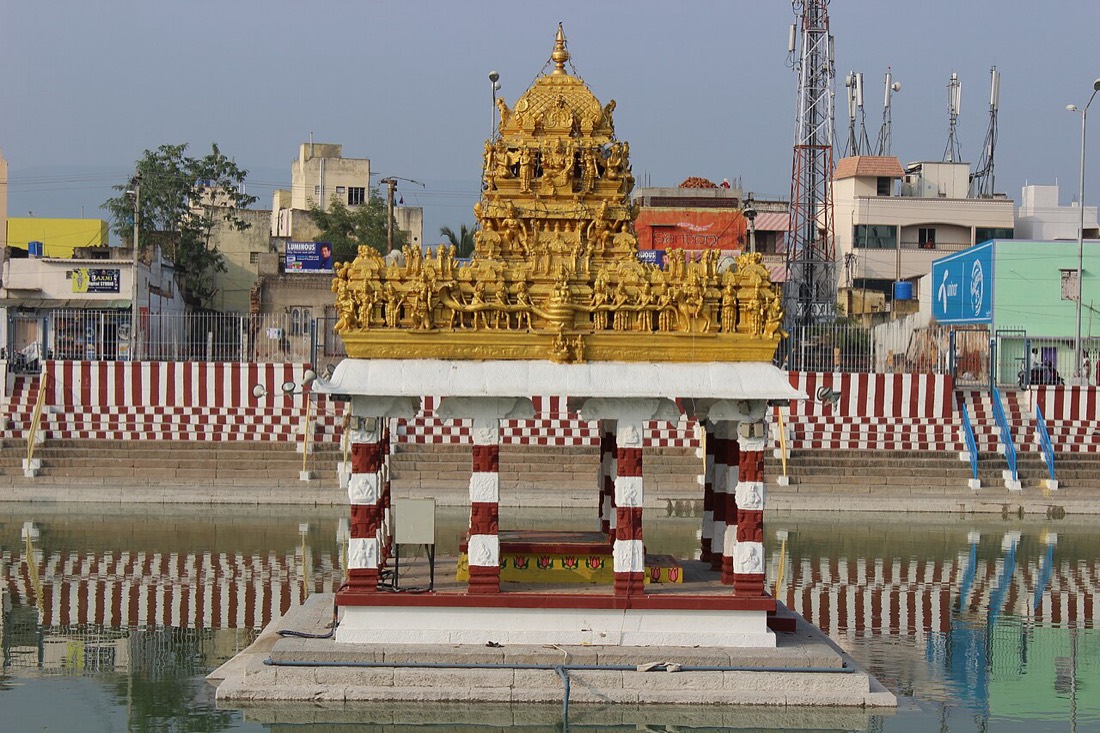
The tank is also the centre of Panchami Theertham, the festival's closing day and, in the priest's account, the day the goddess appeared. He calls it her birthday and says her festival image, the one carried in procession, is given an oil bath that morning. TTD's report of 25 November 2025 then has priests offer the sare to the goddess at the tank-side Panchami Theertha Mandapam. They perform Snapana Tirumanjanam, a ritual bathing, for her and for the Sudarshana Chakrattalwar, Vishnu's discus in personified form. The deity is decked with saffron, pineapple, dry fruits, rose petals and tulsi garlands.
At 12.10 pm the Chakrattalwar takes the sacred dip in the tank, which TTD also calls Padma Pushkarini, and devotees bathe with it. The reports read for this article do not describe the goddess's image entering the water. The discus goes in.
The date moves with the lunar calendar. The closing day was 6 December in 2024 and 25 November in 2025.
The earliest shrine here is Krishna's
The temple is a compound of shrines, and TTD's dates are for the neighbours. The Krishna shrine, called the Alagiyaperumal shrine, is the earliest inside the compound. TTD says historical evidence shows it existed by 1221 CE. A donor named Pokkiran gave the shrine a piece of land he had levelled for cultivation. Its servants agreed to hold the Panguni festival for the deity. The Sundararaja Swamy shrine to its south came, TTD says, sometime in the sixteenth century.
TTD's 2016 Brahmotsavam story links this order to the main gateway. A Krishna image brought from Mullapudi, a village next to Tiruchanur, was installed first, it says. That is why the temple's main entrance tower, the rajagopuram, faces the Krishna shrine. The legend page offers another builder: the temple was constructed in the time of Tondaman Chakravarthi, who in that tradition is Padmavathi's elder brother.
Even the rulebooks differ. TTD says worship at Tiruchanur follows the Pancharatra Agama, based on the Padma and Prasna Samhitas, while Tirumala follows the Vaikhanasa Agama. An Agama is a manual of temple ritual.
Seeing her before Tirumala
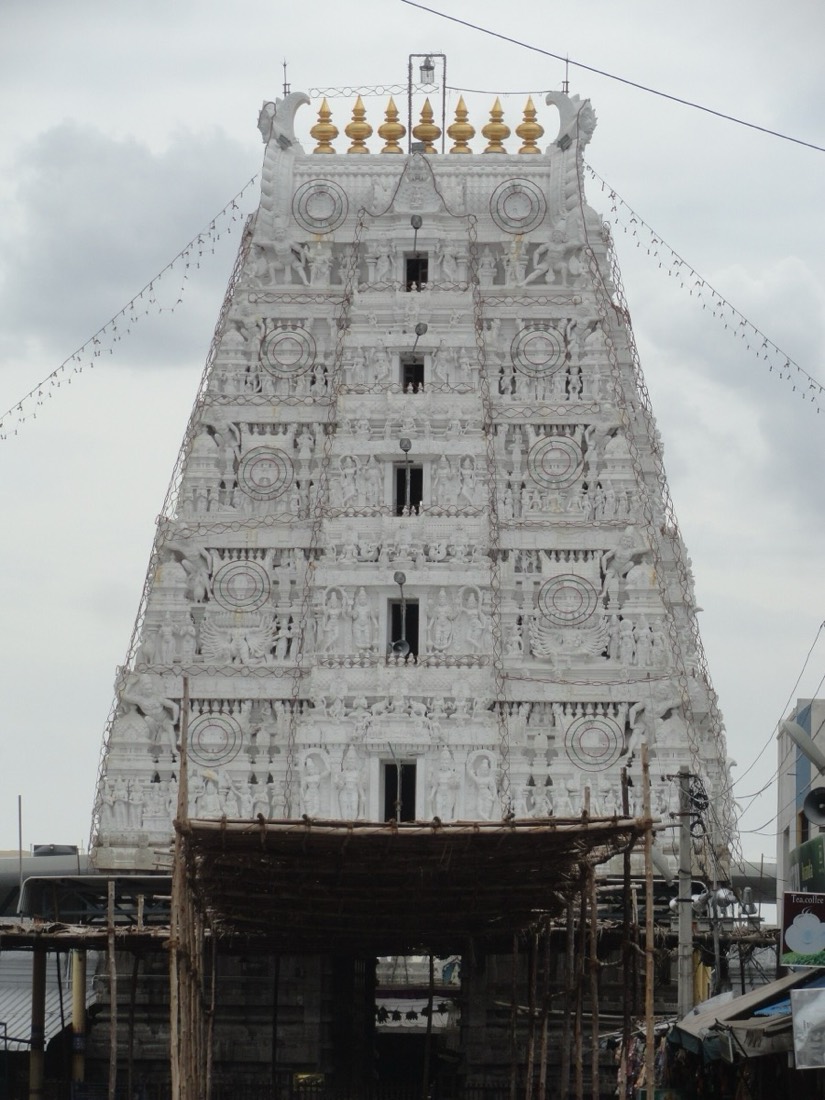
Tiruchanur is about 5 km from Tirupati. TTD runs the temple, and on 4 November 2026 the Tirupati district website still listed it under TTD's administration. TTD's legend page notes a strong belief among pilgrims that they should visit Padmavathi before they visit the Lord at Tirumala. It also advises booking sevas well in advance through TTD's official portal. Use that portal and TTD's notices for darshan, bookings, dress and rules. They change, so this article gives no timings.
Questions people ask about Padmavathi Temple
Are Padmavathi, Alamelumanga and Mahalakshmi the same goddess?
In TTD's accounts, yes. Padmavathi, Alamelumanga and Mahalakshmi name the goddess of Tiruchanur, said to have appeared on a golden lotus. A 2017 TTD note counts one goddess at several addresses, including Kolhapur, Tiruchanur and Venkateswara's chest at Tirumala, where she is called Vyuha Lakshmi.
Should I visit Padmavathi's temple before Tirumala?
TTD's legend page notes a strong belief among pilgrims that Padmavathi should be visited before the Lord at Tirumala. It describes this as a belief, and the TTD pages read for this article set no rule. TTD also advises booking sevas well in advance through its official portal.
Why is Padmavathi's temple at Tiruchanur and not on the Tirumala hill?
In the priest's account that TTD published, Padmavathi rose from a thousand-petalled golden lotus at Tiruchanur after Srinivasa waited twelve years, so the town is her place of appearance. A 2017 TTD note adds that after she appeared, Venkateswara kept her on his chest as Vyuha Lakshmi and returned to Tirumala. In that reading she is at both places.
Why did Venkateswara borrow from Kubera for his wedding with Padmavathi?
It is a widely told tradition, not a record. In the tradition, the Lord took a loan from Kubera, the treasurer of the gods, to meet the costs of his marriage to Padmavathi, and devotees' offerings at Tirumala are seen as helping him repay it. Wikipedia retells it on its Kubera page and its Tirumala temple page, which marks the passage as lacking a citation. The Kubera page says this is one reason Kubera is linked with Lakshmi. The TTD pages cited in this article do not tell it, so treat it as tradition.
When is Dhanteras in 2026, and are Lakshmi and Kubera worshipped together?
Dhanteras falls on Friday, 6 November 2026. Drik Panchang, a panchang site, says Goddess Lakshmi is worshipped with Lord Kubera on this day. Its puja window is 6:15 pm to 8:13 pm in Hyderabad and 6:14 pm to 8:10 pm in Chennai, and differs from city to city. Wikipedia describes Dhanteras as the day Dhanvantari, the physician of the gods, is worshipped, with the festival also celebrated as Lakshmi Puja and lamps lit for Yama. The sources read for this article describe no Dhanteras programme at the Padmavathi temple, so check TTD's notices.
When is Panchami Theertham?
It closes the nine-day Karthika Brahmotsavam, on the day devotees believe the goddess appeared from the lotus. The date moves with the calendar: it fell on 6 December in 2024 and 25 November in 2025. For 2026, posts reviewed for this article name 6 to 14 December, with Panchami Theertham on 14 December, but no TTD announcement was found, so check TTD's notices before planning.
Is the Tiruchanur temple the same as the Tirumala temple?
No. TTD runs both, but they are separate temples. The Padmavathi temple is about 5 km from Tirupati, while Venkateswara's temple stands on the Tirumala hill. TTD says Tiruchanur follows the Pancharatra Agama and Tirumala the Vaikhanasa Agama, so their rulebooks differ.
How old is the Padmavathi temple?
The sources read for this article give no founding date for the goddess's main shrine. TTD's legend page says it was built in the time of Tondaman Chakravarthi, which is tradition, not a date. TTD does date neighbours: it says the Krishna shrine existed by 1221 CE and the Sundararaja shrine came in the sixteenth century.
Who waits for whom
In the priest's telling, Srinivasa waits twelve years for the lotus to open. The pilgrim's road, as TTD describes it, runs the other way: first to Padmavathi, then to him. Once a year, on Panchami Theertham, a gift makes the trip in reverse, from his temple down to hers.
Devam also gathers bhajans, mantras, aartis and quizzes beside its temple stories, and it is coming soon to both the App Store and Google Play. The waitlist is open for anyone who wants to hear when it arrives.