Meenakshi Amman Temple, Madurai: the queen crowned before the bride
In Madurai, Tamil Nadu, one temple complex holds two principal shrines: Meenakshi, the fish-eyed goddess identified with Parvati, and Sundareswarar, a form of Shiva. A Tamil poem tells how they came to marry, and it begins earlier than the wedding, with a crown. This article follows that story to its end, then looks at how the temple's festival keeps its order. It closes with a different kind of record: a court case that followed a day of worship in 1939.
The daughter nobody planned for
The story comes from the Tiruvilaiyatar Puranam, Paranjoti Munivar's Tamil poem on Shiva's acts in Madurai. What follows paraphrases its fourth chapter as sacred narrative, not as the record of a royal birth.
King Malayadhvaja of the Pandya line and Queen Kanchanai have no child. The king performs horse sacrifices, ninety-nine of them. Indra, king of the gods, grows anxious: a hundredth would threaten his own seat. So he steers the king towards another rite, a sacrifice for offspring.
From that fire a girl appears. She is three years old, and she has three breasts. The queen lifts her, embraces her and kisses her. The king sees a daughter when he wanted a son, and he fears that his enemies will laugh at her unusual body.
Then a voice speaks from the sky. Give her the rites meant for a prince, it says. Name her Tatatakai. Crown her. And when she meets her future husband, the third breast will vanish. The king's worry about an heir gets its answer in one breath: she is the heir.
Crowned first, then off to Kailasa
Tatatakai is trained for the throne. She learns the arts, the handling of elephants, chariots and horses, and the use of weapons. When the king is old, he arranges the coronation. Sacred waters are brought, kings and ministers gather, and she is crowned and carried round the city on an elephant. Only after that does her father die. She performs his rites and rules.
Her mother then raises the matter of marriage. The young queen replies that it will happen in its time. First she will win victory in every direction. Her minister Sumati is with her, and kings fall before her army, then the guardians of the directions. At Kailasa, Shiva's mountain, Nandi's forces come out against her and are defeated.
Then Shiva himself appears. At the sight of him, the sign promised at her birth comes true: the third breast is gone. Sumati recognises what that means. Shiva promises to come to Madurai for the wedding, and she returns home to prepare. The poem's fifth chapter tells this part.
In this telling, the husband meets a ruler. She has been trained, crowned and victorious before he arrives.
If you like temple stories told this fully, join the waitlist for Devam, which is bringing together the stories of more than 1,000 Indian temples and is coming soon on the App Store and Google Play.
Madurai still keeps the order
The festival follows the poem's sequence. Each year in the Tamil month of Chithirai, roughly April to May, the days run from Meenakshi's coronation (pattabhishekam) to a conquest procession (Digvijayam), then the wedding, then the chariot procession. The dates follow the lunar calendar, so they move: reports place the wedding on 2 May in 2023 and 8 May in 2025.
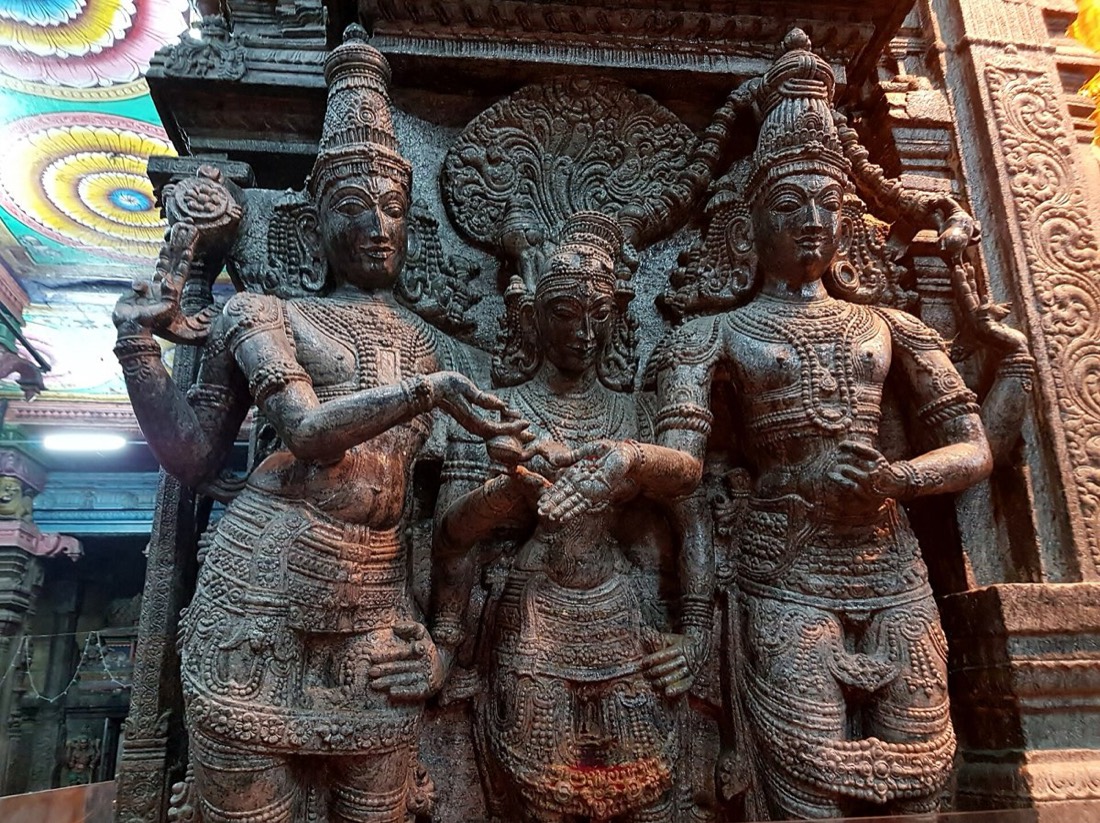
The photograph above shows a carved group in the complex. In the wedding as tradition tells it, Vishnu is Meenakshi's brother and gives her hand to Shiva.
At the 2023 coronation, a report says, the goddess's diamond crown was bathed and worshipped with lamps, and a golden sceptre was carried round the shrine's circuit and placed near her. The same report says the festival is said to mark the passing of rule over the city from Sundareswarar to Meenakshi, who is believed to hold it from Chithirai to Avani, about April to September. In 2025, a report puts the conquest procession on 7 May, the day before the wedding.
One temple, many builders
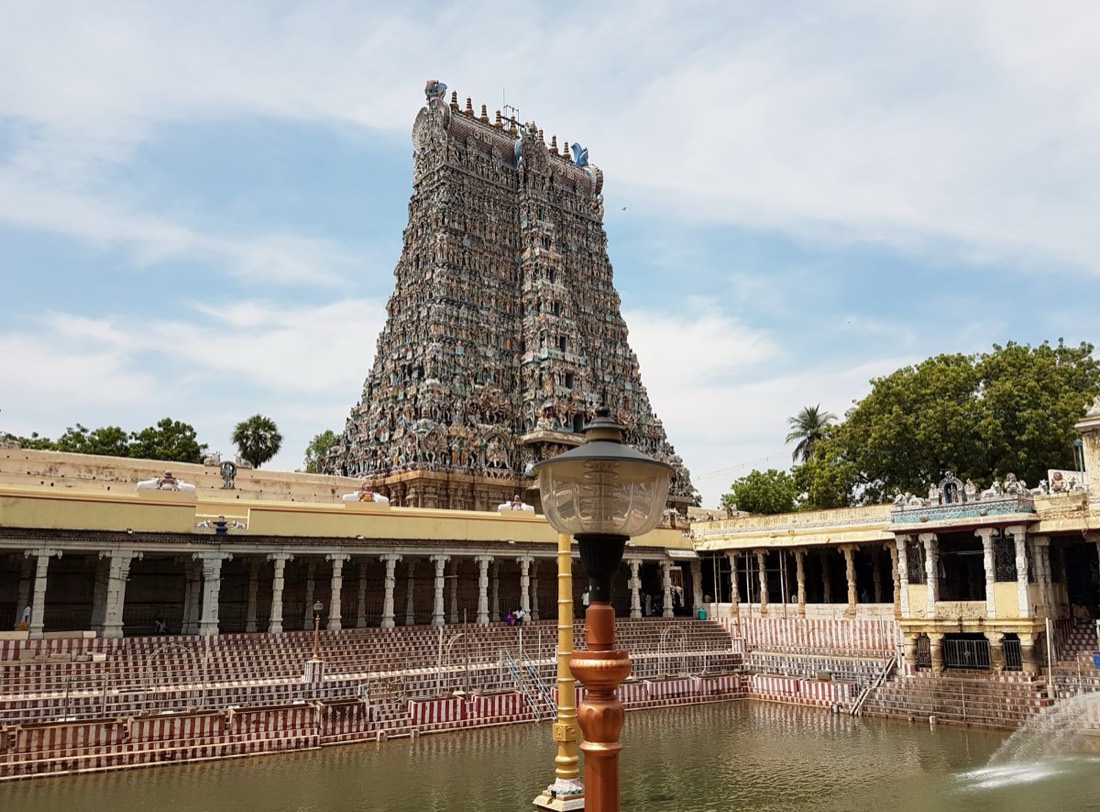
The complex that stages all this was built over time. Madurai district's official page says it grew with the contributions of successive dynasties, expanded greatly under Thirumalai Nayak (1623 to 1655), and has five massive gateways enclosing the two shrines. The page also says the temple first came into being 2,000 years ago. That round figure is the page's own claim, not a dated foundation.
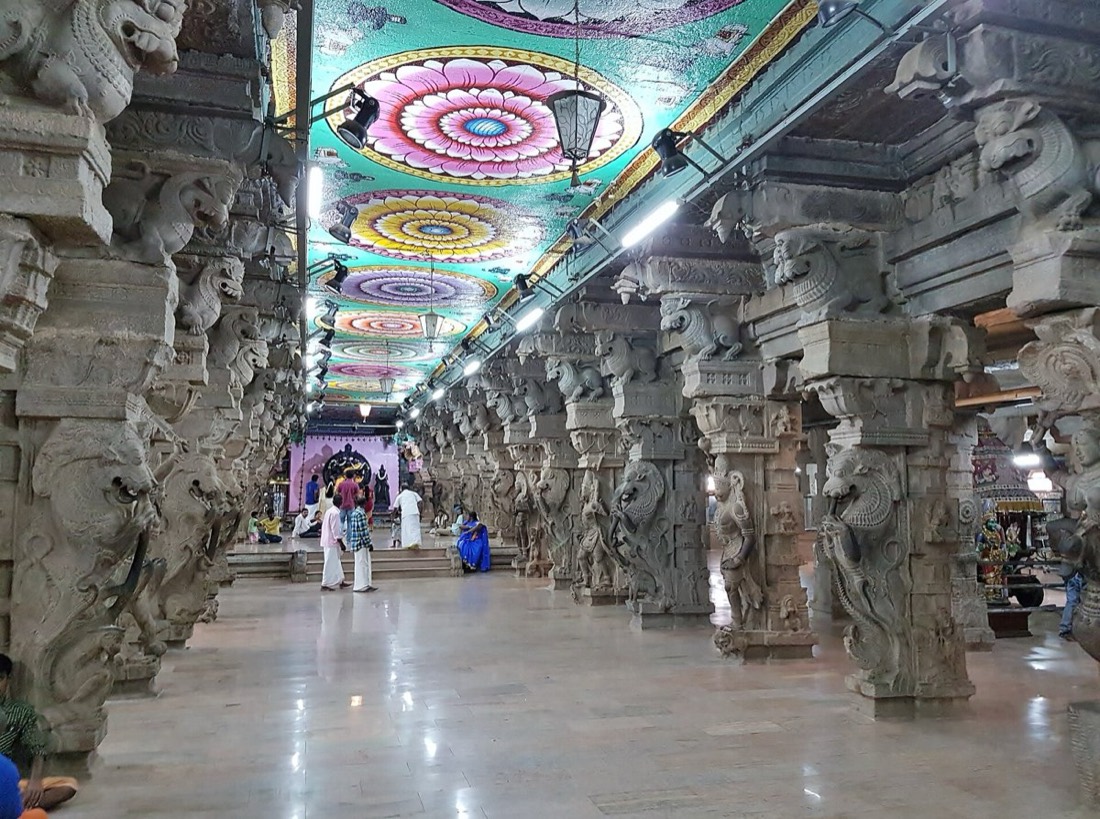
The same page picks out the Hall of Thousand Pillars, where each pillar carries bold, life-like sculpture, and the outer corridors, where stone pillars are said to sound different notes when tapped. Those are the page's descriptions.
On 17 September 2026, Organiser reported, the temple held a maha kumbhabhishekam, the consecration ceremony of its towers, 17 years after the previous one. The photographs in this article were taken in 2017.
The July morning in 1939
On 8 July 1939, people whom the temple's custom had kept out because of caste entered to worship. A 2019 profile names A. Vaidyanatha Iyer, president of the Harijan Sevak Sangh, and P. Kakkan among those who led them in.
What followed is set out in a Madras High Court judgment of 15 December 1944. Five days after the entry, on 13 July, the plaintiffs filed suit. They called the entry desecration and asked for purification rites, orders barring the worshippers' return, and a deposit in court towards the cost of purification. Their pleading says the temple's executive officer received the group at the entrance and a priest performed puja at three shrines.
Then the law moved. The Madras Temple Entry Authorisation and Indemnity Act, 1939, protected those involved in the entry and listed the Meenakshi temple among seven in its schedule. It also required the provincial government's sanction to continue a suit already pending, and that sanction had been refused. The High Court held that the provincial legislature could pass the Act and that the suit could not be maintained. It dismissed the appeal with costs.
The court did not decide where different communities may worship inside the temple, because nobody had raised that in the pleadings. It is a narrow ruling, but a documented one.
Checking the temple's own notices
As of 10 November 2026, the temple's official HR&CE page, last updated that day, lists a morning and an evening darshan session with a break in the afternoon, and says daily puja timings change at festival time. The district's tourism page gives a different evening closing hour. Dress, phone and photography rules, bookings and festival-day arrangements are not covered here; the temple's official notices settle them.
Questions people ask about Meenakshi Amman Temple
Who is worshipped at the Meenakshi Amman Temple?
Meenakshi, the fish-eyed goddess identified with Parvati, and Sundareswarar, a form of Shiva, are enshrined in two principal shrines within one complex in Madurai. Madurai district's official page calls it a twin temple, with five massive gateways enclosing the two shrines.
Is Meenakshi's coronation history or tradition?
It is sacred narrative, told in the Tamil Tiruvilaiyatar Puranam, and the festival that keeps its order is living practice. Neither dates a royal birth or the temple's founding. The documented history here is narrower: the Nayak-period expansion the district describes, and the 1939 entry and court case.
When is the Chithirai festival held?
Each year in the Tamil month of Chithirai, roughly April to May, with dates that follow the lunar calendar. Reports place the wedding on 2 May in 2023 and 8 May in 2025. Because the dates move, the temple's official notices are the place to confirm any particular year.
What did the 1944 High Court judgment decide?
The Madras High Court held that the provincial legislature could pass the 1939 temple entry Act and that the plaintiffs' suit over the entry could not be maintained, so it dismissed their appeal with costs. It expressly left open where different communities may worship inside the temple.
Crown, conquest, wedding
Strip the Madurai festival to its order and the poem is still there: crown, conquest, wedding. In the poem, the goddess meets her husband as a queen who has already been crowned and has already won her wars, and the festival gives its days in that sequence.
Devam, coming soon on Google Play and the App Store, is gathering the stories of more than 1,000 Indian temples and of the gods and goddesses at their centre. To hear when it opens, join the waitlist.