Konark Sun Temple: Twenty-Four Wheels and the Slab That Stayed
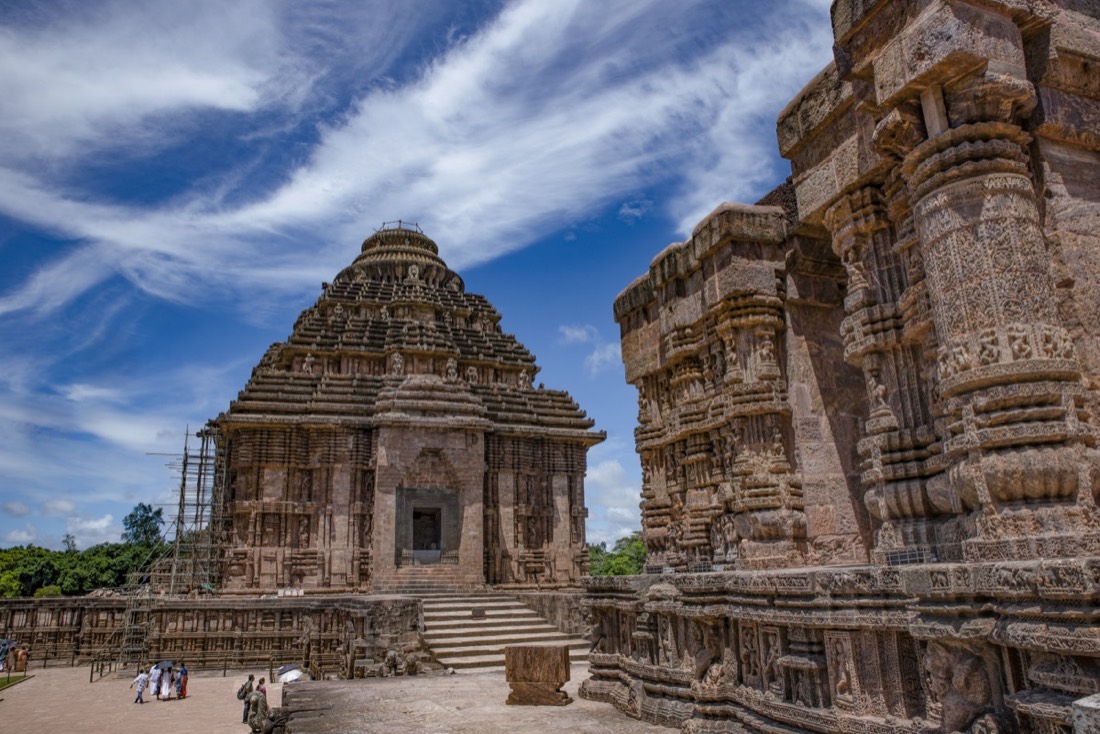
UNESCO counts twenty-four carved wheels on the platform of the Sun Temple at Konark, on the coast of Puri district in Odisha: twelve pairs, each about three metres across. Seven horses are carved at the eastern stair. Together they turn a thirteenth-century temple into a chariot for Surya, the Sun god.
The wheels and horses survive. The sanctuary tower does not. The tall stepped building in most photographs is the assembly hall that stood in front of it, the jagamohana. Here is what fell, what sand buried and what was carried off. Above all, it is about one carved slab of nine planetary deities that officials tried to send to Calcutta in the nineteenth century. It never arrived.
The chariot that stops at its wheels
UNESCO ties the wheel motifs to the seasons and months. It dates the building to the reign of Narasimhadeva I of the Eastern Ganga dynasty, 1238 to 1264, and has listed it since 1984. The Archaeological Survey of India (ASI) protects it. UNESCO's one-line summary says six horses; its fuller statement says seven, as does the archaeologist Debala Mitra, whose 1968 ASI monograph is the main source here.
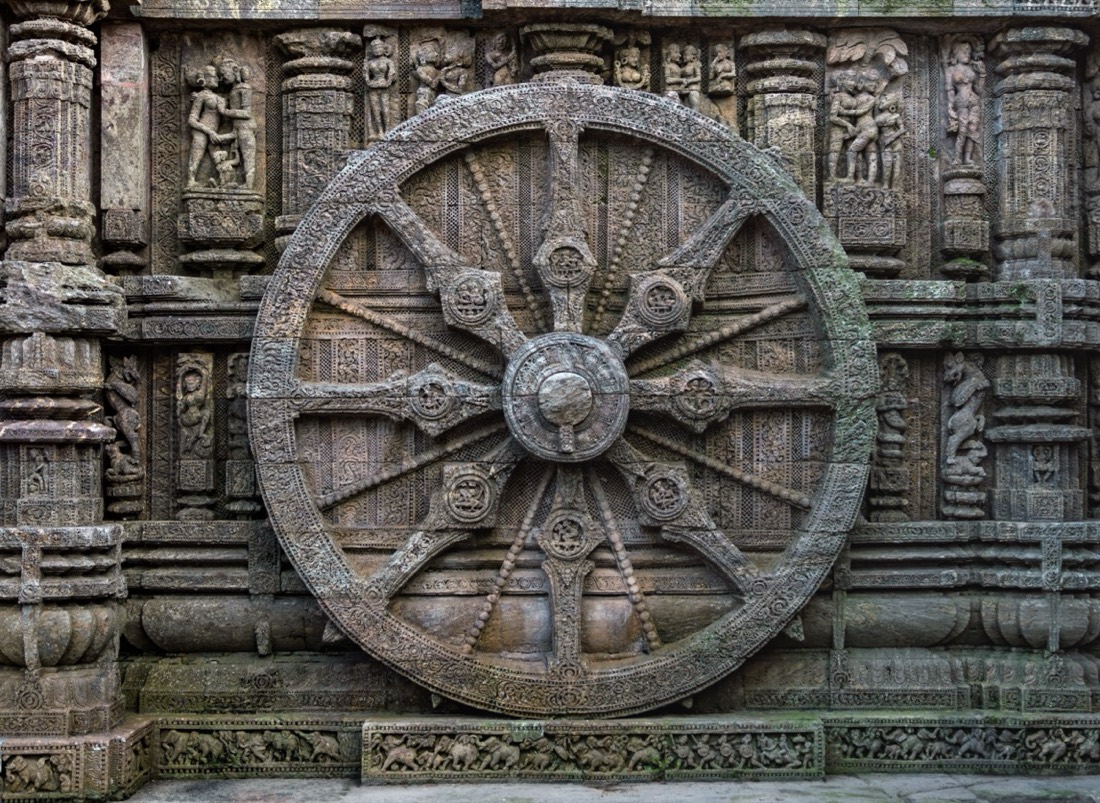
Mitra notes that the chariot idea goes no further than the wheels and horses. Behind them stands an ordinary Odishan temple: a sanctuary with a curving tower and, in front of it, the jagamohana, whose roof climbs in horizontal tiers.
Tourism pages, an official one among them, call the wheels sundials that tell time by the spokes' shadows. No builder's text or survey consulted for this article tests that, so it remains a popular explanation, not a measurement.
A tower lost by degrees, wheels lost to sand
The tower fell slowly. A. Stirling, who saw it shortly before 1825, estimated a section still at about 120 feet and said it looked from a distance like "a ship under sail". A gale in October 1848 brought down the last strip.
Mitra reads the cause as neglect: trees rooting in the stonework, and iron cramps that rusted and split the stone. By 1838, Kittoe recorded, workmen of the Raja of Khurda were stripping carved stones from the hall's doorways to carry to Puri. Mitra adds that local people took stone and iron too. The story that a magnet at the summit pulled ships ashore is, in her account, a legend, and no record consulted supports it.
One piece was moved rather than lost. The Aruna pillar, named for the Sun's charioteer, was taken by the Marathas to Puri in the eighteenth century and now stands in front of the Jagannath temple.
The wheels vanished under drifting sand; Mitra infers this from Stirling saying nothing about them. After the Lieutenant-Governor, Sir John Woodburn, visited in December 1900, a clearance began, and in April 1901 a trench at the foot of the assembly hall exposed a wheel. Later, to keep the hall from collapsing, engineers packed its interior with sand and sealed the doors.
The nine-planet slab and the road to the sea
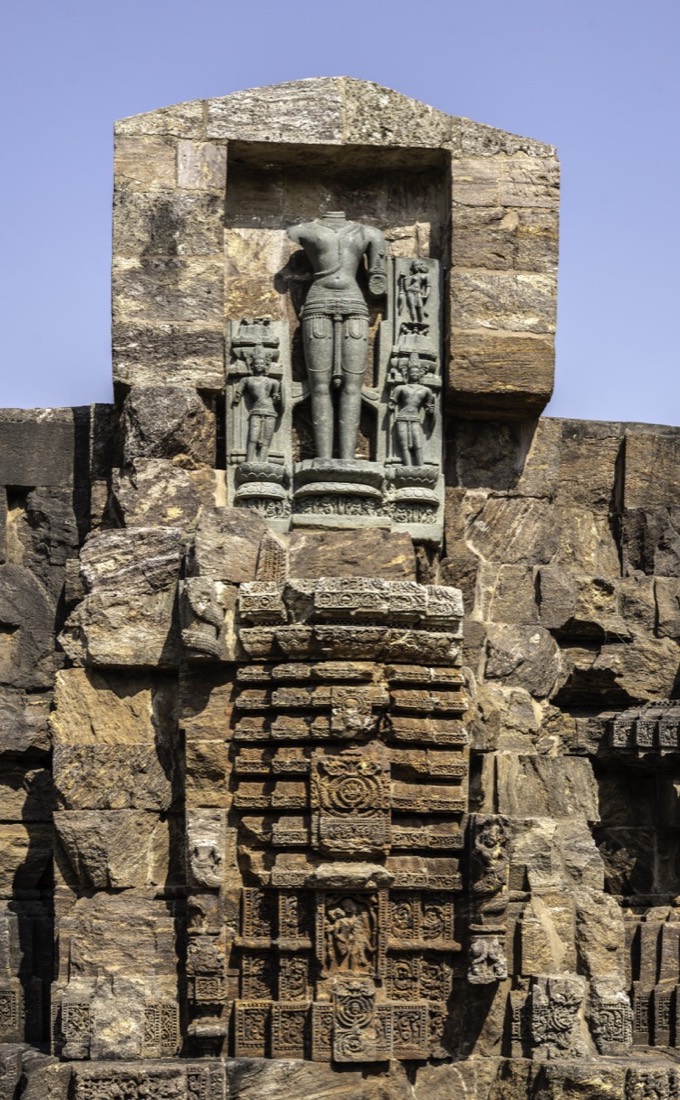
Above the eastern doorway of the assembly hall once sat a long carved stone showing the navagraha, the nine planetary deities. They are the Sun, Moon, Mars, Mercury, Jupiter, Venus, Saturn and the shadow planets Rahu and Ketu. Mitra concludes it was brought down before 1838, during the stripping of the doorways. That year the Government told the Raja to take no more stone. Deborah Sutton's study of colonial custody of temples gives its weight as over 24 tonnes.
In 1859 the Asiatic Society of Bengal proposed moving it to the Indian Museum in Calcutta. The route was by sea, but a stone this heavy first needed a road to the water. The attempt of 1867 spent its money on a tramway and carried the slab only to just outside the south-eastern corner of the enclosure, with the sea still about three kilometres away.
Officials tried again in 1892 and 1893 and lightened the load by slicing the slab lengthwise. The plain back stayed. The carved front went onto a specially made truck and was drawn some metres towards Telikood Creek, where it was to join thirteen smaller sculptures on a barge.
Then, as Mitra tells it, local people objected on religious grounds. In 1893 the Bengal Government ordered the Public Works Department to leave the slab alone. Only the thirteen smaller sculptures reached Calcutta, in 1894. The navagraha slab was later moved into a sculpture shed.
The argument now moved to the shed door. By the first decade of the twentieth century, Sutton writes, the stone was being worshipped. In February 1915 the sevaks, the temple servants who attended it, petitioned the government. They said their worship continued the main temple's tradition, yet the archaeological department's control of the shed limited their access: a watchman opened it, and the priest was sometimes locked out.
In 1921 the collector of Puri, R. E. Russell, urged extreme caution, since the museum could in effect become a temple. No decision was taken. Under every dispute lay a single question, whether the stone is an exhibit or an object of worship.
By 1968, Mitra reports, the ASI had moved the slab to a new shed beyond the north-east corner of the enclosure and ended the practice of smearing it with vermilion and oil. She also notes that on Magha Saptami (January or February) pilgrims bathe before sunrise in the Chandrabhaga, a shallow pool within about three kilometres of the temple. Afterwards they go on to worship the navagrahas.
If you enjoy a temple's story told through its stones, Devam is an app coming soon on the App Store and Google Play, with stories of more than 1,000 Indian temples. Its waitlist is open for word of the launch.
Samba's twelve years of penance
The sacred story tied to Konark is about a cure, not a construction. In Mitra's summary of the Bhavishya and Samba Puranas, Krishna's son Samba, vain about his looks, mocks the sage Narada. Narada contrives revenge: he leads Samba to the bathing place of his stepmothers, then brings Krishna there, and Krishna curses his son with leprosy. Samba proves his innocence, but the curse cannot be withdrawn.
Sent to Mitravana, beside the Chandrabhaga, to win over Surya, healer of skin disease, he does twelve years of penance and is cured. Bathing the next day, he finds an image of the god shaped by Vishvakarma from Surya's body, and installs it in a temple he builds.
Mitra thinks the Bhavishya Purana set this by the Chandrabhaga that is the Chenab, at modern Multan, and sees Konark's version as a later transfer.
The craftsmen's legend, with two endings
UNESCO itself calls the best-known story of Konark's builders a legend. Twelve hundred artisans worked for twelve years under a master builder, Bisu Moharana, who had left home before his son was born. The grown son completed the cupola his father could not, then jumped to his death.
Gopabandhu Das's Odia poem Dharmapada ends differently. Its boy, Dharmapada, goes to Chandrabhaga to find his father among the builders. King Narasimha has ordered that if the temple is not finished within two days, the craftsmen's heads will be cut off. The boy finishes it overnight, which puts the builders in fresh danger, and his father is torn between his son and the twelve hundred. Dharmapada decides for himself: he goes into the river at night, and it carries him out to sea.
No document consulted fixes the boy or the numbers, and Mitra rejects the idea that the temple was never finished, since the sanctum's platform and spouted pedestal show long religious use.
Visiting while the sand comes out
Konark is a ticketed ASI monument. On 3 November 2026 the Odisha Tourism page for the temple showed hours of 6:00 am to 8:00 pm and an entry fee. It is undated, as is another tourism page that repeats them, so check with the ASI, whose homepage links to online ticketing. In November 2025, a PTI report said, the ASI barred visitors from entering or climbing the Nata Mandap, the eastern pavilion, and from touching the carvings after tourists were hurt in falls. No end date was given.
Reports describe the assembly hall's interior as sealed while engineers remove the sand. The latest report found, from 21 August 2026, calls the work ongoing with no completion date. Where the slab stands now, and what worship goes on at it, could not be confirmed. Entry to the monument, the slab's shed and the bathing ground are separate matters.
Questions people ask about the Konark Sun Temple
Is the Konark Sun Temple still a place of worship?
Konark is a ticketed monument protected by the Archaeological Survey of India and listed by UNESCO. In 1968 the archaeologist Debala Mitra recorded pilgrims bathing in the Chandrabhaga on Magha Saptami and going on to worship the navagrahas. Where the slab stands now, and what worship goes on there, could not be confirmed.
Did the Konark wheels work as sundials?
Tourism pages, an official one among them, call the wheels sundials that tell time by the spokes' shadows. No builder's text or survey consulted for this article tests that, so it remains a popular explanation, not a measurement.
Who built the Konark Sun Temple?
UNESCO dates the building to the reign of Narasimhadeva I of the Eastern Ganga dynasty, 1238 to 1264. The well-known story of twelve hundred craftsmen under a master builder, Bisu Moharana, is a legend, as UNESCO itself says, and no document consulted fixes the boy or the numbers.
What the count comes to
So the count at Konark comes to twenty-four wheels, seven horses, no tower, one pillar in Puri and a stone that two attempts could not get to the sea.
Devam is coming soon to the App Store and Google Play, with stories of gods and goddesses as well as temples, and with bhajans, mantras, aartis and quizzes. If you would like to know when it opens, leave your email on the waitlist.