Kashi Vishwanath, Varanasi: Shiva and the King With No Fault
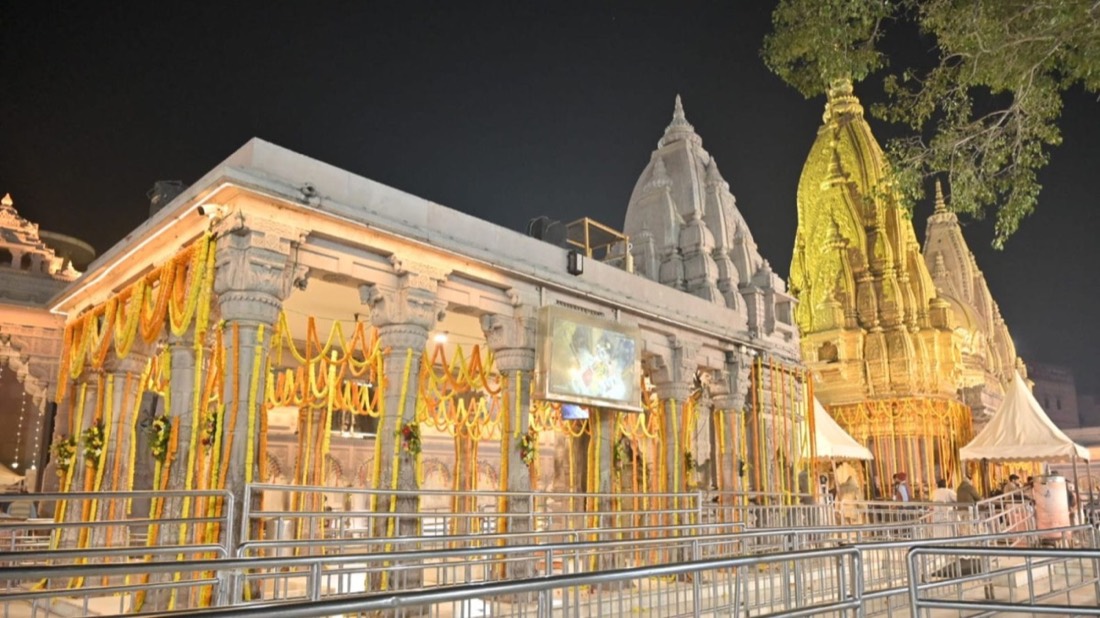
On Mount Mandara, Shiva sits in a jewelled palace and cannot enjoy it. He is homesick for Kashi, the city now called Varanasi, where the Shri Kashi Vishwanath Temple stands today and where he is worshipped as Vishwanath, the Lord of the Universe. No demon holds the city and no curse bars the way. What keeps him on Mandara is its king, who is so good that no god can find a fault in him. The Kashi Khanda of the Skanda Purana tells how that standoff ends: with envoys who never come back, an astrologer who is really Ganesha, and the one fault the king turns out to have.
A god homesick on Mandara
This version follows Tagare's translation of the Kashi Khanda; other retellings of Divodasa's story differ in details. In chapter 44, the gods sit around Shiva and he is miserable. He rubs sandal paste on his skin to cool the fever of separation, and it dries into something like ash. He ties lotus stalks round his wrists, then cries out that they are snakes. One line gives him away: even a wind blowing from Kashi, he says, might cool his limbs when a snowfield cannot.
Parvati asks what separation an all-powerful god could feel. His answer is a name, Kashi. She describes the city, which she says he holds up on his trident when the waters rise at the end of an age, and asks to be taken there.
So why not go? Because the city is in good hands. Chapter 43 says Shiva went to Mandara at Brahma's request and the other gods followed. In their absence King Divodasa rules Kashi so righteously that the gods, hunting for a weakness, find none in eighty thousand years. Indra tries a trick: Fire is withdrawn from the earth, so that people without their sacred fires will turn on the king. Divodasa tells his citizens not to be afraid. He will do fire's work himself, and the Sun, his family's own deity, may stay.
Shiva's reasoning, in verses 53 to 57 of chapter 44, is that he has no heart to attack a king who has done no wrong. People who keep to righteousness are the very ones he should protect. So there will be no army. He will send someone to look for a fault.
The envoys who never came back
The first to go are the sixty-four Yoginis. They enter Kashi in disguise, as red-robed ascetics, a gardener's wife, a physician, a dancer, a palmist and more. They search and find no opening. Then the errand turns. They decide not to go back, because they could live without their lord but not without Kashi (chapter 45).
On Mandara, Shiva starts counting. The Yoginis have not returned. Neither have the Sun, Brahma or a band of his own attendants (chapter 55, verse 32). Everyone sent to find a flaw in Kashi has fallen for it instead.
The astrologer who was Ganesha
So Shiva sends Ganesha, who arrives as an old Brahmin astrologer. At night he sends the citizens frightening dreams. In the morning he explains the omens, and some people flee. He wins over the women of the inner apartments by telling them events they have lived through, and Queen Lilavati brings him to the king (chapter 56).
Divodasa has done everything a king should, yet he admits that nothing holds his mind any more. The astrologer tells him to wait. On the eighteenth day a Brahmin will come from the north, and the king should do as he says.
The one fault, and the road home
The visitor is Vishnu in disguise, called Punyakirti in chapter 58. He names the fault that remains, the greatest of all: the king has kept Vishveshwara, Shiva, far from Kashi. The remedy is to install a linga, which, the Brahmin says, clears even sins as many as the hairs on one's body.
Divodasa crowns his eldest son and installs a linga named after himself, Divodaseshwara. A divine chariot descends, full of Shiva's attendants, and the king leaves in it. Chapter 56 looks ahead to the result: with the city renovated by Vishvakarman, Shiva comes from Mandara to Varanasi (verses 82 and 83). The text does not tell the king's exit in one voice. Tagare titles chapter 58 "Attainment of Salvation by Divodasa", while that passage in chapter 56 has Vishnu expelling him.
In all of this Shiva sends envoys, not an army. One way to read the story, and it is a reading rather than the text's own claim, is that a flawless reign had left no place in it for the god of the city.
Devam is a coming-soon app, headed for the App Store and Google Play, built around the stories of more than 1,000 Indian temples and of gods and goddesses, with bhajans, mantras, aartis and quizzes. If tales like this one are what you look for, you can join its waitlist.
What Kashi kept
The Kashi Khanda gives the city a holiness older than any building, and it dates no stone. For the stones, the sources have to be named one by one.
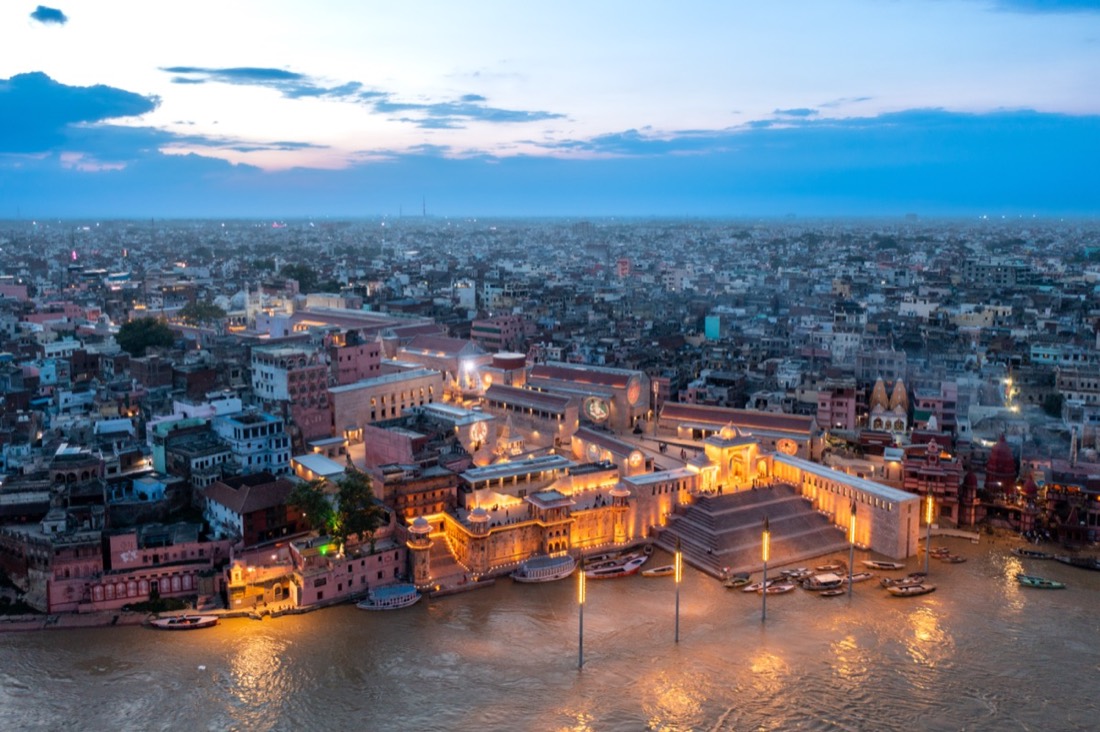
The Temple Trust places the temple in the heart of Varanasi, on the Ganga's western bank, and describes its linga as a Jyotirlinga, a linga of light. The temple pilgrims enter today was built by Maharani Ahilyabai Holkar of Indore. The Trust dates it to 1780. The historian Mahesh Gogate says rebuilding began in 1775 and the consecration came on 25 August 1777. The Trust adds that Maharaja Ranjit Singh of Punjab gave gold in 1839 to cover two of its domes. The Gyanvapi mosque stands beside the temple complex; cases concerning it have been before the courts and lie outside this article.
The approach changed in 2021. Shri Kashi Vishwanath Dham, widely called the Kashi Vishwanath Corridor, is a walkway-and-courtyard complex meant to link the temple with the Ganga, and its first phase was inaugurated on 13 December 2021. The government's preview release says the project meant acquiring more than 300 properties, rehabilitating around 1,400 shopkeepers, tenants and homeowners, and restoring more than 40 older temples that were rediscovered. The Dham is a recent setting. It belongs neither to the Kashi Khanda's story nor to the temple's older history.
Questions people ask about Kashi Vishwanath
Is the story of Divodasa and Shiva history?
No. It is the Skanda Purana's Kashi Khanda, read here in Tagare's translation, and other retellings differ in details. The Purana gives Kashi a holiness older than any building but dates no stone. The temple's documented history is a separate matter.
Who built the temple standing today?
Maharani Ahilyabai Holkar of Indore. The Temple Trust dates the building to 1780, while the historian Mahesh Gogate says rebuilding began in 1775 and the consecration came on 25 August 1777. The sources differ on the date, not on the builder.
What is the Kashi Vishwanath Dham?
Shri Kashi Vishwanath Dham, widely called the Kashi Vishwanath Corridor, is a walkway-and-courtyard complex meant to link the temple with the Ganga. Its first phase was inaugurated on 13 December 2021. It is a recent setting, separate from the Purana's story and the temple's older history.
Planning darshan at Vishwanath
The Trust's portal is the authority and its rules change, so treat this as orientation. These details were checked against the Trust's pages on 3 November 2026.
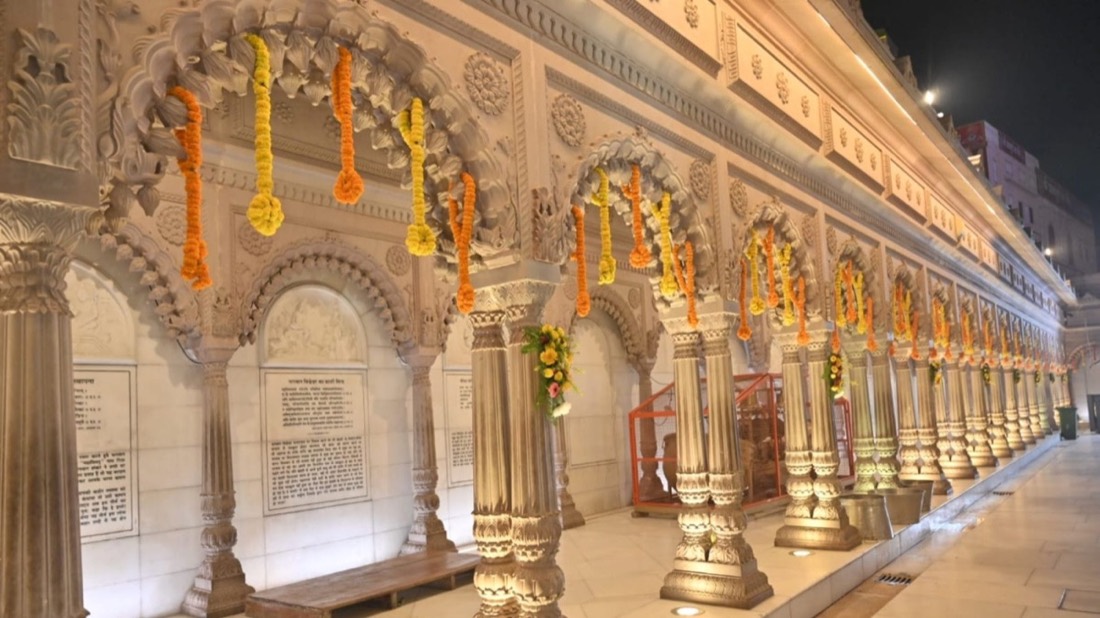
Timings: the Trust's pages disagree on aarti timings. Its Important Notices page has the temple opening at 2:45 am for Mangala aarti and closing at 11 pm after Shayan aarti, while its aarti page lists Mangala aarti at 3 to 4 am. Purnima, eclipses and other special days can change the hours.
Permissions are separate matters: when an aarti starts, when you must report for it, general darshan, a booked aarti, the paid Sugam Darshan queue and standing near the sanctum. The Notices page says a valid ticket is mandatory for Mangala aarti, and nothing else follows from that.
Belongings and roads: phones, smart watches, cameras and other recording devices are not allowed in the premises or sanctum, and lockers are limited. The stretch from Godowlia to Maidagin is closed to vehicles, and Ganga Dwar entry may be restricted.
From afar: the portal lists a free live darshan feed.
When Shiva sends the Yoginis, the Sun and Brahma to Kashi, none of them comes back. In the end the god has to come himself.
Kashi is one of many Indian temples with a story worth retelling. Devam, an app coming soon on the App Store and Google Play, is being built around such stories, together with bhajans, mantras, aartis and quizzes, and its waitlist is open.