Kalika Mata Temple, Chittorgarh: a Sun temple that became a goddess's
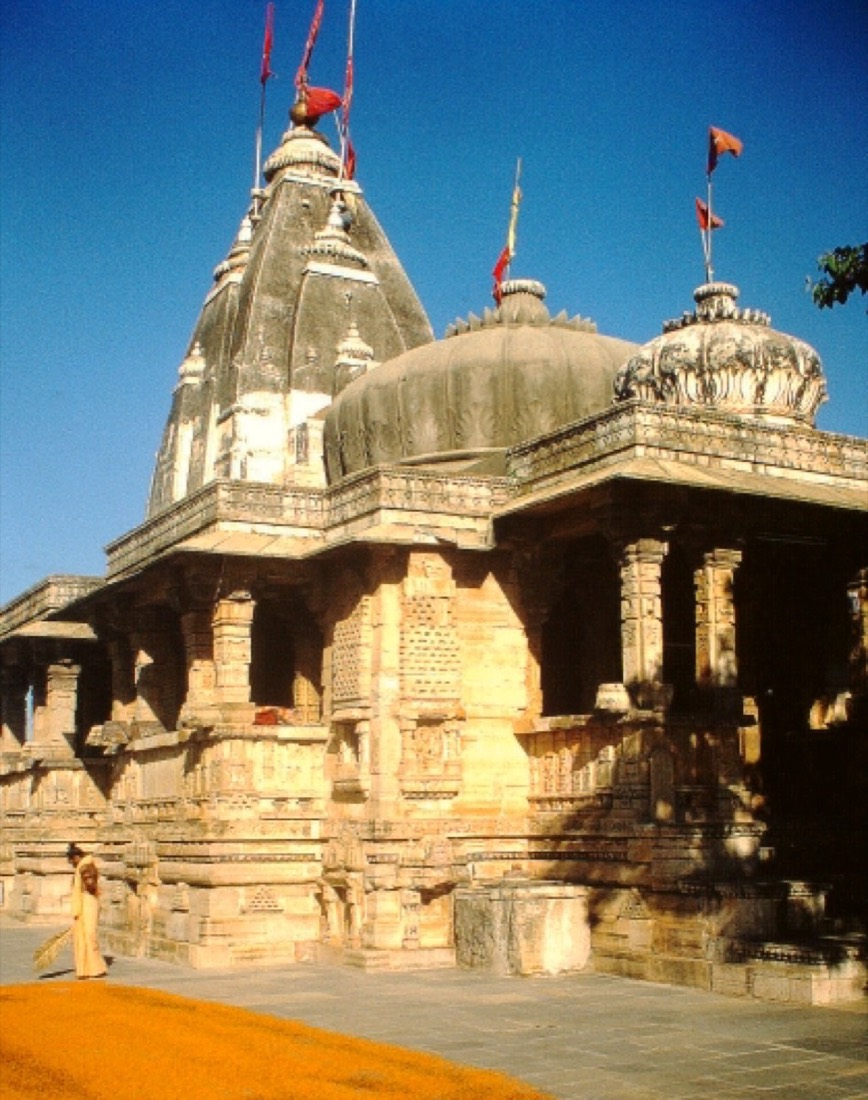
Kalika Mata Temple stands inside Chittorgarh Fort in Rajasthan. The goddess worshipped here is Kalika Mata, the Mother in her form as Kali. Yet the British Library's caption for an 1882 photograph of the temple points to something else on its outer wall: Surya, the Sun god, in the central niche. The building began as a Sun temple. This article reads what the stone, a UNESCO nomination file and the temple's own traditions each say about that change, and keeps the three apart.
The Sun god in the central niche
The 1882 print is by O. S. Beaudesson. A pointed tower and a rounded dome rise above a rough stone wall and a few trees. The caption, as reproduced on Wikimedia Commons, describes the outer walls: Surya in the central niche, and the Dikpalas, the guardians of the directions, in the corner niches. The porches, it says, rest on finely carved pillars.
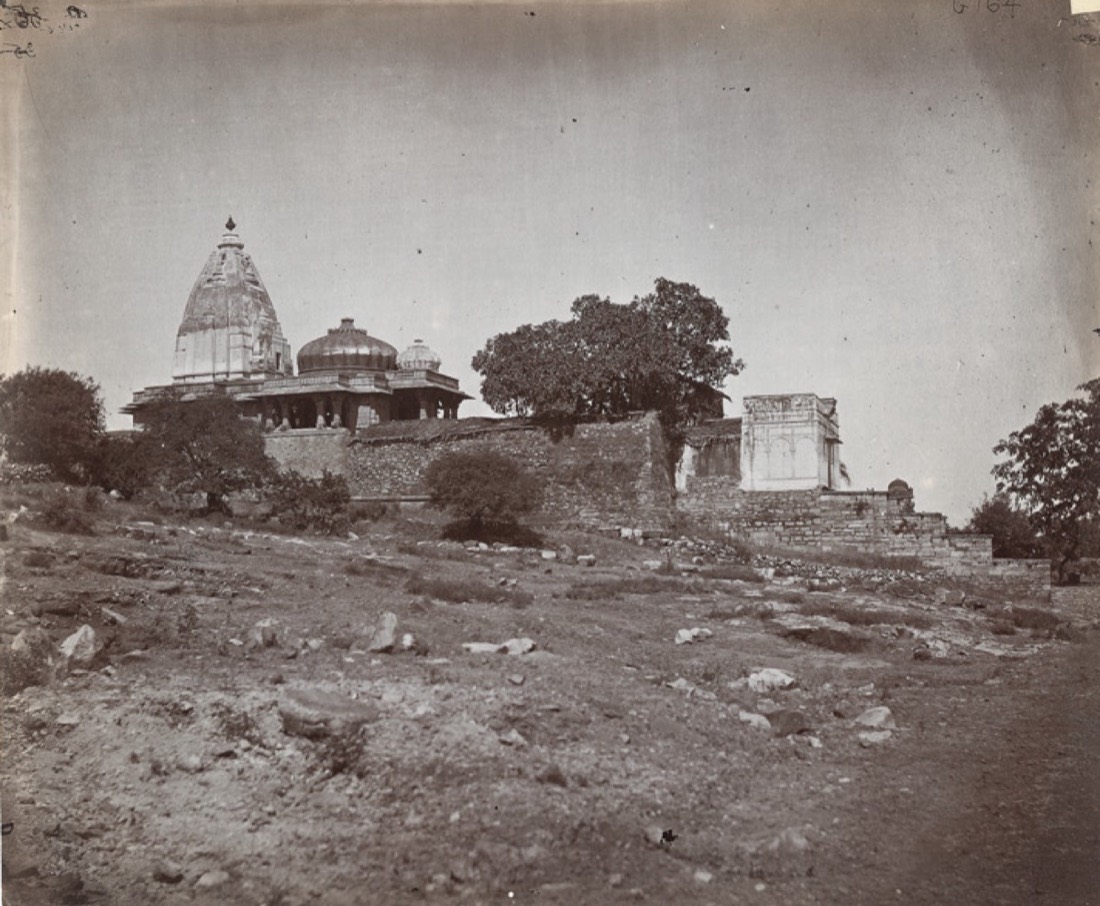
Art historian Elizabeth A. Cecil, in a 2020 study of Pashupata Shaiva sites, reads the temple the same way. Cecil writes that it was built as a Surya temple, with Sun images in niches inside and outside and over the inner doorway. The study also cautions that parts have been rebuilt, so not every feature belongs to the first phase.
One date for the Sun, several for the goddess
The nomination file for the Hill Forts of Rajasthan, the UNESCO World Heritage listing that includes Chittorgarh Fort, gives the temple its own entry. It lists the building as eighth century and originally dedicated to Surya, with Raja Manbhanga, an early ruler of the fort in its timeline, as patron. The file's timeline for the fort says the same, and adds that the Sun temple later became the Kalika Mata temple. It gives no date for that change.
The entry also describes the plan: a sanctum with a walkway around it, a vestibule, a closed hall and a porch. None of the roofs, it says, is original. A band of lotus scrolls runs along the cornice, and in the closed hall the ceiling panels carry relief figures of deities.
Other sources do give the goddess a date, and they differ. Rajasthan Tourism says Rana Hameer rebuilt the temple in the fourteenth century and it was then dedicated to Kali. Incredible India says a Kali temple was made from its ruins in the fourteenth century. The British Library caption says the temple was partly rebuilt in 1568. No source read for this article cites an inscription that settles it.
An attack enters some tellings. A 2023 report by NDTV Rajasthan links the temple's damage to Alauddin Khalji and says a Kalika image was installed afterwards. The UNESCO file records that Khalji took the fort in 1303. It does not say what happened to this shrine.
A Sun temple holding a goddess's worship is the kind of layered story Devam is gathering. Devam is bringing together stories of more than 1,000 Indian temples and of gods and goddesses, with bhajans, mantras, aartis and quizzes, and it is coming soon on the App Store and Google Play. If you would like to hear when it arrives, join the waitlist.
Plaster off the pillars
Now the story passes to people with tools. The nomination file keeps a conservation log for the fort, and its Kalika Mata entries read like a slow uncovering. In 1982-83, it says, thick lime plaster and whitewash came off the ceiling and pillars, mechanically and with dilute acetic acid. Small sculptures that had been hidden appeared.
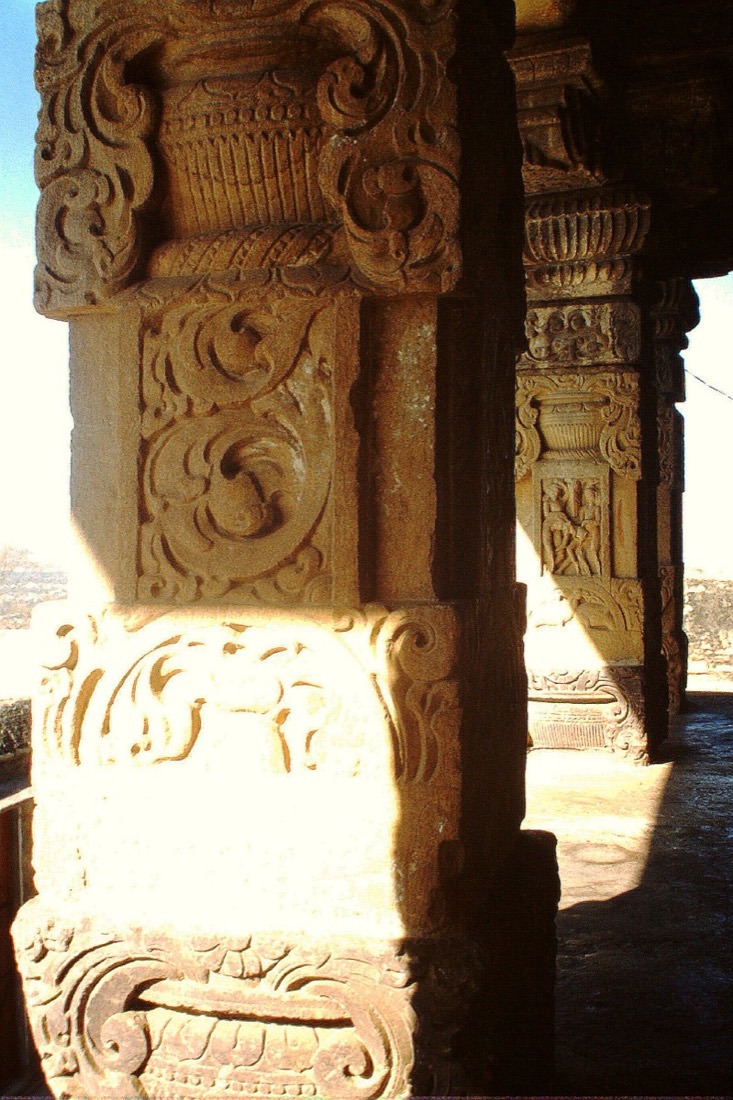
The work went on along the pradakshina path, the passage for walking round the sanctum. In 1985-86 and 1986-87 the log records chemical cleaning that brought out more carved detail. In 1988-89 the stone was cleaned of dust, moss and lichen, then treated with a preservative. The entries do not say when the plaster first went on.
Some of the carving a reader can study today was under lime until the 1980s.
An image that travelled with the kings, in the mahant's telling
The same NDTV Rajasthan report quotes the temple's mahant, its senior religious head, Ram Narayan Puri. Puri recalls that rulers carried the Kalika image with them in wartime. Rana Sajjan Singh, in this telling, later set an Ambey image beside it, so that worship could carry on while she was away. This is the temple's own tradition, as reported. No royal record read for this article confirms it.
The report also describes Navratri that year. The mahant and priests ask the district administration in writing for the goddess's gold ornaments, which are kept in the treasury. Crowns and necklaces are among them. The pieces are checked and weighed as they are issued, five armed police guard the shrine for the nine days, and the ornaments go back afterwards.
It adds that Udaipur's Maharana Darbar is said to sponsor the Ashtami havan, a fire offering, while the temple trust conducts the Navami worship and havan. These are one reporter's details from 2023, not a standing rule.
Finding the shrine, and where to check
Incredible India places the temple between Padmini Palace and the Victory Tower, and says a Shiva temple, Jogeshwar Mahadev, stands in the same complex. It adds that the temple is lit up during Navratri and holds ratri jagran, nightly prayers. The UNESCO file lists the Kalika Mata temple as in religious use, with the small Kshemankari temple, dated to 825-850, in a tank opposite.
No official page with worship timings, dress rules or booking was found on 4 November 2026, and third-party sites give different hours. Ask at the fort, or check with Rajasthan Tourism and the temple's own notices. The practical points here were checked on that date.
Questions people ask about Kalika Mata Temple
Was Kalika Mata Temple a Sun temple first?
Yes, according to the UNESCO nomination file and Elizabeth Cecil's study. Both describe an original dedication to Surya, the Sun god, and the 1882 caption describes Surya in a niche. None of them fixes the year the goddess was installed.
Who built the original temple?
The UNESCO nomination file names Raja Manbhanga as patron of the eighth-century Sun temple. It cites no inscription for this, and no source read for this article gives one. Treat the name as the file's attribution, not as an inscribed fact.
Is the 1303 attack documented, and did it damage this temple?
The nomination file records that Alauddin Khalji took Chittorgarh in 1303. That the attack damaged this temple, and that a Kalika image followed, comes from a 2023 news report. No building record read for this article confirms it, so it stays a reported account.
Where can timings and rules be checked?
No official page with worship timings, dress rules or booking was found on 4 November 2026, and third-party sites give conflicting hours. The temple is in religious use, so ask at the fort or check with Rajasthan Tourism and the temple's own notices.
The Sun in the stone, the goddess in worship
Two things about this building stand on firm ground. The stone says Sun: a Sun god in the central niche, Sun images at the inner doorway, a plan the nomination file places in the eighth century. The worship today is Kalika Mata's. What lies between them, the reported attack, the rebuilding and the day her image was set in place, is told differently by different sources. Kalika Mata has the worship, and Surya still has his niche.
For more temples that hold two stories in one building, Devam is coming soon on Google Play and the App Store, and its waitlist is open.