Jagannatha Temple, Puri: wooden gods and a king with a broom
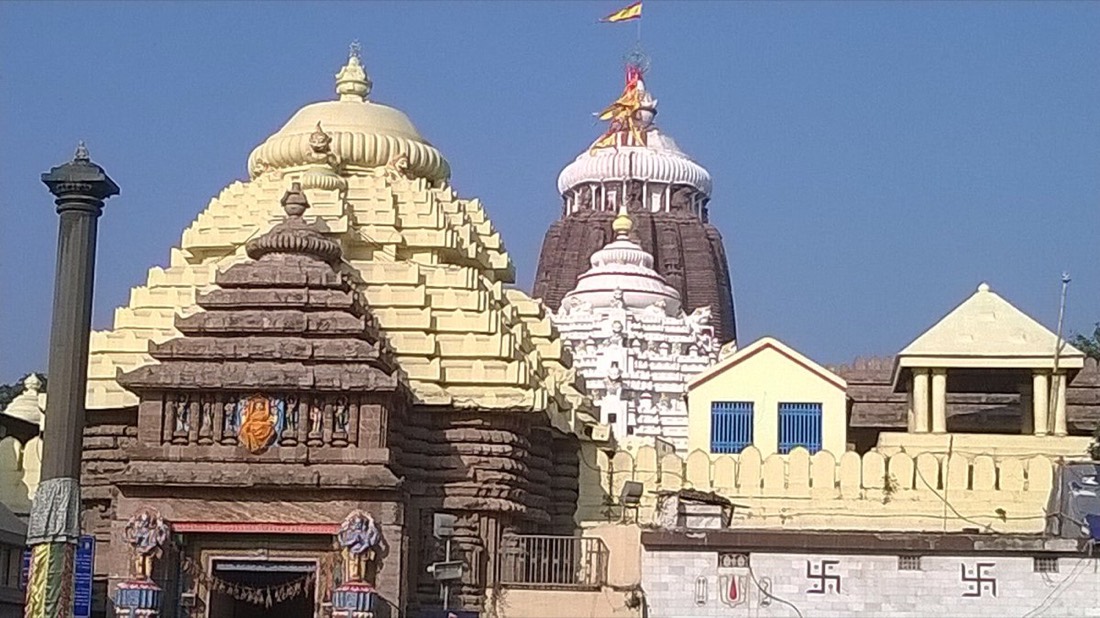
In Puri, on the Odisha coast, the Shree Jagannatha Temple shelters three wooden deities inside a stone sanctuary. Devotees worship Jagannatha as Vishnu, identified with Krishna, together with his elder brother Balabhadra and younger sister Subhadra. Once a year the three leave the temple on chariots. Before the ropes are touched, a king climbs aboard with a broom.
Two stories explain the wood and the broom. This article tells both, to the end.
A stone temple for wooden gods
Odisha Tourism attributes the great temple, also called the Srimandira, to the twelfth-century Eastern Ganga king Anantavarman Chodaganga Deva. It gives the tower's height as 65 metres and counts Puri among the Char Dham, the four great pilgrimage centres. A wheel and a flag crown the summit.
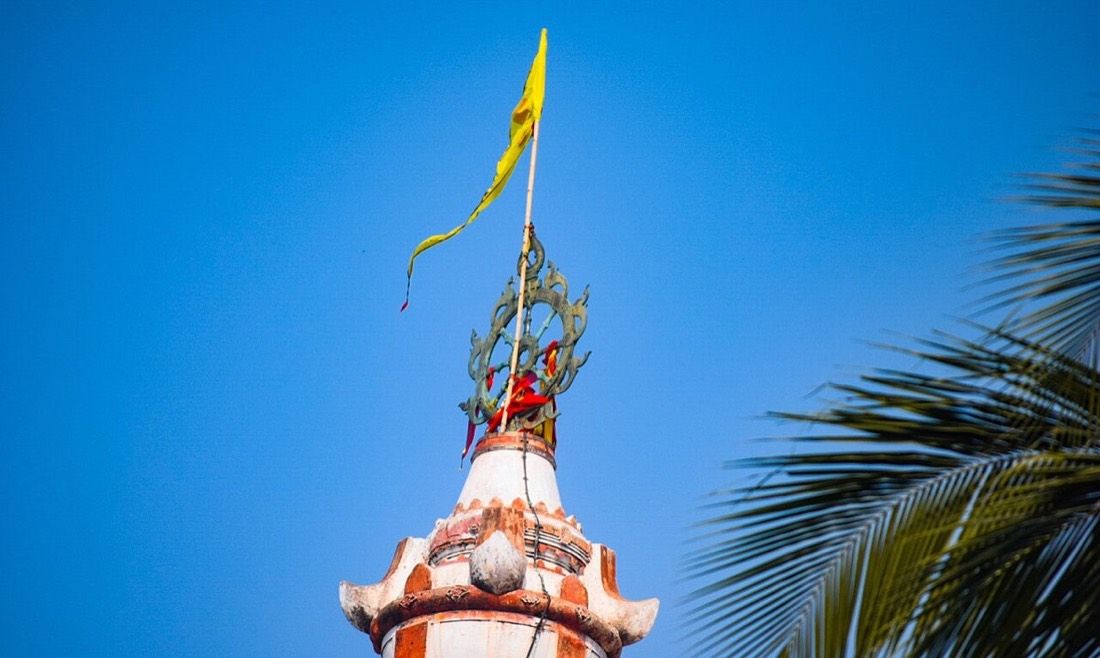
Inside, the images are not stone. The same page says they are carved from neem wood and renewed every 12 to 19 years in a ritual called Nabakalebara.
The stone building has a historian's date. The stories below belong to scripture and devotion instead.
The tree that washed ashore
The Skanda Purana tells how Jagannatha came to be worshipped at Puri. This telling follows its Purushottama-kshetra-mahatmya, chapters 7 to 9 and 18 to 19, in G. V. Tagare's English translation.
King Indradyumna of Avanti wants to see Vishnu with his own eyes. A pilgrim describes the Lord's hidden form, Nila Madhava, near a banyan tree and the Rauhina pool at Puri. The king sends Vidyapati, a priest's younger brother, to find him.
Vidyapati loses the path on the Nila mountain. Voices lead him to a Shabara settlement, where he meets Vishvavasu coming back from worship. Vidyapati will not eat until he has seen the deity.
Vishvavasu hesitates. The hidden Lord sustains his people, and showing him will change that. But the stranger is a guest. So Vishvavasu leads him by the hand along a rocky, thorny path with room for only one person, calling out directions in the dark. Afterwards comes a meal fit for a king. The dishes, Vishvavasu explains, are what remains of offerings that gods bring to Nila Madhava.
Then he gives a warning. The Lord will vanish under golden sand. The king will see him in a dream and set up four wooden forms. And Vishvavasu's family will remain, by the Lord's blessing.
It happens. As Vidyapati leaves with a garland from the deity, a gust scatters the golden sand. The gods who come to worship find only a heap of it. In Avanti, Vidyapati places the garland round the king's neck. Indradyumna sets out for Puri, but does not see the Lord.
Later, at the shore, attendants report a huge tree floating in the sea. The sage Narada says it is a form of Vishnu. The king brings it ashore and sets it on the altar. A voice tells him to admit an old carpenter, close the doors, cover the altar for fifteen days and keep music playing. No one may look in. In the text, the carpenter is Narayana himself.
On the fifteenth day the work is done. The king unveils the altar. Four finished forms stand there: Krishna, Balabhadra, Subhadra and the discus Sudarshana.
The story turns on Vishvavasu's choice: hospitality outweighs his fear of losing what his people live on.
A popular retelling on jagannath.in is the version many people know, and it is not a translation of the Purana. Here Vidyapati marries Vishvavasu's daughter Lalita, who persuades her father to show him the shrine. Blindfolded, Vidyapati drops mustard seeds to mark the way. When the king arrives, Nila Madhava has vanished. A log floats ashore, and a carpenter, Vishnu in disguise, asks for twenty-one days alone behind closed doors. After fifteen days of silence, Queen Gundicha fears he has died and persuades the king to open the door. The carpenter is gone. Four wooden images stand incomplete, in the form devotees worship. So the Purana, as translated, describes finished forms, and the popular telling describes unfinished ones. They are separate accounts, and this article keeps them apart.
Devam collects stories like this one. It is bringing together the stories of more than 1,000 Indian temples, with bhajans, mantras, aartis and quizzes. It is coming soon on the App Store and Google Play, and you can join the waitlist to hear when it opens.
The king with the golden broom
Each year in the month of Ashadha, in June or July, the deities leave the temple and travel along Bada Danda, the Grand Road. The date follows the lunar calendar.
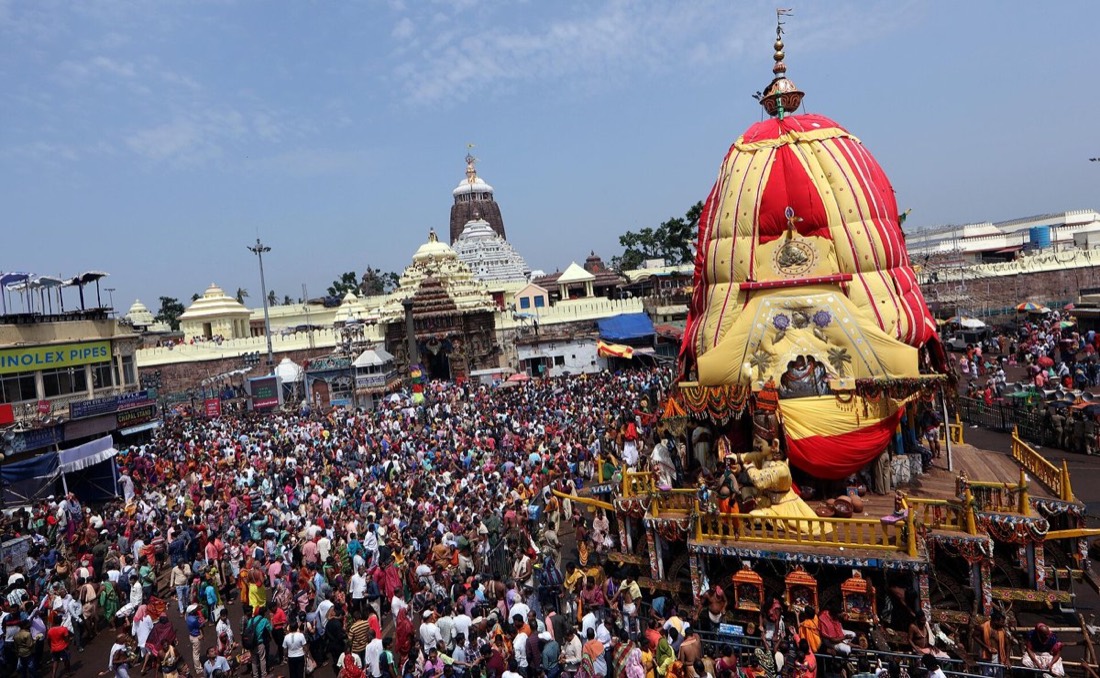
Three chariots wait, and none is reused. An undated essay by Dr Subas Pani on a National Informatics Centre site says carpenters with hereditary rights build all three new every year. Jagannatha's Nandighosa has sixteen wheels, Balabhadra's Taladhwaja fourteen and Subhadra's Darpadalana twelve.
The deities step out through the Singhadwara, the Lion Gate, in a slow procession called pahandi, to gongs, trumpets and drums. Sudarshana comes first and takes a place on Subhadra's chariot. Balabhadra follows, then Subhadra, carried at a quicker pace, and last Jagannatha. The brothers wear tahia, large floral headpieces, and the essay compares their swaying walk to an elephant's.
Then a messenger tells the Gajapati, the title of Puri's king, that the deities are seated. The Gajapati leaves the palace in a silver-plated palanquin behind a decorated elephant and climbs the chariots one by one. On each, the Gajapati offers prayers, then sweeps the platform with a golden broom, scattering flowers and scented water. The ritual is called Chhera Pahanra.
The essay reads it as worldly power bowing to the divine. It says Odisha's rulers, beginning with Chodaganga in the twelfth century, declared themselves servants of Jagannatha. Odisha Tourism calls the Gajapati the foremost servitor and the sweeping a gesture of humility.
Only after the Gajapati leaves are the wooden horses fixed to the chariots and coconut-fibre ropes, about 250 feet long, tied on. Then the devotees take hold and pull. The chariots roll to the Gundicha Temple, which the Ministry of Tourism describes as the Lord's annual visit to his birthplace. Later the deities return in Bahuda Yatra.
The order is worth noticing. Carpenters build, servitors carry, the king sweeps, and only then do the crowds pull.
What the temple's own notices say
The Shree Jagannatha Temple Administration runs the official website, which lists darshan arrangements, notices and a festival calendar. As of 10 November 2026, its FAQ says only Hindus are allowed inside the temple. It also says darshan of the deities pauses for about a fortnight after the bath on Jyeshtha's full-moon day, when the deities are said to fall ill. The site also warns of fraudulent websites offering room bookings and online puja. Check timings, booking and rules there, not on third-party pages.
Questions people ask about Jagannatha Temple, Puri
Who is worshipped at the Jagannatha Temple in Puri?
Devotees worship Jagannatha as Vishnu, identified with Krishna, together with his elder brother Balabhadra and younger sister Subhadra. The three main images are wooden, set in a stone temple. Sudarshana, Vishnu's discus, also takes part in the Ratha Yatra procession and appears as a fourth form in the Skanda Purana.
Who built the Jagannatha Temple?
Odisha Tourism attributes the twelfth-century temple to the Eastern Ganga king Anantavarman Chodaganga Deva. King Indradyumna belongs to the Skanda Purana, a sacred account of how the deities came to be worshipped, not a dated record of construction. The two answers rest on different kinds of evidence.
When is Ratha Yatra, and where do the chariots go?
Ratha Yatra falls each year in Ashadha, in June or July, by the lunar calendar. The three chariots travel along Bada Danda, the Grand Road, to the Gundicha Temple, which the Ministry of Tourism calls the Lord's annual visit to his birthplace. The deities return later in Bahuda Yatra.
Are the chariots reused every year?
No. An undated essay by Dr Subas Pani says carpenters with hereditary rights build all three chariots new each year. Jagannatha's Nandighosa has sixteen wheels, Balabhadra's Taladhwaja fourteen and Subhadra's Darpadalana twelve. Before the chariots move, the Gajapati sweeps each platform with a golden broom.
Who steps aside in Puri
Put the two stories side by side and a pattern shows. Indradyumna rules a kingdom, yet obeys a voice that tells him to keep a door shut for fifteen days while a carpenter works. The Gajapati has a palace and an elephant, yet climbs three chariots with a broom. In the Purana, a forest worshipper's hospitality is what puts the king's messenger in front of the Lord. That pattern is this article's own reading, not a claim from the sources.
The broom is one of many stories Devam is gathering. The app is coming soon on the App Store and Google Play, with the stories of more than 1,000 Indian temples, and you can leave your email on the waitlist to be told when it is ready.