ISKCON Bangalore: how a rocky hill became a glass-roofed temple
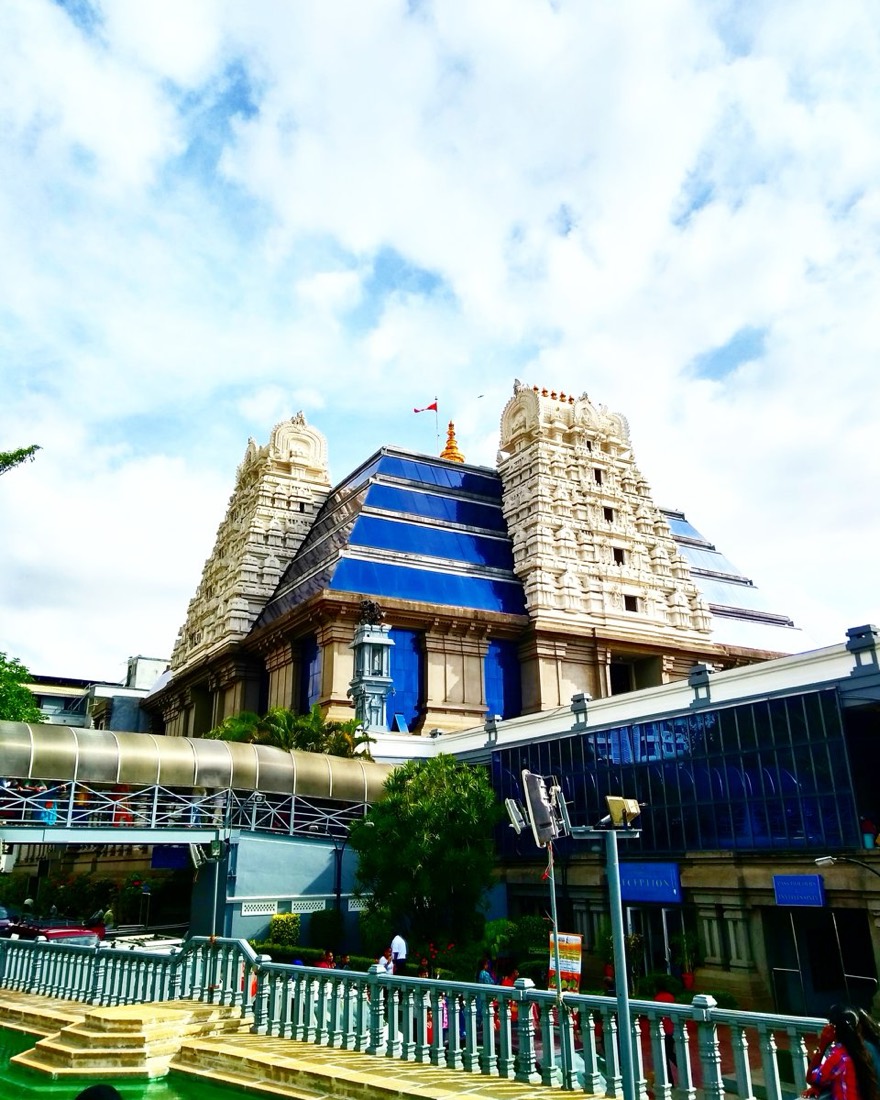
Hare Krishna Hill, in Rajajinagar, Bengaluru, holds ISKCON Bangalore's Sri Radha Krishnachandra Temple. Radha and Krishna are worshipped here, along with Krishna and Balarama, Nitai and Gauranga, Srinivasa Govinda and Prahlada Narasimha. The blue glass roof and pale gopurams look as if they were drawn in one sitting. The temple's own accounts say otherwise: a chariot that lost an axle, a hill of rock called waste land, a temporary shed, and two years without an architect.
The chariot that lost an axle
Krishna and Balarama were on Bengaluru's streets before the hill was theirs. A recollection republished on the temple's blog goes back to a Friday in December 1985. Its writer is unnamed, and recalls being a sub-editor at a Bengaluru weekly, City TAB.
Two chariots stand ready near Silver Jubilee Park Road, one for Krishna and one for Balarama. Volunteers, the writer among them, have borrowed buckets from nearby houses and shops to wet the road ahead. Around four in the afternoon, after the deities' puja, devotees begin to pull.
Then an axle breaks. One chariot falls to the road, with the puja items and the devotees riding on it. Nobody is hurt, the writer says.
The other chariot is still sound. Devotees place both deities on it, the pullers are told to go carefully, and the procession carries on to Ravindra Kalakshetra. The route is short, but the continuous kirtan stretches it past an hour.
A senior devotee, the writer reports, called it Krishna's own play: the brothers wanted to share a chariot. That is one devotee's reading, kept beside the plain facts. The facts make the same point more quietly. The plan broke, and one chariot was still sound, with room for both.
Devam is bringing together stories like this one, of how a temple came to stand where it does, for more than 1,000 Indian temples. The app is coming soon on the App Store and Google Play, and you can join the waitlist.
A hill of rock and a shed for two brothers
By 1987 the society was working from a rented house in Bangalore. It applied to the Bangalore Development Authority (BDA) for land to build a temple and cultural complex. On 3 August 1988 came the allotment. The temple's own history describes a seven-acre hillock, one huge piece of rock that could not be turned into building sites, and says the BDA called it "karaab land", meaning waste land.
A temporary shed went up. In September 1988 the deities of Krishna and Balarama moved in, on Balarama's appearance day. So the story starts with two images in a shed on a rock, and a design still to be found.
Two years without an architect
The temple history credits Madhu Pandit Dasa, a civil engineer, with conceiving the temple, with help from Jagat Chandra Dasa, an architect and product engineer. In a 1997 Back to Godhead interview, in the movement's magazine, Madhu Pandit Dasa says that for the first two years after getting the land, the devotees could not find a professional architect who understood what they needed.
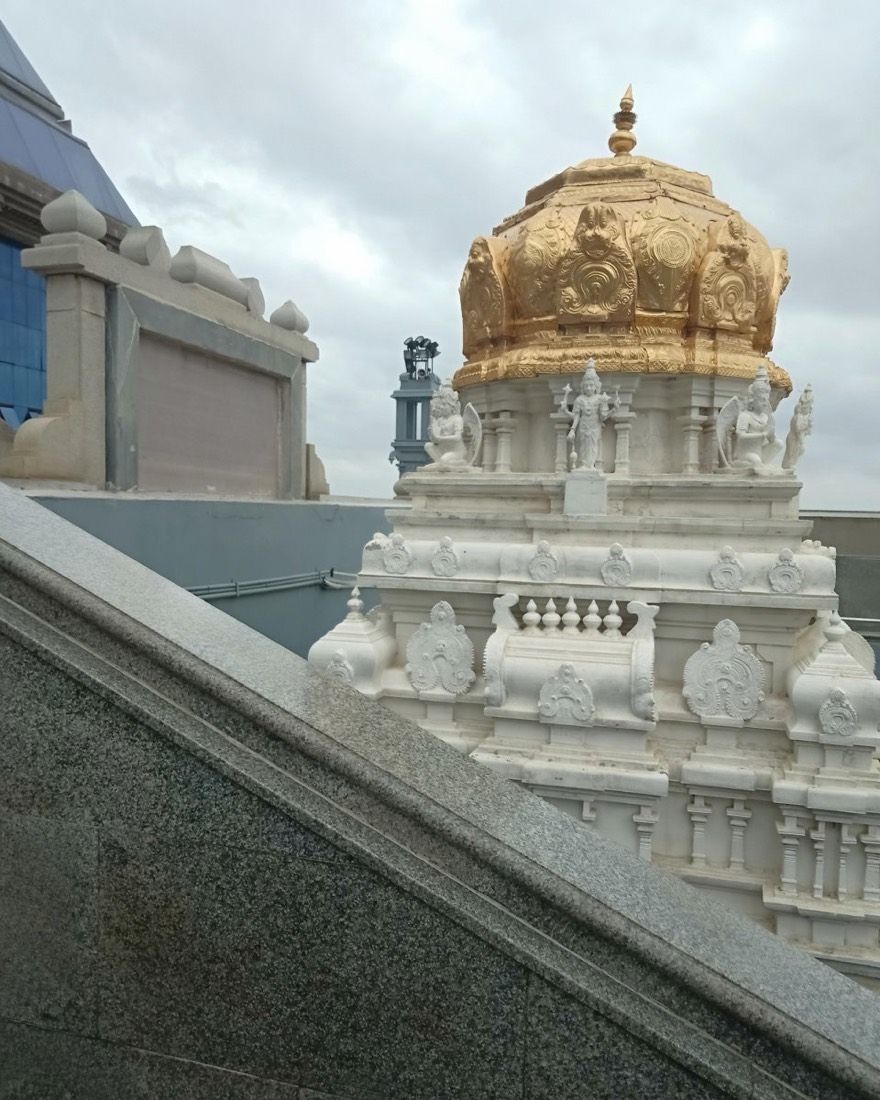
Then Jagat Chandra Dasa proposed a glass tower. In the interview's words, it set the design rolling toward a mix of traditional and modern elements. Bhaktilata helped shape the overall look and the interiors. The Kannada version of the temple history names Bhaktilata beside Madhu Pandit Dasa in developing the design for the sloping rock.
Read that way, the glass is not decoration laid over a finished plan. It is a proposal that a small group kept refining on difficult ground.
Which year was the temple built?
It depends on what is counted. The society was registered on 8 May 1978. The land was allotted on 3 August 1988. Construction began in 1990, the temple history says. The Kannada history places the festivals that installed the deity images in April 1997, with fire rituals continuing for 45 days. On 31 May 1997 the then President of India, Shankar Dayal Sharma, inaugurated the temple and its cultural complex.
None of the sources read for this article places an older temple on the hill. The sacred stories told here come from texts, not from the ground.
Ownership of the temple property was also long disputed between ISKCON Bangalore and ISKCON Mumbai. A Supreme Court of India judgment of 16 May 2025 held that it belongs to ISKCON Bangalore, according to legal-news reporting. ISKCON Mumbai's review petitions were still undecided in reports dated through 9 October 2026, which said the matter was awaiting a fresh bench.
The punishment that was a feast
Each year, on the bright thirteenth of the month of Jyeshtha, which the temple places in May or June, Hare Krishna Hill celebrates Panihati Chida-dahi. The date follows the lunar calendar; the temple's announcement gave 27 June for 2026. Nitai and Gauranga are bathed, carried in a flower-decorated palanquin to the temple pond and taken for a boat ride. Flattened rice with yoghurt is offered first and then shared.
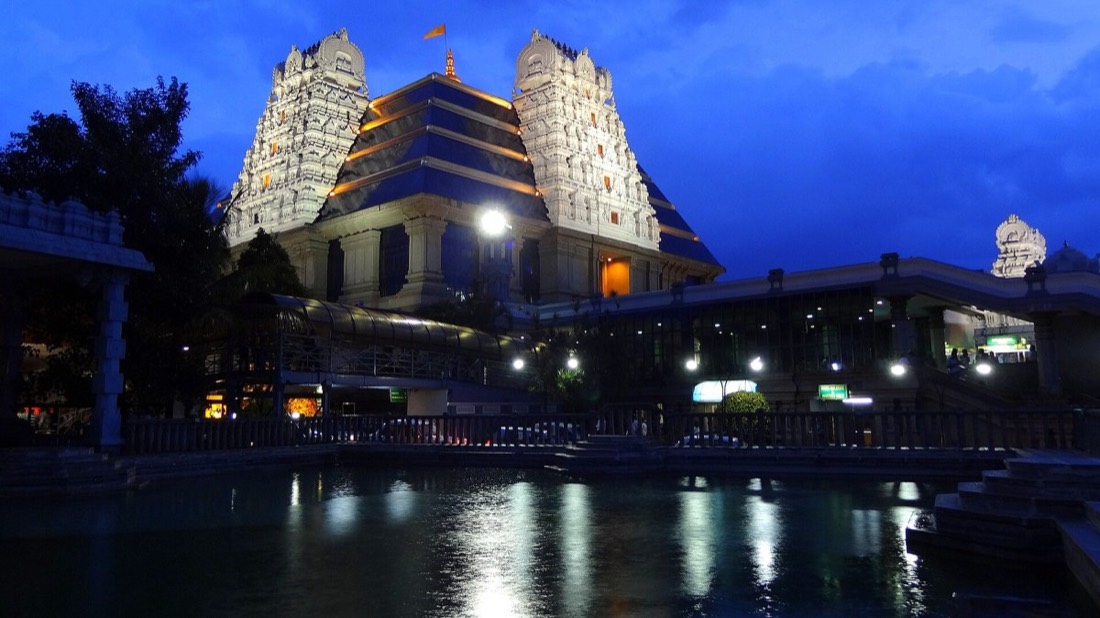
Nitai is Nityananda and Gauranga is Chaitanya. The temple's page teaches that the two are none other than Krishna and Balarama. The story behind the feast comes from the Chaitanya-charitamrita, Krishnadasa Kaviraja's life of Chaitanya. This retelling follows the Bhaktivedanta Book Trust edition on Vedabase (Antya 6).
At Panihati, on the bank of the Ganges, Nityananda sits on a rock under a tree, surrounded by kirtan singers. Raghunatha Dasa arrives and bows from a distance. Nityananda calls him a thief for keeping away, catches him and places his feet on Raghunatha's head. The punishment, Nityananda announces, is a feast. Raghunatha must feed all the companions flattened rice and yoghurt.
Raghunatha sends men to buy flattened rice, yoghurt, milk, sugar and bananas, and gathers hundreds of earthen pots. Half the rice is soaked in hot milk with yoghurt, sugar and banana. The other half is mixed with thickened milk, banana, ghee and camphor. Everyone gets two pots. Some sit on the bank and some eat in the river.
Then, the text says, Nityananda brings Chaitanya to the spot in meditation. Nityananda feeds Chaitanya a morsel from each pot, and Chaitanya feeds one back. Most of the eaters do not see what is happening. Only a few fortunate ones see Chaitanya there.
Shopkeepers from other villages arrive with more food to sell. Raghunatha buys all of it, pays them, and feeds them the same meal. At the end Nityananda gives Raghunatha the leftovers from four pots, and Raghunatha shares them with his companions.
The temple reads the festival as Raghunatha Dasa receiving Nityananda's blessing to take shelter at Chaitanya's feet. It is also a story about hospitality: a punishment that spreads a meal wider and wider. In the temple's teaching, the two brothers sharing the pots are Krishna and Balarama again, the same pair who shared the chariot.
The shrines, and the 108 steps
Radha and Krishna are worshipped together here. The temple's page presents Krishna as the original divine person and Radha as his inseparable energy, and notes that many people regard Krishna as the eighth avatar of Vishnu. The complex also worships Krishna and Balarama, Nitai and Gauranga, Srinivasa Govinda and Prahlada Narasimha.
Visitors may walk the Harinam Mantapa, 108 steps with the Hare Krishna maha-mantra chanted on each, or go straight for darshan of Prahlada Narasimha, the temple's page says.
Timings, booking, dress and rules change, so use the temple's official website, iskconbangalore.org, and its posted notices for them. As of 10 November 2026, the official pages read for this article described a daily round of worship that begins before dawn and ends at night with a shayana arati.
Questions people ask about ISKCON Bangalore
When was ISKCON Bangalore built?
No single date answers this. The society was registered in 1978, the hill was allotted in 1988, construction began in 1990, the deity images were installed in April 1997 and the temple was inaugurated on 31 May 1997. Which counts depends on whether you mean the society, land, building or opening.
Is Hare Krishna Hill an ancient sacred site?
No source read for this article says so. The documented story starts with the land allotment in 1988, and none of the sources places an older temple on the hill. The sacred stories told here, such as the Panihati feast, come from texts about other places, not from this ground.
Who is worshipped at the temple?
Radha and Krishna, as Sri Radha Krishnachandra, are worshipped together. The complex also has Krishna and Balarama, Nitai and Gauranga, Srinivasa Govinda and Prahlada Narasimha. The temple's teaching presents Krishna as the original divine person; many people regard Krishna as Vishnu's eighth avatar, as the temple's own page notes.
Must visitors climb the 108 steps?
No. The temple's page says visitors can walk the Harinam Mantapa, chanting the Hare Krishna maha-mantra on each step, or go straight for darshan of Prahlada Narasimha. For current timings, booking, dress and rules, check the temple's official website and posted notices rather than relying on any article.
Two brothers, one hill
Seen in order, the hill's story keeps solving problems on the move: a broken axle, a rock that could not be cut into building sites, no architect who understood the brief. Each time, the answer came from what was at hand. The glass roof is what that looks like finished, and the image to carry away is two brothers on one chariot.
Coming soon to the App Store and Google Play, Devam gathers the stories of more than 1,000 Indian temples and of gods and goddesses, with bhajans, mantras, aartis and quizzes. To hear when it launches, join the waitlist.