Hangseshwari Temple, Bansberia: A Shrine Built Like a Body
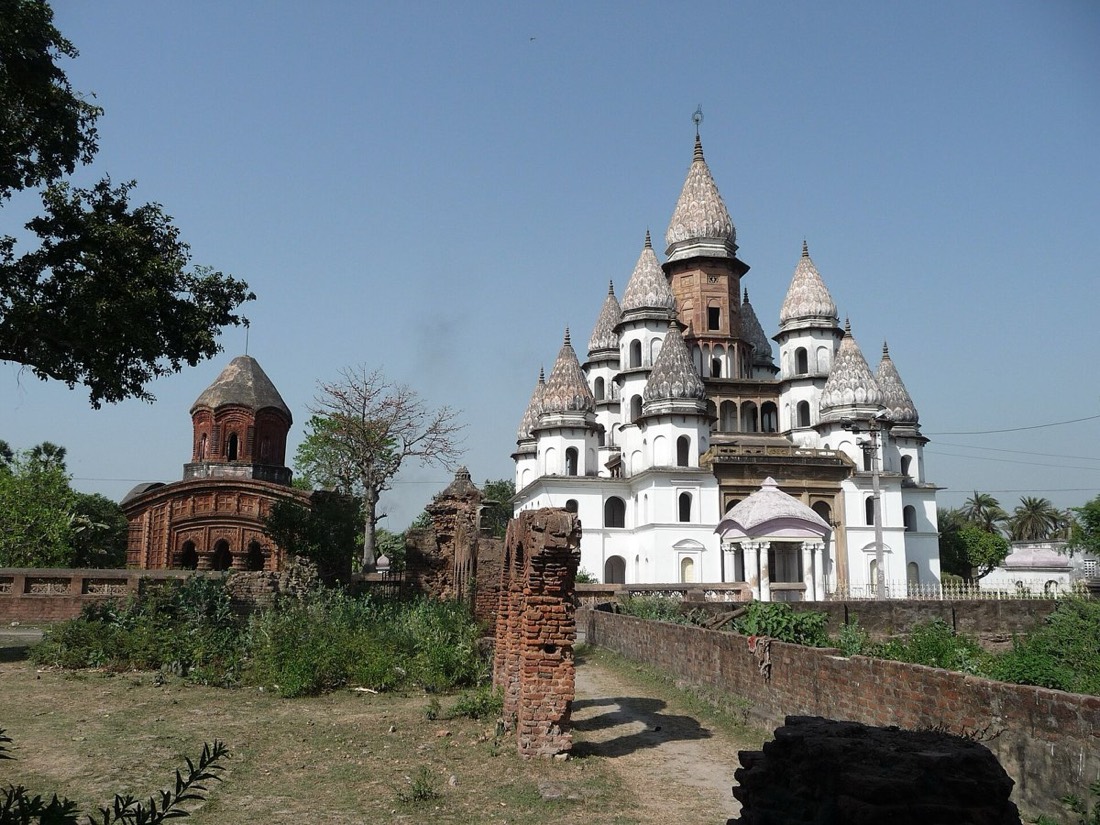
Thirteen lotus-bud spires rise above the old royal compound at Bansberia, in Hooghly district, West Bengal. They crown the Hangseshwari Temple, where the goddess Hangseshwari is worshipped as a blue, four-armed wooden image. A king planned the building as a map of the human body. He died before it was done, and his widow finished it.
That is the story this article follows, along with the meaning of the goddess's name and the one night in the year when her appearance changes. A word on identity first. The National Monuments Authority's record calls her Hamsesvari. A 2012 magazine article by Sikha Banerjee calls her a manifestation of Kali, and her main yearly worship is on Kali Puja night. This article uses the temple's own name for her and says where a source uses Kali.
A skyline of lotus buds
The temple has five storeys. Around its central tower stand twelve smaller pinnacles, thirteen in all. Architects call such pinnacles ratnas, meaning jewels.
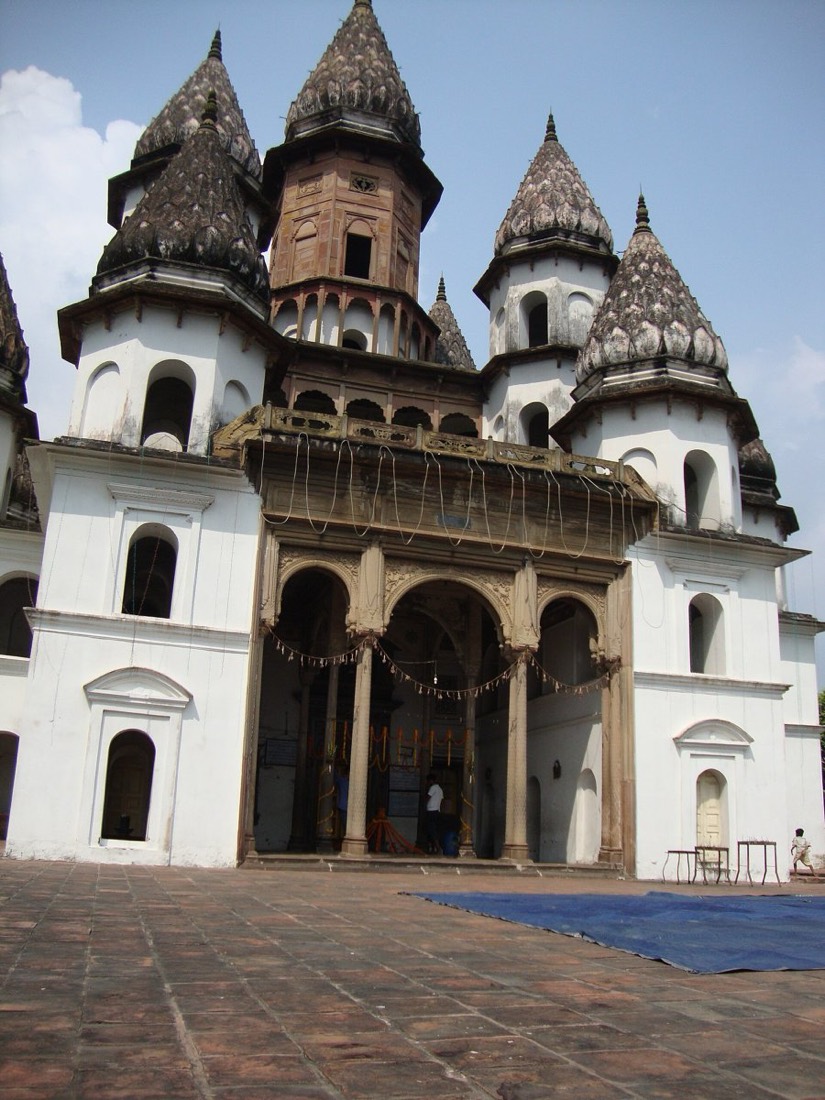
Here the ratnas are conical, and each carries a lotus-petal pattern instead of the usual ridges. The monument record published by the National Monuments Authority offers a reason. The sandstone came from quarries near Varanasi, and the architect and masons are believed to have come from there too. They seem not to have known Bengal's temple habits well. The record calls the result unique, a blend of northern Indian styles with Bengal's own, built from sandstone, brick and wood.
The shape is meant to say something. The same record says the design is intended to symbolise esoteric tantric metaphysics. The Hooghly district administration's page is more specific. It says the structure represents shat-chakra-bheda, the tantric passage through the body's six chakras, which yogic teaching describes as centres of energy.
Local writers go further. A local-history article on Hooghly Heritage describes five staircases standing for five of the body's subtle channels, above which a hidden chamber holds a white image of Shiva. Banerjee names the same five channels. These are explanations by writers, not something the monument record measures. Published heights also differ, from about 21 to 27.5 metres, so none is given here.
What the king began, the queen finished
Raja Nrisinghadeb Raj, the zamindar (landholder) of Bansberia, commissioned the temple in 1799, says the monument record. He died in 1802 with the building unfinished. His widow, Rani Sankari, completed it in 1814.
A basalt tablet at the temple tells much the same story. The Hooghly Heritage article transcribes it and reads the verses as naming the king as the one who began the shrine and Srishankari as the one who finished it, in Shaka year 1736, which is 1814 CE. That is a secondary transcription, not a fresh reading of the stone.
Why did a landholder set out to build something so unusual? Accounts differ, so they are kept apart here.
One, in the Hooghly Heritage article, is practical. After his father's early death, the family lost part of its estate, and winning it back would have meant a slow, costly petition to the Court of Directors in London. Nrisinghadeb instead spent the 1790s in Kashi, studying tantra. Back at Bansberia in 1799, he put the money set aside for London into a tantric temple. Banerjee's article tells a version of this as a legend: he cancelled a plan to visit Britain and built on yogic ideas.
Another is a dream. ABP Ananda's 2023 report says it is said that he received a command from the goddess in a dream and resolved to build for her. A 2021 Live History India article passes on the same local lore. None of this is in the monument record, so each is local history or tradition, not documented fact.
Stone had its own reason, says Hooghly Heritage. Beside the site stands the older Ananta Vasudeva temple, built in 1679 by Raja Rameswar, whom that article calls the king's great-grandfather. The monument record describes it as a rare seventeenth-century single-pinnacle temple, its terracotta panels showing Krishna's life, soldiers in ships and the war of Rama and Ravana. According to Hooghly Heritage, Nrisinghadeb watched that clay temple decay and chose stone for his own.
A king's savings, a dream, a decaying neighbour: the accounts do not settle which one moved him. They agree on who finished the work. If a temple built as a body, completed by a widow, is the sort of story you like, you can join the waitlist. Devam is gathering stories of more than 1,000 Indian temples and of their gods and goddesses, and it is coming soon on the App Store and Google Play.
A name that sounds like breathing
The name appears as Hangseshwari, Hanseswari and Hamsesvari. Banerjee reads it as a joining of two syllables, ham and sa, the sounds that, the article says, go with breathing out and breathing in. One stands for Shiva and one for Shakti, so the temple holds both in its name. The article adds that the image was designed and installed on the lines of yoga and pranayama, or breath control.
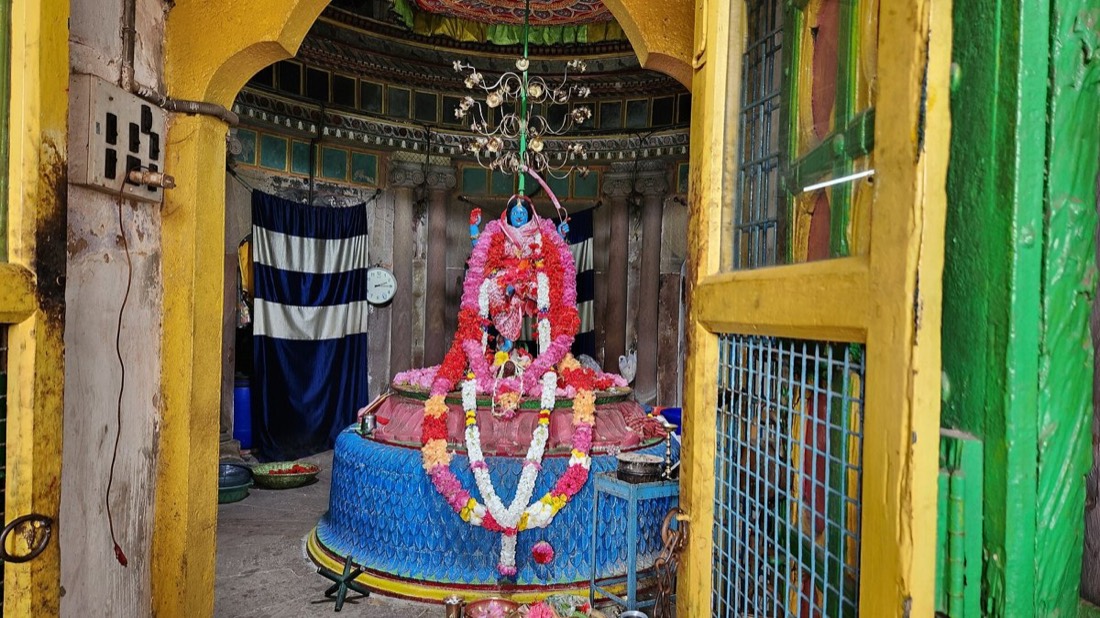
In the sanctum, the goddess sits on a lotus. The monument record says its stalk rises from the navel of a reclining figure. Banerjee identifies him as Shiva, Mahadeva. The image is wooden, blue and four-armed, Banerjee writes, made of neem wood. ABP Ananda adds that the wood is said to have floated down from Benares.
Descriptions agree that her left hands hold a sword and a severed head. The right hands are less certain. Banerjee describes a fear-not gesture and a blessing gesture, while ABP Ananda and Hooghly Heritage describe the fear-not gesture and a conch. Banerjee reads the sword as power over demons and the raised palm as the protector's sign.
One night in royal clothes
The priest Basanta Chattopadhyay told ABP Ananda in 2023 that the goddess is calm for most of the year. On the annual Kali Puja night, the priest said, she becomes Elokeshi, the loose-haired form, for that one night. The image is dressed in royal attire, with a silver mask and a gold tongue. At dawn the royal dress is taken off.
Kali Puja falls on Kartik Amavasya, the new-moon night of the Bengali month of Kartik, usually in October or November. Hooghly Heritage calls it the temple's main annual worship and says the mask is fitted after the evening aarti. ABP Ananda's report describes the other 364 days as calm worship.
The same report says the old custom of animal sacrifice at the temple was being ended that year, which the priest linked to the cruelty of the practice. No later source read for this article says how things stand today.
Planning a visit
The monument record places the temples inside the Bansberia Rajbari, a royal compound ringed by a moat, reached by a bridge on its east side. It says the Archaeological Survey of India maintains the protected monuments. Hooghly Heritage says the Rajbari family still oversees the image and its ornaments.
No official temple website or notice giving timings, entry rules or festival schedules was found on 4 November 2026, and travel sites disagree on opening hours, so none are given. The district administration's tourism page and notices from the Archaeological Survey of India are the places to start. ABP Ananda's report says visitors are not allowed inside the Vasudeva temple while its terracotta deteriorates, so ask on arrival what is open.
Questions people ask about Hangseshwari
Is Hangseshwari a Kali temple?
Several sources say so. A 2012 magazine article calls Hangseshwari a manifestation of Kali, and her main yearly worship is Kali Puja. The National Monuments Authority's record names her only as Hamsesvari. This article therefore uses her temple name and attributes the Kali label to the sources that use it.
Who built Hangseshwari Temple, and when?
Zamindar Raja Nrisinghadeb Raj commissioned it in 1799, according to the National Monuments Authority. He died in 1802 with it unfinished, and his widow, Rani Sankari, completed it in 1814. Stories of why he began, such as a dream or a cancelled trip to Britain, come from local histories and lore.
What is the temple's design meant to show?
The monument record says the design is meant to symbolise tantric metaphysics, and the district page links it to the six-chakra practice. Local writers map five staircases to five channels of the body. That mapping is their interpretation, not a surveyed fact. The five storeys and thirteen lotus-bud spires are what the record documents.
What happens on Kali Puja night?
On Kartik Amavasya, the priest told ABP Ananda in 2023, the goddess is worshipped as Elokeshi for one night. The image wears royal attire, a silver mask and a gold tongue. The royal dress is removed at dawn. That is one priest's account to one newspaper, not a timetable.
Lotus, again and again
Count the lotuses. Thirteen spires shaped like buds, each cone carved with petals. A lotus under the goddess, its stalk rising from a reclining figure. Then, for a single night, a mask and a tongue, taken off by morning.
A king drew up the plan and did not live to see it done. His widow saw it through, and the blue wooden goddess at its centre is the same image before the mask and after it. Devam, coming soon on Google Play and the App Store, has its waitlist open for readers who want more temples that carry an idea in their building.