Dakshineswar Kali Temple, Kolkata: A Dream, a Deed and a Mended Krishna
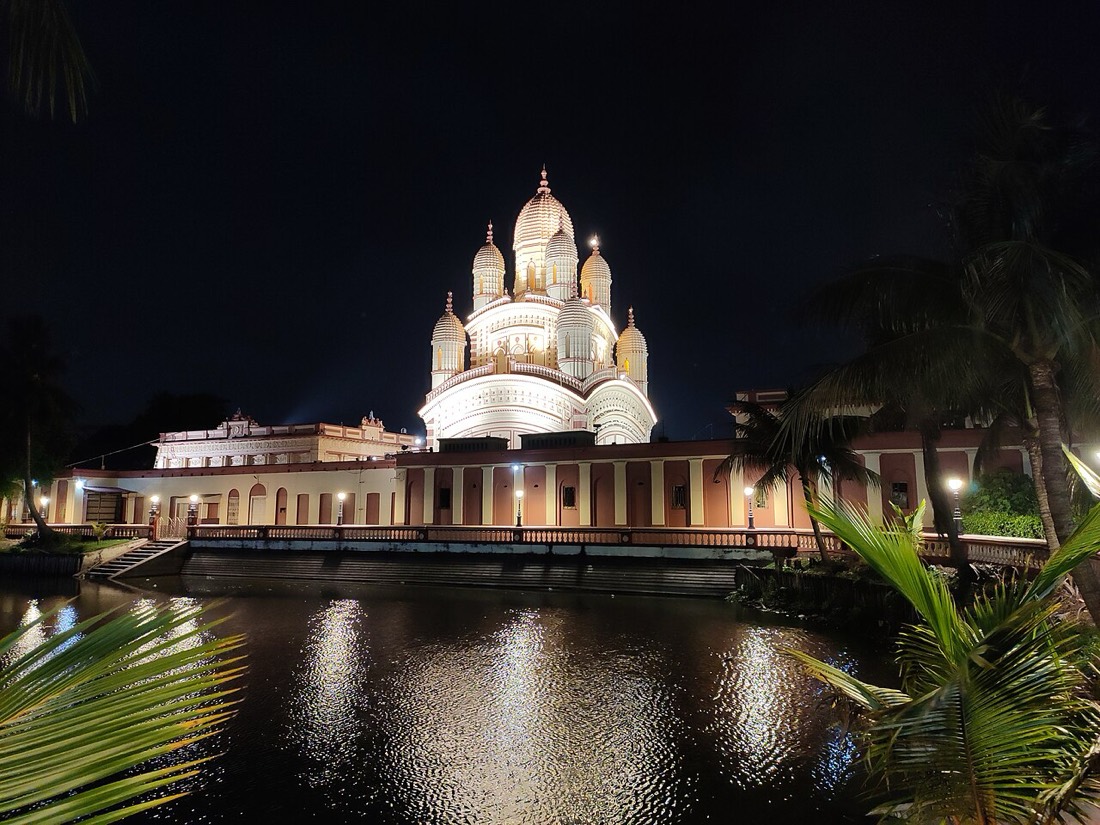
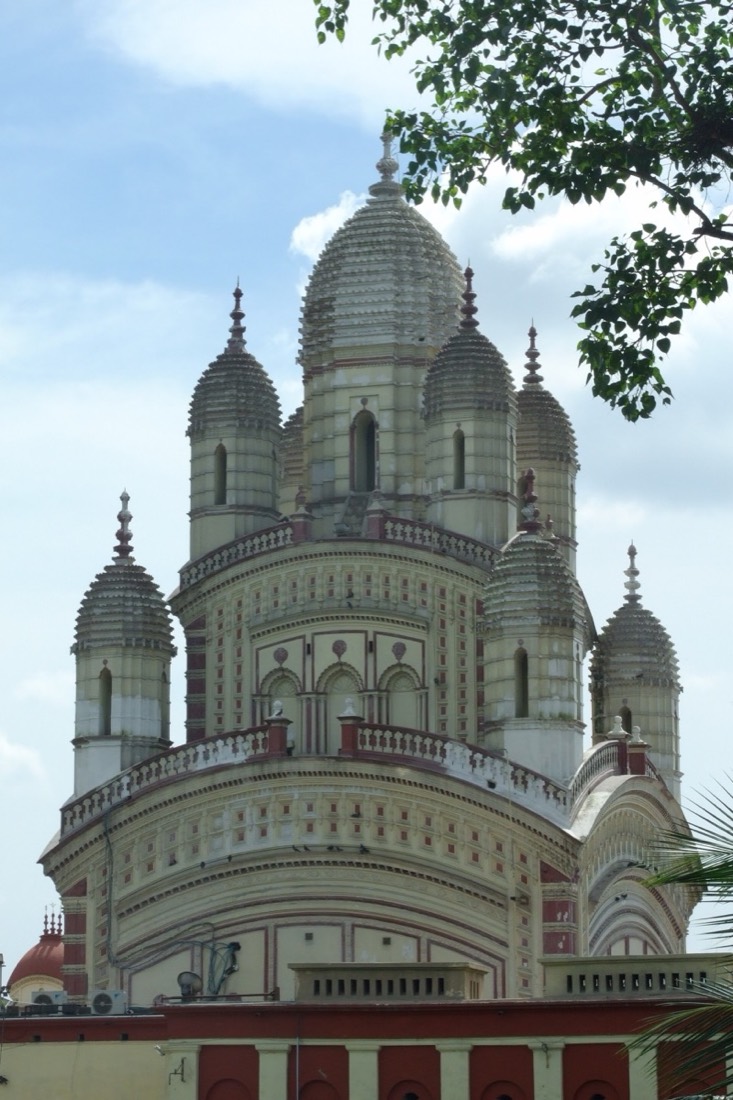
One classic description of Dakshineswar, north of central Kolkata, begins on the water. In Swami Nikhilananda's introduction to the English Gospel of Sri Ramakrishna, a visitor arrives by boat. The steps of a bathing ghat on the Hooghly's east bank lead up to a roofed terrace, with six Shiva temples on either side. Beyond them, nine domes rise over the shrine of Bhavatarini, the form of Kali worshipped here. The temple's own website presents her as the Mother who frees her devotees from the ocean of worldly existence.
This article follows that route. On the way it meets the rani who built the place, the day it opened in 1855, and a Krishna image that was mended, not replaced.
Up the steps, past twelve Shiva temples
The steps lead to the chandni, a roofed terrace, and the Shiva temples stand on either side in a line. The Dakshineswar Kali Temple and Debottar Estate, the body behind the temple's official website, counts twelve in all. This article calls it the estate. By its description they share the Bengal aat-chala style, each holds a black stone linga, and worship is offered in them every day.
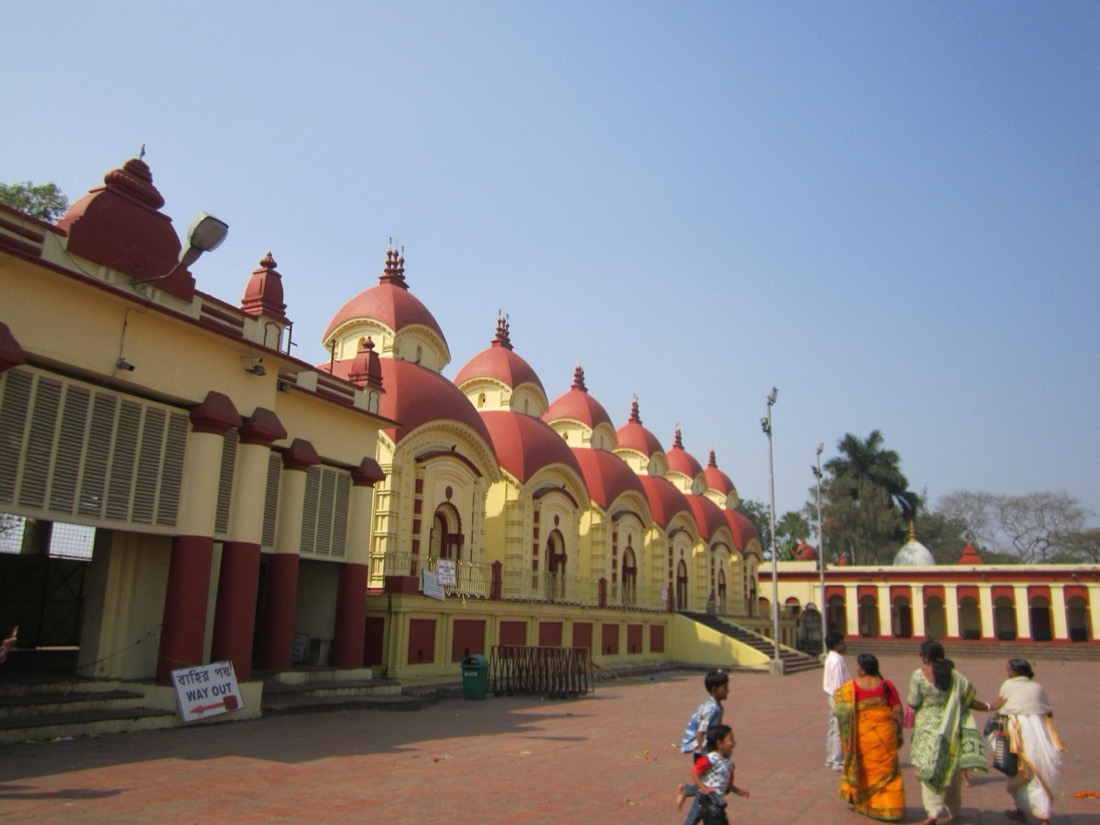
Who built all this, and why? The estate's history begins with a pilgrimage plan. Rani Rashmoni, a widow, wished to fulfil her late husband Rajchandra's dream of a temple, and was preparing to travel to Varanasi. The estate says Kali appeared in her dream the night before she set out. She asked Rashmoni to set up a temple on the bank of the Ganga. In Kali Mandir's retelling, the Mother's words were that there was no need to go to Kashi.
The land came first. The estate says Rashmoni bought it from James Hasty on 6 September 1847. Building followed, and the estate credits the firm Mackintosh Burn with the works. They include the courtyard, the Natmandir hall, Chandni Ghat, food-offering rooms, stores and staff quarters. Daily worship, the list suggests, needed kitchens and stores as much as a sanctum.
The day the Mother was installed
One hurdle remained, and it was about who could be fed. The same retelling says many looked upon the rani, despite her wealth, as being of low birth. On that view she could not own a temple and feed Brahmins cooked food there.
The pandits she consulted found no answer. Then Pandit Ramkumar Chattopadhyay, Ramakrishna's elder brother, suggested consecrating the temple in the name of a Brahmin. It was consecrated in the name of her guru. The estate's own history says only that the temple was founded "after facing many conflicts."
The day chosen was Snan Yatra, the bathing festival of Jagannath. M.'s Bengali Kathamrita records it as Thursday, 18 Jaistha 1262, or 31 May 1855, and names Ramkumar as the first priest. The estate gives the same date.
Brahmins came from many places, the estate says, and food went to people of every caste, creed and colour. The rani oversaw the programmes herself. Among those present was Ramkumar's younger brother Ramakrishna, then a teenager. Set beside the earlier obstacle, the open feeding stands out.
The estate describes the black stone image as the work of the sculptor Nabin Bhaskar. M.'s Kathamrita describes the sanctum. Kali, in a Banarasi sari and ornaments, stands on a Shiva of white stone. He lies on a silver lotus of a thousand petals.
Devam is coming soon on the App Store and Google Play. It is gathering stories of more than 1,000 Indian temples and of gods and goddesses, with bhajans, mantras, aartis and quizzes. If a founding story like this one is why you read about temples, you can join the waitlist.
The Krishna who was mended, not replaced
Later in 1855, the Radha-Krishna temple in the same compound had an accident. The estate calls it the Radha-Kanta temple. Its images are Jagamohini Radha and Jagamohan Krishna.
The account comes from Swami Saradananda's biography of Ramakrishna, in a passage reproduced by Holy Trio Footprints. No temple record of the repair was found for this article. In the account, it is Nandotsava, the day after Janmashtami. The midday worship and offerings are over. The priest, Kshetranath, lays Radha to rest in another room. Carrying Govinda, as Krishna is called here, to do the same, he falls. One leg of the image breaks.
The temple is in uproar. Pandits give their opinions. Mathur Babu, the rani's son-in-law, who supervises the temple's administration, wants Ramakrishna's advice on replacing the image. Ramakrishna first enters an ecstatic state, his nephew Hriday later said, and then says no replacement is needed. At Mathur's request, Ramakrishna joins the leg himself. Saradananda writes that the join was so fine that, even examined closely, no one could tell the image had broken.
A later retelling by Kali Mandir, a temple in California in Ramakrishna's tradition, adds a detail. The pandits advised immersing the image in the Ganga, and the rani was heartbroken. Ramakrishna asked whether a family would throw a son-in-law into the river if he broke his leg. As the retelling frames it, the image is a member of the family, not an object that has failed.
The estate says the leg later broke repeatedly. Holy Trio Footprints records that in 1929 the joined part broke again while the image was being dressed. A new Krishna was installed beside Radha in 1930. The estate says the original is kept in a room next to the shrine.
The deed meant to outlast her
Rashmoni saw only the temple's first years. By the estate's dates she died on 19 February 1861, less than six years after the opening. Kali Mandir's account says she signed her deed of endowment the day before.
In that deed, the estate says, she declared that after her death her name would be struck off. Her late husband's heirs would be registered as shebaits, the people responsible for the deities' service. The aim was that worship would continue from generation to generation.
The estate's website describes that service as daily. It begins before dawn with Mangal Aarti and ends at night with an offering and Shayan, the laying of the deities to rest. The sanctum closes for a midday rest. The estate also lists three Kali pujas it says have been observed since 1855. Phalaharini falls on the new-moon night of Jyeshtha, and the estate links it to Ramakrishna's 1872 worship of his wife, Sarada Devi, as the Divine Mother. Dipanwita, on the new-moon night of Kartika, is the one the estate calls the most celebrated. Ratanti falls in Magha.
Reading the official notices
The temple's own website, as archived on 15 August 2026, lists darshan from 6:30 am to 12:30 pm and from 3:30 pm to 7:30 pm, and says the trustees can change timings. That web address has since stopped showing the temple's pages, which is why this article links to the archived copy. Visitors pass a security check and leave bags and shoes at counters. Modest dress is asked for, and photography is not allowed inside the sanctum.
The page also lists the railway station by skywalk, bus and taxi, and ferries between Chandni Ghat and Belur Math. Aarti times, festival arrangements and any booking are matters for the temple's notices. This is not the nearby Adyapith, a separate pilgrimage centre founded by Annada Thakur.
Questions people ask about Dakshineswar Kali Temple
When is Kali Puja in 2026, and what happens at Dakshineswar that night?
Kali Puja falls on Sunday, 8 November 2026, the same night as Diwali. Drik Panchang, a panchang site, gives Kolkata's Nishita time, the midnight window it uses for Kali Puja, as 10:55 pm to 11:46 pm. The new moon runs from 11:27 am on 8 November to 12:31 pm on 9 November. The estate's archived website calls Shyama Puja the grandest night at Dakshineswar and describes night-long rituals, with the complex lit by ten thousand lamps. Its calendar listed Shyama Puja under a different date, 18 November, which does not match the panchang, and the live address no longer shows the temple's pages. Confirm the date and any night arrangements with the temple before you travel.
Why do some people worship Kali and others Lakshmi on Diwali night?
It is the same new-moon night. Drik Panchang says most of India worships Lakshmi on the Amavasya of Diwali, while West Bengal, Odisha and Assam worship Kali on it, calling it Kali Puja or Shyama Puja. Wikipedia adds that at the Kalighat temple in Kolkata, Kali is worshipped as Lakshmi on this day. The sources read for this article do not say whether Dakshineswar does the same. Lakshmi Puja in 2026 also falls on Sunday, 8 November.
What are the Dakshineswar Kali Temple timings?
The estate's archived website lists morning darshan from 6:30 am to 12:30 pm and evening darshan from 3:30 pm to 7:30 pm, with the sanctum closed for a midday rest in between. It lists Sandhya Aarti at 6:30 pm and Shayan at 8 pm, and says the trustees can change the timings. Other sites quote slightly different hours, and festival days can differ, so confirm with the temple.
Which metro station is nearest Dakshineswar Kali Temple?
The archived website says Dakshineswar metro station, the terminus of the Blue Line, connects to the temple directly by skywalk, as does Dakshineswar railway station on the Sealdah to Dankuni line. Check current services before you set out.
Who is worshipped at Dakshineswar Kali Temple?
Kali as Bhavatarini is the presiding goddess. The estate says the same compound also holds twelve Shiva temples and a Radha-Krishna temple. "Kali temple" therefore names the largest shrine, not the whole complex, which also includes a ghat, courtyard and the Natmandir hall.
Is the rani's dream documented history?
No. The 31 May 1855 installation is recorded by the estate and in M.'s Kathamrita, and the 1847 land purchase is the estate's account of her deed. Kali's dream is devotional tradition, told by the estate and in biographies, as the reason the temple exists.
How is the mended Krishna known?
Through devotional biography. Saradananda's life of Ramakrishna tells it, and Kali Mandir retells it with more detail. No repair record was found for this article. The estate does say a new image replaced the original in 1930 and the older Krishna is kept in a room beside the shrine.
Is Adyapith part of this temple?
No. The North 24 Parganas district lists Adyapith separately, near Dakshineswar, as a pilgrimage centre founded by Annada Thakur. This article concerns Rani Rashmoni's riverside temple of Bhavatarini, with its Shiva and Radha-Krishna shrines, so the two should not be mixed up when planning a visit.
Who owns Dakshineswar Kali Temple?
It is a debottar estate, meaning property dedicated to the deity, and the body that runs it calls itself the Dakshineswar Kali Temple and Debottar Estate. By the estate's account, Rani Rashmoni's deed of endowment made her late husband's heirs the shebaits, the people responsible for the deities' service, so that worship would continue. The sources read for this article do not name the present trustees.
Is Dakshineswar a Shakti Peetha, and how is it different from Kalighat?
The sources read for this article do not list Dakshineswar among the Shakti Peethas. Wikipedia lists the Kalighat temple as one of the 51 Shakti Pithas, the place where the toes of Sati's right foot are said to have fallen, and says its present building is about 200 years old. Dakshineswar was built in 1855 by Rani Rashmoni and is associated with Ramakrishna. They are two separate temples in Kolkata, so check the name before you set out.
The older Krishna, still in the next room
The nine domes belong to Bhavatarini. One of the quieter facts of the compound sits beside the Radha-Krishna shrine, where, the estate says, the original Krishna is still kept. He was mended in 1855, replaced in 1930, and never sent away.
If a detail like that is what draws you to temples, add your name to the Devam waitlist. Devam is coming soon, on both Google Play and the App Store, with more temple stories like this one.