A Clay Flower, a Silver Image and Twenty-Four Lamps at Tirumala
King Tondaman brings golden lotuses to the Lord at midday, as he does every day. This time a flower lies on top of them. It is made of clay.
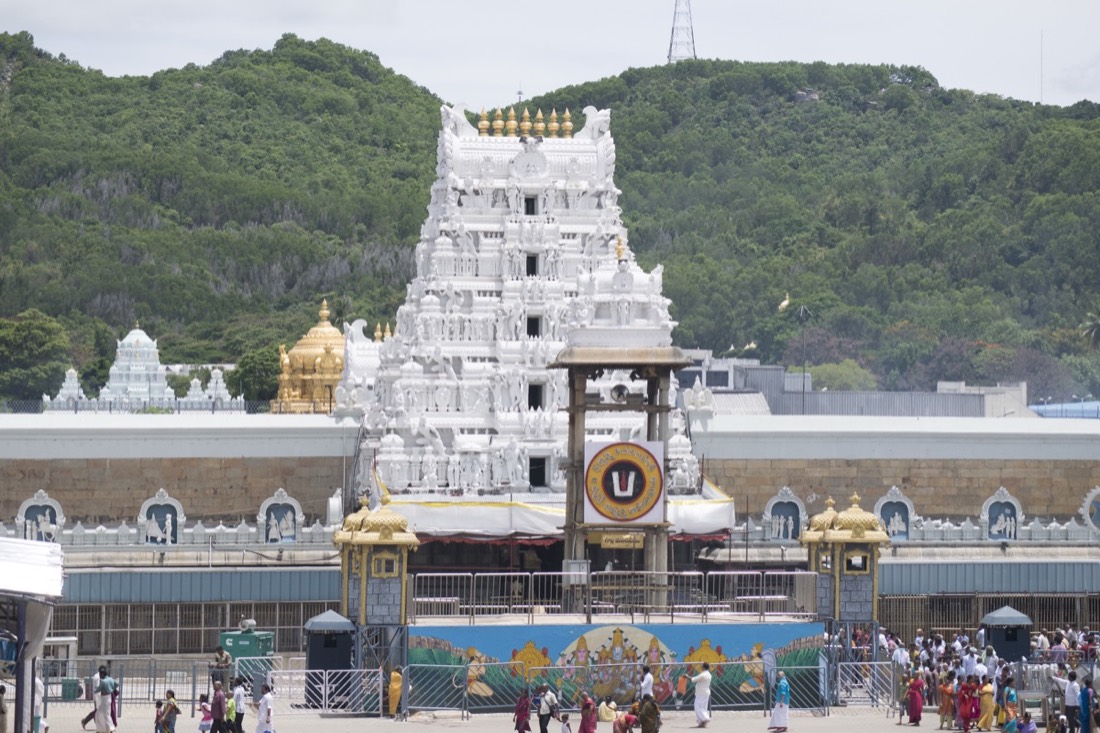
The scene comes from the Skanda Purana's account of the Venkata hill. It belongs to the Sri Venkateswara Swamy Temple at Tirumala, in the Seshachalam hills above Tirupati in Andhra Pradesh, where Vishnu is worshipped as Venkateswara, also called Srinivasa and Balaji. Below, the story is told to its end. Then comes a record of another kind, cut into the temple's own wall. In it a queen gives a silver image and arranges the rice, lamp and land that will keep it served. The first is about what the Lord accepts. The second is about who keeps a gift going once the giver has left.
The forest chief, the boar and the anthill
The Venkatachala-mahatmya is the Skanda Purana's section in praise of the Venkata hill, and its tenth chapter holds this story. The retelling follows G.V. Tagare's English translation, hosted by Wisdom Library, in which Varaha, the boar form of Vishnu, narrates. It is the Purana's tradition, not a record of events.
Something keeps eating the grain in a forest chief's field. Vasu, the chief, finds only footprints by day, so one night he waits with his bow. A boar comes out of the field, shining like ten million moons. Vasu roars, the boar bolts, and he chases it through the rest of the night until it runs into an anthill and vanishes. Furious and amazed, he digs the anthill open. He sees the boar, and he collapses.
His devout son praises Varaha, and the Lord speaks through the fallen father. He is Varaha, he says, and he means to stay. The anthill is to be washed with the milk of a black cow, the image brought out and set on the rock slab beneath, and food offered to it. Vasu carries this to the king, Tondaman, and names the spot: the banks of Svami-pushkarini, which is still the name of the temple tank at Tirumala.
That night Tondaman dreams of a trail of sprouts leading from his city to a cave. In the morning the sprouts are there, and he follows them. He washes the anthill, builds a rampart wall and worships with sages of the Vaikhanasa tradition, reaching the Lord each day by an underground path. By now the text calls the Lord Srinivasa.
An episode follows that this article skips. It ends with the Lord giving the king a daily routine: come at midday, after the food offering, and worship with golden lotuses.
Gold lotuses, and a flower of clay
So Tondaman comes at midday with golden lotuses. One day he finds a tulasi flower made of clay lying on top of them. He asks the Lord who worships him with clay lotuses and tulasi leaves.
The Lord answers that a potter named Bhima, in the village of Kurvagrama, worships him at home, and that he accepts it. The king sets off to find him.
Bhima stands and bows when the king reaches his door. Tondaman asks how he worships the Lord. "I have never known any worship," the potter answers in Tagare's translation, and he asks who told the king that a potter worships. Srinivasa himself, says the king.
Then Bhima remembers. Long ago the Lord promised that he would be freed when three things had happened: his worship was revealed, King Tondaman came, and the two of them spoke. All three have just happened.
A heavenly chariot arrives. Bhima and his wife see Vishnu, bow and give up their lives. While the king watches, the potter takes a divine form and steps into the chariot, and the couple go together to Vishnu's realm.
Tondaman returns to his city, delighted, and crowns his son, who is also named Srinivasa. He tells the young man to protect the land and its people with justice. Then the king begins a great penance. Vishnu appears on Garuda with the goddesses Lakshmi and Bhumi and asks what he wants. Tondaman asks for a place in Vishnu's world, where there is neither death nor old age. He prostrates, leaves his body and rises in a heavenly chariot, and he reaches a form like the Lord's in the realm from which there is no return.
Notice who finds whom. The king has the throne, the gold and a daily appointment, yet it is the Lord who spots the clay and sends the king to look for its maker. Nothing in the text says the golden lotuses were unwelcome, and the chapter draws no moral at this point. One reading is that the quiet surprise belongs to Bhima, who does not think of himself as a worshipper at all.
If stories of this kind are what you look for on a temple page, Devam, an app about India's temples and their gods and goddesses, is coming soon on the App Store and Google Play. You can join the Devam waitlist to hear when it opens.
Samavai's silver image, with rice, a lamp and land
The Purana is tradition; the inscriptions are documented history. On the north wall of the first prakara, one of the temple's concentric enclosing walls, two Tamil inscriptions record gifts by a queen named Samavai, also called Kadavan Perundevi. T.K.T. Viraraghavacharya prints and translates them in volume 1 of his History of Tirupati (1953), as Nos. 8 and 9 of Appendix II.
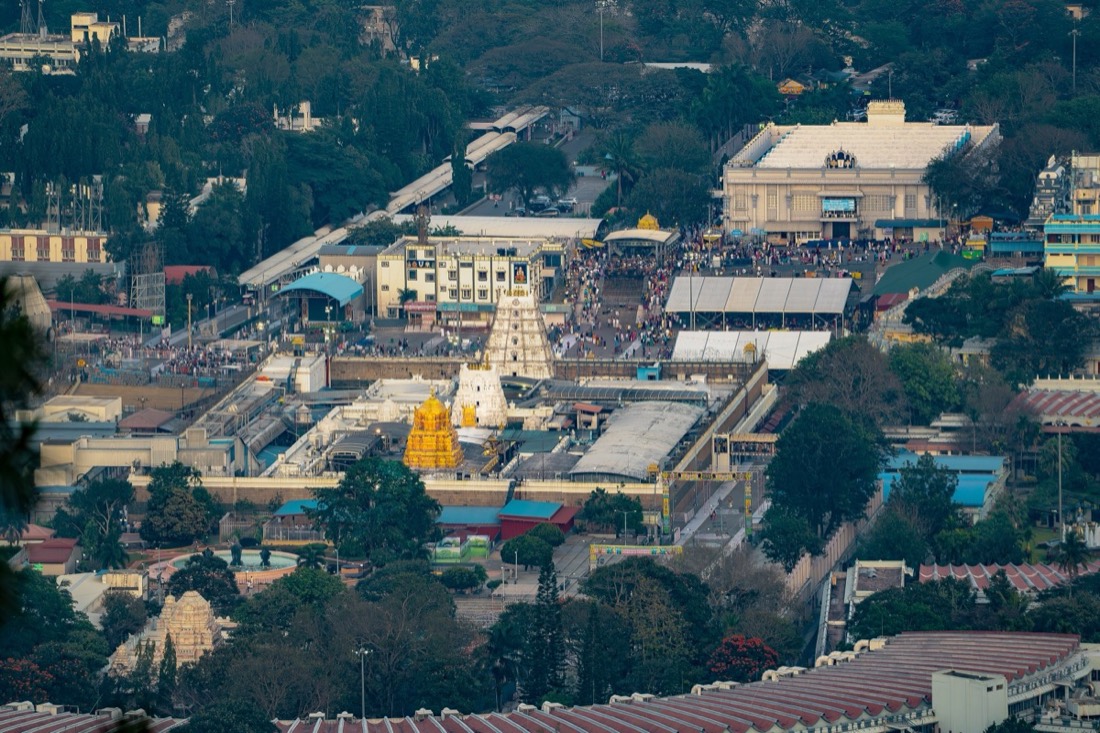
Samavai gave a silver image of the Lord. The inscription calls it Manavalapperumal, and the temple history page of TTD, the Tirumala Tirupati Devasthanams that runs the temple, identifies it as Bhoga Srinivasa. She gave gold ornaments too, many set with diamonds, rubies, pearls and corals. Then came the less glittering part. She set up a daily offering of cooked rice and a lamp that was never to go out. She provided for ritual baths on four fixed days of the solar year. She also provided for a nine-day festival in the Tamil month of Purattasi, around September and October, that opened with the sowing of seeds. To pay for it all she bought land and had it made free of tax. The temple's managers were to carry out the services, and the village assembly was to protect the land from taxation.
Why a silver image at all? N. Ramesan's The Tirumala Temple (1981) describes the principal image as fixed in the sanctum. The smaller silver image is the one bathed and tended in its place.
TTD's temple history page dates this to 614, while a TTD news article of 6 September 2026 gives 966 CE, the year Viraraghavacharya argued for; this article does not choose.
Twenty-four lamps promised, two burning
Another inscription on the same wall shows an arrangement like this slipping. It dates from the first year of the Chola emperor Rajendra I, and the charity it records is not Samavai's. The village assembly of Tirumundiyam had taken money to keep twenty-four lamps lit in the temple, one of them a camphor light. Only two were burning.
An official held an inquiry and ordered the original capital recovered into the temple's general funds. From then on the temple's managers were to light the lamps, with ghee from the temple's own stores. Viraraghavacharya prints it as No. 19 in the same appendix.
Booking a visit: start at TTD's portal
tirumala.org is TTD's official site, and its home page links to the booking portal at ttdevasthanams.ap.gov.in for darshan, accommodation and seva bookings. On 3 November 2026 that home page listed darshan categories such as Sarva Darshan and Special Entry Darshan, and said ticket availability can change before pilgrims reach the counters. A darshan slot and a booked seva, or temple service, are separate permissions, and neither stands in for the other. Timings, dress and security rules belong on TTD's pages, not here.
Questions people ask about Tirumala
Are the clay-flower story and Samavai's gift both history?
No, they are different kinds of record. Bhima's story is the Skanda Purana's tradition. Samavai's gifts are recorded in Tamil inscriptions on the temple wall, which are documented, though dated differently: TTD's history page gives 614, and a TTD article of 6 September 2026 gives 966 CE.
Where do I book darshan at Tirumala?
Tirumala Tirupati Devasthanams (TTD) runs the temple. Its official site, tirumala.org, links to the booking portal for darshan, accommodation and seva. Availability can change, and a darshan slot and a booked seva are separate permissions, so check the portal for the current rules.
What were the twenty-four lamps?
An inscription from the first year of the Chola emperor Rajendra I says the village assembly of Tirumundiyam took money to keep twenty-four lamps lit in the temple, but only two were burning. An inquiry ordered the capital recovered and the temple's managers to light the lamps.
The flower and the lamps
Set side by side (the pairing is this article's own, not either source's), the two accounts answer different halves of one question. In the Purana, a king arrives with gold and is sent to look for clay, and the Lord accepts what a potter never thought to call worship. On the wall, a queen arrives with silver and puts her effort into rice, a lamp and land. An inquiry on the same wall has to count how many of twenty-four promised lamps were still alight.
The clay flower is about what the Lord receives. The two lamps that burned are about what comes after, when the gift has been made and someone still has to turn up every day.
Devam is an app with the stories of more than 1,000 Indian temples and the gods and goddesses behind them, along with bhajans, mantras, aartis and quizzes. It is coming soon to the App Store and Google Play; the waitlist is the place to hear when it opens.